Windows Errors? Fix Them Before They Spread
Repair common Windows errors and clear accumulated junk for a smoother, more stable PC - no reinstall needed.Free scan · no reinstallOutdated Drivers Are Slowing You Down
One free scan finds every outdated or missing driver and matches the right update for your exact hardware.Free scan · exact hardware matchThe best ledger sheet is the one that fits the transactions and accounts you need to track—and that you can keep complete alongside the receipts, invoices, and other documents behind each entry. For U.S. small-business recordkeeping, the IRS does not prescribe one universal format; it says to choose a system suited to your business that clearly shows income and expenses.
What a ledger sheet does—and what it does not do
A journal records individual transactions using supporting documents. A ledger organizes journal totals by account. The IRS defines a ledger as “a book that contains the totals from all of your journals.” A ledger sheet is therefore part of a recordkeeping system, not a replacement for transaction details or their source documents. IRS: How should I record my business transactions?
For business records, the IRS says most businesses may choose a system that fits their activity, provided it clearly shows income and expenses. Requirements can vary with the business and transaction, so a ledger sheet alone may not meet every recordkeeping obligation. IRS Publication 583, Starting a Business and Keeping Records; IRS: Recordkeeping
Choose a sheet based on the system you use
Before buying accounting ledger sheets or a bound ledger book, decide how you will record transactions. The IRS describes two approaches; neither is universally best for every business.
#1 Best Overall
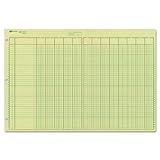
- | EFFICIENT| 40 numbered lines, 13 numbered columns with descriptions for quick reference.
- | COMPREHENSIVE | Precision-printed lines in green and brown ruling are smudge-proof and easy to read
- | PRACTICAL | Tear-off headers for custom labeling.
- | QUALITY | Premium Green Eye-Ease paper helps avoid eye strain when working over long periods of time.
- | VERSATILE | 50 double-sided, side-punched sheets in ample 11 x 16-3/8 inches of workspace.
| System | How it is organized | What to consider |
|---|---|---|
| Single-entry | Simpler records organized around income and expenses. The IRS describes daily cash-receipt summaries and monthly summaries of receipts and disbursements. | Consider this approach if a straightforward income-and-expense summary suits your business records. It does not use the journal-and-ledger structure described for double-entry. |
| Double-entry | Transactions are recorded in journals and posted to ledger accounts. Debits and credits are used, and total debits must equal total credits. | Choose a layout that gives you room to record the accounts and debit-and-credit entries your process requires, and a way to check that the totals balance. |
These descriptions are from IRS Publication 583. The IRS does not specify a particular sheet design, ruling, page size, or brand.
What to look for in a paper ledger
- Fields that match your records: Choose headings and writing space suited to the accounts or transaction details you actually track. For double-entry bookkeeping, the layout needs to support debits and credits; for a simpler income-and-expense approach, prioritize clear categories and summaries.
- A format you can maintain: Loose sheets can be filed with related records; a bound book keeps pages together. Pick the format that fits the way you will store and update your records.
- A place for useful references: Make it practical to identify the date, account or category, amount, and source document for an entry. These are selection tips, not IRS-prescribed product specifications.
- Space for the transactions you have: A business may need more than a ledger, depending on its activity. The IRS lists possible records such as a business checkbook, cash receipt summaries, a disbursements journal, worksheets, and employee compensation records.
The IRS notes that journals and ledgers are available from stationery or office-supply stores, but does not endorse a specific product. IRS: How should I record my business transactions?
Rank #2

- Adams Columnar Analysis Pads are adaptable ledgers perfect for accounting or other numeric data; 4-column ledger has fill-in headers, numbered columns & rows & 50 double-sided 3-hole punched sheets
- Columnar sheets are printed on green tinted non-glare paper to help prevent eye strain; heavy-duty 75 gsm bond is acid free and archival safe for recordkeeping
- Shaded double columns keep your data straight and your decimals aligned; 4-column record books are ideal for recording expenses and other transactions for your home, business or side gig
- Each ledger sheet has numbered rows and columns to eliminate the need for hand numbering; increases your accuracy and saves time
- Quality columnars at a stock-up price; Adams columnar pads are sturdy and have a 3 hole punch to fit a standard binder; securely stores your accounting books for tax season
Paper or electronic records?
Paper and electronic recordkeeping are both possible. The key standard in the IRS guidance is that records should be complete and accurate and accessible to the IRS. Choose a method you can maintain while keeping the supporting documents organized and connected to your entries; the cited guidance does not establish that one method is inherently more secure or convenient. IRS: Recordkeeping; IRS Publication 583
Independent reader supportYour contribution helps us test, update, and keep practical guides available for everyone.Set up the ledger with its supporting records
- Keep source documents. Retain records such as sales slips, paid bills, invoices, receipts, deposit slips, and canceled checks. These substantiate entries; a ledger records the accounting information but does not replace the documents.
- Organize documents consistently. The IRS advises organizing supporting papers by year and by type of income or expense, so the records behind an entry can be located.
- Record expenses when they occur. Timely recording helps keep the ledger aligned with the underlying transaction. Identify the source of receipts so you can trace where the income came from.
- Keep business and personal activity distinct. In its business-recordkeeping guidance, the IRS advises having a separate business checking account and using it for business purposes.
- Keep context as well as payment proof. Proof that you paid an amount does not by itself establish that the cost is deductible. An invoice or other supporting information may help show what the expense was for.
These recordkeeping recommendations are from IRS Publication 583 and the IRS Recordkeeping page. This is U.S. business-recordkeeping guidance; check current IRS publications and applicable local requirements for your circumstances.
Recommended Free Tools
Quick Recap
Best Value

- Adams Columnar Analysis Pads are adaptable ledgers perfect for accounting or other numeric data; 6-column ledger has fill-in headers, numbered columns & rows & 50 double-sided 3-hole punched sheets
- Columnar sheets are printed on green tinted non-glare paper to help prevent eye strain; heavy-duty 75 gsm bond is acid free and archival safe for recordkeeping
- Shaded double columns keep your data straight and your decimals aligned; 6-column record books are ideal for recording expenses and other transactions for your home, business or side gig
- Each ledger sheet has numbered rows and columns to eliminate the need for hand numbering; increases your accuracy and saves time
- Quality columnars at a stock-up price; Adams columnar pads are sturdy and have a 3 hole punch to fit a standard binder; securely stores your accounting books for tax season
Rank #4

- Green paper printed in green and brown inks
- Faint colors make figures stand out sharply
- Punched for use with post binders
- Printed on both sides
- Sold 100 sheets per pack
Rank #3

- Columnar Analysis Pad Bulk: Comes with 2 packs of double page format analysis pads, 50 sheets per pad, 100 sheets in total, which suitable for accounting or other numeric data, and enough quantity to meet your use and replacements needs.
- Eye Protection Ledger Book: Our columnar pad 3 columns sheets are printed on soothing green color, designed to minimize visual fatigue during long working hours, suitable for those who need to look at spreadsheets and columns for a long time.
- 3 Hole Accounting Ledger: The 3 columnar analysis pad is designed with 3 hole punch to fit a standard binder, which gives you flexibility in how you use or store these accounting books for tax season.
- Quality Columnar Books: The columnar pad measure 8.5 x 11 inches/ 21.59 x 27.94 cm, and made of 75gsm paper is archival for record-keeping; Each ledger sheet has numbered rows and columns to eliminate the need for hand numbering; increases your accuracy and saves time.
- Ledger Paper Usages: our accounting ledger book with a padded back and a ripping surface with adhesive, which are easy to use in an office or personal environment, suitable for accountants, teachers, students, meet the needs of most people.
Product prices and availability are accurate as of the date/time indicated and are subject to change. Any price and availability information displayed on Amazon at the time of purchase will apply.




