Benchmark led a $19 million Series A investment in New Lantern on November 20, 2024, backing a cloud-based platform that combines radiology imaging, worklists, reporting and AI assistance. New Lantern is pitching AI to reduce repetitive workflow—not to diagnose scans autonomously or replace radiologists. Its productivity claims remain company claims, not independently validated results.
What Benchmark funded
New Lantern announced the $19 million Series A on November 20, 2024. Benchmark led the round, and the company said the financing brought its total funding to more than $23 million. Benchmark general partner Eric Vishria joined New Lantern’s board. Afore Capital, SV Angel, Neo, Anthology Fund and several technology executives and angel investors were also named as participants in the funding announcement.
The announcement did not disclose the company’s valuation, investor ownership, liquidation preferences or a breakdown of how the proceeds would be spent. New Lantern’s funding announcement and TechCrunch’s coverage describe the round and the product thesis.
The workflow problem New Lantern is targeting
Radiology work often spans several systems. Images arrive through imaging infrastructure and are stored or accessed through a picture archiving and communication system (PACS). A radiologist reviews them in a viewer, then may switch to separate dictation or reporting software. Managing worklists, comparing prior studies, entering measurements and completing structured report fields can add more steps. Practices also need to distribute cases, monitor turnaround times and balance workloads.
#1 Best Overall

- Quad-Screen Diagnostic Power - 2 pcs 36-inch crossbar supports four 21" displays simultaneously, enabling side-by-side PACS image comparison, EHR documentation, and real-time vital sign monitoring on a single mobile platform. Certified industrial-grade strength, tested to meet stringent ANSI/BIFMA X5.5-2021 standards
- Adjustable Monitor Angle - Fully motion mounts for holding 2 monitors that tilt 45° up and down & side to side rotate in 360°. Supports dual 21" horizontal monitors (VESA 75x75mm & 100x100mm compatible), easy to adjust the angle to fit your sight well
- Heavy Duty Workstation - This is more than just a home desk; it's a professional-grade workstation designed for durability and long-term security.Heavy duty aluminum that is wear and corrosion resistant. Each shelf has a maximum load capacity of 44lbs, providing you with a sturdy and stable working platform
- Complete Mobile Workstation - Includes adjustable keyboard tray, dedicated CPU holder, printer shelf, utility basket, and integrated power strip mount. Everything you need for a fully functional diagnostic station at the point of care
- Purpose-Built for Medical Environments - Designed for ORs, ICU/CCU, emergency departments, and radiology suites. 4 smooth-rolling Wheels for flexible mobility, 2 of which are lockable provide silent maneuverability and rock-solid stability when positioned for patient evaluation. Item may be shipped in multiple packages.
New Lantern’s premise is that these tasks should be handled in one workspace rather than across loosely connected applications. Founder and CEO Shiva Suri told TechCrunch that watching his mother, a radiologist, spend much of her day on routine work helped inspire the company. The reported estimate that she spent seven to eight hours on routine tasks and about 5% of her day on “radiology thinking” was an interview anecdote, not a representative workforce study.
What the platform says it does
New Lantern’s current product materials describe a broader offering than the platform covered in its 2024 launch reporting. The company markets a browser-based, cloud-hosted PACS and image viewer, worklist management, reporting tools and operational analytics. Its current product descriptions are first-party claims; they do not establish independent performance or customer validation.
Images and PACS
The company describes browser-based image viewing, prior-study loading and alignment, hanging protocols, and 3D tools including multiplanar reconstruction, maximum intensity projection and volume rendering. It also lists support claims for modalities and specialties including CT, MRI, ultrasound, PET/CT, mammography, cardiology and pathology. See New Lantern’s product overview for its current feature descriptions.
Reporting and AI assistance
New Lantern says its Curie system can draft reports using dictation and signals from the viewer, support structured reporting, and use optical character recognition to extract information from technologist worksheets. The company also announced a radiology-specific speech model on March 10, 2026; that release is described on its speech-model announcement page.
Free tools Windows power users keep installed
One-click scans. No signup required.
Worklists and practice operations
The platform’s listed operational features include case prioritization and routing based on factors such as subspecialty, availability, shift rules and workload; multi-site distribution and load balancing; and analytics for study volume, relative value units, turnaround time and service-level compliance. These features aim to connect clinical workflow with practice management, but their practical value depends on how well they fit a group’s staffing rules and existing systems.
Connectivity and hosting
New Lantern says it supports DICOM routing, HL7 and FHIR connectivity, and connections with EHR environments including Epic and Oracle Health. It describes its system as browser-delivered and cloud-native, without local workstation installations or on-site PACS servers. Those are vendor descriptions to verify during technical review, not guarantees that every integration or deployment will work in a particular practice.
Why this is a workflow-AI investment, not a diagnostic-AI bet
New Lantern’s positioning differs from products whose main purpose is to detect disease in medical images. The company says it does not make clinical determinations. Curie drafts reports for a licensed radiologist to review, edit and sign. In short, New Lantern is positioning AI as a workflow and reporting assistant, not as an autonomous radiologist. The phrase “AI Radiology Resident” is product branding, not a regulated professional designation.
Rank #2

- 2MP CLINICAL DISPLAY: 24" IPS monitor with 1920 x 1200 resolution and 16:10 aspect ratio for clear, detailed clinical viewing. DICOM COMPLIANT: Up to 600 cd/m² brightness and DICOM support help deliver consistent image presentation for medical applications. CALIBRATION SENSOR: Built-in front sensor supports consistent display performance; Pathology Mode supports specialized workflows. ERGONOMIC STAND: Height, tilt, swivel, and pivot adjustments provide flexible and comfortable positioning. VERSATILE CONNECTIVITY: HDMI, DisplayPort, DVI, and USB ports support flexible professional and medical workstation setups.
That distinction helps explain the investment thesis reported by TechCrunch. Vishria had considered other radiology-AI companies and was skeptical of approaches focused mainly on image analysis. New Lantern instead proposed automating repetitive work around interpretation while keeping the radiologist responsible for reading and signing reports.
There are three related but distinct commercial propositions here:
- Labor productivity: Reducing time per case or enabling a radiologist to handle more cases.
- Software consolidation: Combining PACS, reporting, worklists and analytics that might otherwise come from separate products.
- Cloud migration: Shifting hosting and maintenance away from local infrastructure.
One proposition does not prove the others. A unified interface might reduce application switching without improving clinical outcomes; cloud hosting might change infrastructure costs without raising productivity. Each claim needs to be evaluated separately.
What the efficiency claims establish—and what they do not
In 2024, New Lantern said radiologists could complete twice as many cases in the same period using its software. Its launch announcement also said the platform automated about 25% of radiology workflows at the time and set a goal of eventually automating as much as 90%. These are company-reported claims and an aspiration, not independently established results.
The available reporting did not provide a study design, control group, customer-level productivity data or quality measures that would verify the “twice as many cases” claim. The result could vary with modality mix, subspecialty, case complexity, a practice’s existing PACS and dictation setup, and how productivity is measured. Study count alone is not enough: a useful evaluation would also consider RVU-adjusted output, turnaround time, report quality, discrepancy rates and whether clinicians worked longer hours.
AI drafting also creates failure modes that human sign-off does not automatically eliminate. A practice evaluating the product should ask how it detects hallucinated or omitted findings, incorrect measurements or laterality, faulty prior-study comparisons, template contamination, copy-forward errors and speech-recognition mistakes. It should also ask what audit trail records generated text and edits, and how the system responds when a radiologist rejects a draft.
How the platform strategy compares with alternatives
New Lantern is selling an integrated platform. The alternative is often to retain an existing PACS or reporting system and add specialized tools. The right choice depends on whether a practice values consolidation more than modularity; the named categories and vendors below are not a ranking of product quality.
Rank #3
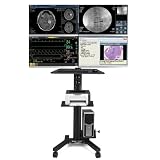
- Quad-Screen Diagnostic Power - 2 pcs 36-inch crossbar supports four 21" displays simultaneously, enabling side-by-side PACS image comparison, EHR documentation, and real-time vital sign monitoring on a single mobile platform. Certified industrial-grade strength, tested to meet stringent ANSI/BIFMA X5.5-2021 standards
- Adjustable Monitor Angle - Fully motion mounts for holding 2 monitors that tilt 45° up and down & side to side rotate in 360°. Supports dual 21" horizontal monitors (VESA 75x75mm & 100x100mm compatible), easy to adjust the angle to fit your sight well
- Heavy Duty Workstation - This is more than just a home desk; it's a professional-grade workstation designed for durability and long-term security.Heavy duty aluminum that is wear and corrosion resistant. Each shelf has a maximum load capacity of 44lbs, providing you with a sturdy and stable working platform
- Complete Mobile Workstation - Includes adjustable keyboard tray, dedicated CPU holder, printer shelf, utility basket, and integrated power strip mount. Everything you need for a fully functional diagnostic station at the point of care
- Purpose-Built for Medical Environments - Designed for ORs, ICU/CCU, emergency departments, and radiology suites. 4 smooth-rolling Wheels for flexible mobility, 2 of which are lockable provide silent maneuverability and rock-solid stability when positioned for patient evaluation. Item may be shipped in multiple packages.
| Buyer need | New Lantern’s pitch | Alternative approach |
|---|---|---|
| Replace fragmented systems | Combine viewer, worklist, reporting and AI in one platform. | Keep an existing PACS or RIS and add specialized products. |
| Move to cloud hosting | Use a cloud-native, browser-based system. | Retain a legacy or hybrid PACS deployment. |
| Upgrade reporting | Use Curie drafting and speech tools within the broader platform. | Use reporting products such as Microsoft Nuance PowerScribe or separate AI reporting tools. |
| Add third-party AI | Use the company’s proposed integration layer. | Connect tools through a marketplace, middleware or point-to-point integrations. |
| Manage multiple sites | Use centralized case distribution and analytics. | Combine separate worklists and external dashboards. |
| Preserve modularity | Accept a more integrated, single-vendor approach. | Choose best-of-breed products, with more integration work. |
Coverage has identified GE HealthCare and Philips in imaging infrastructure; Microsoft Nuance in reporting; and Rad AI in radiology AI and reporting. New Lantern’s own buyer’s guide also names PACS and reporting vendors including Intelerad, Sectra, Fujifilm, Merge, PowerScribe and Fluency. These examples illustrate different parts of the market; they do not establish that New Lantern has displaced an incumbent.
Independent reader supportYour contribution helps us test, update, and keep practical guides available for everyone.What a practice should evaluate before adopting it
Replacing or consolidating PACS is a clinical-operations project, not simply a software swap. An evaluation should cover the whole path from archived images to signed reports and business continuity.
The Tool Desk
Outbyte Driver Updater FREEFix the driver behind crashes, sound loss and screen glitchesFind Drivers →Outbyte PC Repair FREEClear out junk files and repair common Windows errorsFree Scan →Migration and integration
- How will historical images and reports be migrated, retained or accessed?
- Which scanners, modalities, DICOM routes, RIS and EHR workflows are supported in the practice’s actual environment?
- Can report templates, user roles, authentication and voice-recognition workflows be transferred?
- Can the system run in parallel with existing tools during validation and training?
Continuity, security and contracts
- What are the downtime procedures if the platform or network is unavailable, and how does the practice recover from degraded connectivity?
- What encryption, multifactor authentication, access controls, audit logs, backups and disaster-recovery commitments are provided?
- What do the business associate agreement, subprocessor disclosures, data-retention and deletion terms, data residency provisions and incident-response commitments say?
- What are the storage, implementation, support and exit costs, and how can the practice export its data if it leaves?
A cloud architecture does not by itself establish security or regulatory compliance. Consolidation can reduce the number of systems a practice manages, but it can also increase vendor dependence and the impact of an outage or contract change. Buyers should also ask whether third-party AI models can be added, removed and evaluated without losing access to core viewing and reporting functions.
Clinical governance and regulatory language
New Lantern says it is FDA-registered as a Class I medical image communications device under regulation 892.2020 and says the product is exempt from 510(k) clearance because it is not intended to detect or diagnose disease. That is the company’s description, not an independently confirmed FDA database finding. “Registered,” “listed,” “cleared” and “approved” are different regulatory terms; the available materials do not establish which product components are covered by the stated classification or how Curie is classified. The company’s regulatory and product explanation is at newlantern.ai.
For report drafting, a practice should request validation details, including performance by modality and report type, handling of uncertain or missing inputs, safeguards for laterality and measurements, and documentation of human edits. Radiologist review is an important control, but it does not by itself prove that generated reports are safe or accurate.
What is publicly known about customers and pricing
TechCrunch reported in 2024 that some radiology practices were using New Lantern but did not identify them. The company now publishes testimonials and a case study, including a case study on its site; those are first-party marketing materials rather than independent evaluations. The reviewed public materials do not establish independently verified deployment counts, study volumes, renewal rates or broadly measured outcomes.
Do these 3 things before closing this tab:
1Scan for outdated or missing drivers - takes under a minute2Repair Windows errors before they cause bigger problems3Fix the driver behind crashes, sound loss and screen glitchesNew Lantern does not publish a clear per-study, per-radiologist or enterprise price in the reviewed materials. Its public buying path is to request a demo. Practices should compare written quotes that specify study volume, storage, modalities, sites, users, integrations, support and deployment terms rather than assume a standard price.
New Lantern’s position as of August 2026
As of August 18, 2026, New Lantern’s public materials present a product spanning cloud PACS and viewing, Curie-assisted reporting, worklist distribution, analytics, OCR, 3D reconstruction and mammography capabilities, alongside DICOM, HL7, FHIR and EHR integration claims. The company also announced a radiology-specific speech model in March 2026. This update describes what the company markets; it is not independent verification of product performance, clinical validity or adoption.
Quick Recap
Product prices and availability are accurate as of the date/time indicated and are subject to change. Any price and availability information displayed on Amazon at the time of purchase will apply.




