Recommended Free Tools
Choose Anki if you want customizable, scheduled reviews and are willing to build or curate decks and keep up with them. Choose Quizlet if you want quick access to shared study sets and several ways to practise. Neither is a universal winner: the better fit depends on your study habits, device and budget. Their feature descriptions do not establish that one app produces better learning outcomes.
How Anki and Quizlet differ
| What matters | Anki | Quizlet |
|---|---|---|
| Review scheduling | Anki schedules later reviews based on how well you recall each card. It offers FSRS as an alternative to its legacy SM-2 algorithm. | Learn changes question types as you answer. Quizlet also describes a spaced-repetition feature for sets with at least 100 terms on its Canada-region page; that page says it was not yet available in the mobile app. Check current local availability. |
| Finding and building material | Flexible decks and review controls suit learners who want to create or curate a collection. | You can create, search for and share sets. Quizlet reports that users have created “Over 500 million” flashcards; the page does not state a year, and this vendor statistic is not evidence of learning results. |
| Practice formats | Centred on card review, with configurable options. | Flashcards, Learn, Test and Match, plus Quizlet Live for classroom use. |
| Devices and cost | Free desktop software and AnkiWeb sync; AnkiMobile for iOS is paid, while AnkiDroid for Android is free. Check current device requirements and local store price. | Check the current plan page for local pricing, limits and feature access; a comparable current price was not established. |
| Likely fit | A plausible choice for maintaining a large collection over time if you can sustain regular reviews. | A plausible choice when shared class sets, quick setup or multiple practice formats matter most. |
The fit recommendations are practical inferences from documented features, not results of a head-to-head learning trial.
When Anki is the better fit
Anki asks you to rate how well you recalled a card, then schedules it for a later review. Its product page describes the aim as spending more time on challenging material and less on what you already know. That approach can suit a long-running study project, but it works best when you make useful prompts and return to reviews consistently.
FSRS, SM-2 and review workload
Anki’s current manual describes FSRS as an alternative to the legacy SM-2 scheduling algorithm. With FSRS, the desired-retention setting affects review frequency: higher targets mean more frequent reviews. The manual warns that workload rises quickly above 90% and can become overwhelming above 97%. Those are Anki’s guidance about its setting, not a universal prediction of how much time any learner will spend.
#1 Best Overall

- 10 packs of 100 index cards (1,000 total); ideal for home, classroom, or office
- Made of 7.5 pt. economy weight paper (10% recycled fiber, 10% post consumer fiber)
- Plain white; blank on both sides for writing or drawing freely
- Each card measures 3 by 5 inches
- Backed by an Amazon Basics 1-year limited warranty
If you use FSRS, Anki’s manual says to choose “Again” when you forgot a card. “Hard” is for a card you recalled correctly but with hesitation. Rating honestly helps the scheduler respond to how recall actually went.
Keep setup simple at first
The manual recommends using default deck options for a few weeks before changing them. Adding many new cards can create a larger review burden later, so avoid building a backlog faster than you can revisit it. Anki’s flexibility is useful, but extra controls are not a substitute for a manageable routine.
Rank #2

- Blank 3 x 5 index cards are the perfect study tool for students of all ages; ideal for flash cards, notes or to do list; 500 per pack
- Classic 3x5 cards are a practical size for the whole household; ideal for elementary school flashcards or complex, higher level notes
- Standard weight index cards support pencil, ink pens, gel pens or highlighters; use lots of color for focused, effective notes
- Make Oxford index cards part of your strategy for better notetaking; studies suggest writing notes help you process and recall info better
- Stock up on 500 note card packs in white; perfect for students, teachers, and more
When Quizlet is the better fit
Quizlet makes it straightforward to find, create and share sets, which can be convenient when a class already uses shared material. Its study formats include:
- Flashcards: flip through terms and definitions in a format Quizlet describes as similar to traditional paper cards.
- Learn: practise with changing question types; Quizlet says it creates a personalized study plan based on familiarity with a set.
- Test: practise with a test-style format.
- Match: work through a matching activity.
- Quizlet Live: use a classroom-oriented activity.
These options give learners more ways to interact with a set than card flipping alone. They do not, by themselves, show that Quizlet improves grades or retention more than Anki.
Rank #3
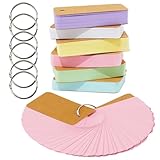
- Made of high quality kraft paper material, this index card is thicker than regular notecard paper, writes smoothly and won't let your ink bleed out.
- Set of 6 packs of 50 sheets each, multi-colored including green, purple, blue, beige, pink and yellow.Smaller size than regular flash cards for easy portability.
- The cards come in 6 different colors, so you can easily sort them by theme or class by making special markings according to the different colors.
- Each pack of small blank cards includes a stainless steel binder ring that you can hang anywhere you want, such as on a keychain or refrigerator wall hanging.
- These small index cards can be used as study cards, business cards, message cards, gift cards, inspiration cards, list cards, bookmarks, Thanksgiving cards, DIY greeting cards, and great as gifts for others.
Quizlet spaced repetition depends on availability
It would be inaccurate to say Quizlet has no spaced repetition. A Canada-region Quizlet feature page describes spaced-repetition scheduling that applies automatically to flashcard sets with 100 or more terms, while stating that the feature was not yet available in the mobile app. Availability can vary by region and device and may change, so check Quizlet’s current local feature information before relying on it.
Compare device access and cost before committing
For Anki, the official site listed version 26.09.3 when accessed on October 4, 2026: desktop software for major platforms and AnkiWeb synchronization were free, AnkiMobile for iOS was paid, and AnkiDroid for Android was free. The iOS price was not stated on the retrieved page; check your local App Store listing.
Rank #4

- 300-count pack of white heavy-weight index cards; ruled on one side for easy note taking
- Made from top-quality heavy commercial stock for added strength; ideal for studying, list making, and more
- Quality engineered with precision-cut edges for uniform size
- Measures 5 by 3 by 3.2 inches
- Premium-weight card stock: 114 lb. paper, 186 gsm
The Quizlet feature pages do not provide a comparable current price table. Check Quizlet’s plan page for your country to confirm which features are included and what they cost. This matters if you need a particular mode or plan to study on a specific device; do not assume feature access or price is the same everywhere.
Independent reader supportYour contribution helps us test, update, and keep practical guides available for everyone.How to choose for your study routine
- Choose Anki if you want recall-rated scheduling, detailed review controls and a collection you can maintain over time.
- Choose Quizlet if you want to start with shared sets, create and share material quickly, or switch among different practice formats.
- Compare access first if you need an iPhone, Android device or a particular paid feature. Confirm current regional pricing and availability before moving a large study collection.
- Try a small set before building a course-wide library. See whether the prompts test what you need to remember and whether the review routine fits your schedule.
Whichever app you choose, write prompts that make you retrieve an answer rather than merely recognize it, and check the feedback when you miss one. Flashcards can support practice, but using an app is not a substitute for understanding course material. The available product descriptions do not establish a definitive efficacy ranking or show that either app causes better grades.
Quick Recap
Best Value

- Sturdy unruled tagboard strips packed in an easy access dispenser box.
- Assorted colors help categorize groups of words.
Product prices and availability are accurate as of the date/time indicated and are subject to change. Any price and availability information displayed on Amazon at the time of purchase will apply.




