A time study estimates how long a defined task should take when performed using a consistent method, meeting its quality requirements, and working at a sustainable pace. To conduct one, define the task and its boundaries, break it into observable elements, record representative cycles, calculate observed and—when justified—normal time, then apply a documented allowance method. A stopwatch reading alone is not a standard time.
What a time study measures
A direct stopwatch time study records how long a task or its component elements take under specified conditions. Its result is meaningful only for the work method, materials, equipment, quality standard, and operating conditions studied. If those change, the estimate may no longer apply.
Keep the terms distinct:
- Observed time: the time recorded for an element or complete cycle.
- Normal time: observed time adjusted for a documented assessment of the worker’s pace, when the chosen method uses performance rating.
- Standard time: normal time adjusted for allowances under a stated convention.
There is no universally established performance rating, allowance percentage, or number of cycles that fits every study. Select and explain the method rather than presenting an example value as a rule.
How to conduct the study
- Define the scope and quality criteria. Specify the job, unit of finished work, product or service, required quality, equipment, materials, and operating conditions. Identify the exact start and stop events. Before observing, decide how to handle waiting, interruptions, rework, and abnormal events.
- Document the method and divide it into elements. Record the steps actually performed, then split the task into observable elements with clear, repeatable boundaries. Check that the method and work conditions are stable before timing; otherwise, process changes become mixed up with timing variation.
- Choose the operator and observation approach. For a direct stopwatch study, observe someone familiar with the method, allowing practice where appropriate. The pace should be sustainable, not a short burst encouraged for the study. If variability matters, consider whether the study needs to include more operators, shifts, product variants, or operating conditions.
- Record comparable cycles consistently. Use a stopwatch to capture either element times or cycle times, and use the same approach throughout. For each observation, note the method version, date, operator context, conditions, and quality outcome. Log interruptions and the reason for any exclusion; do not silently discard inconvenient readings.
- Review the observations. Check for missing elements, inconsistent boundaries, method changes, and observations that do not represent the intended work. If an observation is atypical, decide whether to retain it, analyze it separately, or exclude it—and document the reason.
- Calculate observed time for each element. Choose a summary statistic suited to the study design and retain the raw observations so the calculation can be checked. If an element occurs more than once, or only in some cycles, account for its frequency per unit of finished work.
- Calculate normal time only if the method calls for it. Apply a documented performance rating to observed time when the selected work-measurement method uses one. Rating is an observer judgment, not a direct measurement; use a competent observer and explain the basis.
- Set allowances transparently. Identify relevant categories, such as personal needs, fatigue, or unavoidable delays. Use applicable policy or a suitable professional method, and state both the allowance basis and formula. Do not transplant a percentage from an example or a legally specific context without justification.
- Calculate and report standard time. Apply the stated allowance convention to each element’s normal time, then sum the elemental times, accounting for element frequency. Report the scope, method, conditions, calculations, allowance basis, exclusions, and limitations with the result.
- Validate and revisit the estimate. Compare the estimate with production under representative conditions. Investigate material discrepancies and repeat or revise the study if the method, quality requirements, tools, or work environment changes.
How to calculate observed, normal, and standard time
The Pennsylvania State University-hosted instructional example uses these formulas:
Recommended Free Tools
#1 Best Overall
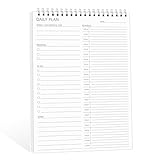
- ✔This daily plan pad features detailed hourly schedule timelines from 12 AM to 11 PM, perfectly segment your morning, afternoon and evening hours. Track meetings, appointments and fixed tasks hour by hour to eliminate procrastination and boost your daily time management efficiency.
- ✔ 1.Put an end to the time black hole: Every hour of activity is recorded, so you always know where your time goes and bid farewell to "being busy yet achieving nothing". 2.Cure procrastination: Visual time grids have an inherent sense of supervision; blank time slots serve as a direct reminder, with more binding power than phone alerts. 3.Gain instant a sense of accomplishment: Check off completed tasks with a simple tick. A filled time axis page by page delivers physical feedback that digital tools cannot match, making it easier to keep going the more you use it.
- ✔ 1.Students & Exam Takers: Plan class, review and practice time; allocate study hours for each subject precisely for targeted exam preparation. 2.Professionals: Schedule meetings, work projects and commute time; prioritize tasks clearly and bid farewell to chaotic overtime. 3.Freelancers & Stay-at-Home Parents: Clearly divide work/childcare/personal time to avoid blurring the boundaries between life and work. 4.Self-Discipline Enthusiasts: Check in on fitness, reading and learning; develop regular routines with hourly scales to build good habits effortlessly.
- Normal time = observed time × (performance rating ÷ 100).
- Standard time = normal time × (1 + allowance percentage ÷ 100).
For a task with multiple elements, calculate each element’s standard time and sum them, accounting for how often each element occurs per finished unit. These formulas illustrate one convention; allowance treatment can be expressed differently. Name the convention you use so readers can understand how the result was produced. Pennsylvania State University’s “How to Perform a Time Study” instructional PDF provides the worked example.
Choosing a work-measurement method
| Method | What it measures | What to consider |
|---|---|---|
| Direct stopwatch time study | Observed time for task elements or cycles using the actual method. | Requires clear element boundaries and consistent observations; performance rating may involve observer judgment. |
| Predetermined motion-time system, such as MTM or MODAPTS | Time built from coded motions. | Requires method-specific training and a suitable task; it may avoid rating an observed pace. |
| Work sampling | Activity proportions or utilization estimated from observations made across time. | Answers a different question from directly timing every cycle. |
The U.S. Department of Labor’s Field Operations Handbook discusses stopwatch, MTM, and MODAPTS in its Section 14(c) context. That discussion is not a blanket endorsement or legal requirement for every time study. U.S. Department of Labor, Field Operations Handbook, Chapter 64
Rank #2

- Stay Organized and Focused: This planner is specifically designed to help individuals with ADHD or busy lifestyles prioritize their day with clear prompts, ensuring that the most important tasks are tackled first
- Comprehensive Layout: With 100 thoughtfully designed pages, including sections for daily scheduling, task prioritization, self-care, and brain dumps, this planner helps reduce distractions and keep your thoughts organized
- Motivation Through Rewards: Keep yourself engaged and motivated with built-in checklists and reward systems that make completing tasks more satisfying
- Flexible and Undated Design: Use this planner at your own pace—it's undated, so you can start anytime without worrying about wasted pages
- Durable and Convenient: Featuring a 7" x 10" size, a sturdy hardcover, and spiral binding for durability, this planner is easy to carry and perfect for daily use
Make the result fair and defensible
- Do not set a standard around unsafe speed, skipped quality checks, or a pace that cannot be sustained.
- Use the same task definition and quality criteria when comparing performance.
- Keep raw observations and document exclusions, assumptions, and study limits so another person can review the calculation.
- Consult applicable labor rules and organizational policy before using a study to set pay, quotas, or disciplinary thresholds. The cited Department of Labor guidance is U.S.-specific and concerns a particular wage program; it is not a universal rulebook.
For broader background, the International Labour Organization publication record for George Kanawaty’s Introduction to Work Study, fourth revised edition (1992) identifies the foundational reference. The University System of Georgia catalog record for its 2025 Work Measurement Study Open Textbook lists direct time study, allowances, work design, and related topics.
Quick Recap
Best Value

- Plan Smarter, Stress Less: Our undated planner has 50 daily planning sheets per planning pad to help you keep your notes organized all in one place. Track important projects, tasks, time blocking, and goals with our planner.
- Enhance Your Productivity: The simple solution for managing your daily schedule. Helps you focus, especially those with ADHD. With our daily planner you can track your appointments and meetings throughout the week, organize your tasks in order of priority, jot down thoughts or ideas, and record when projects are due.
- Upgrade Your Office Supplies: The minimal design makes this a stylish and practical addition to your work from home essentials for both women and men. This to-do list notepad looks professional and keeps you organized.
- Give The Gift Of Organization: The sleek design makes this a beautifully practical gift for moms and dads who need a little extra help keeping track of soccer games, field trips, and doctor’s appointments. Also makes a wonderful gift for college students, coworkers, your boss, or the entrepreneur in your life to help them stay on top of busy schedules.
- Cultivate Healthy Habits: Plan and track your meals and water intake each day and use the checkbox as a visual reminder. Take a minute each day to write down something good that happened. Practicing gratitude is proven to increase happiness!
Rank #4

- Easily Stay On Track & Make The Most Of Your Time: ZICOTOs’ daily planner makes it easier than ever for you to stay organized, reduce stress & enjoy more free time! Arrange your schedule, priorities, to do’s and jot down plans & ideas on the daily notes section
- Smartly Plan Ahead & Boost Your Productivity: Absolutely clever & efficient! With the to do list notebook / notepad you can break down your daily tasks into half-hourly focus blocks and map out priorities & follow-up duties to keep your day on track and enhance productivity
- Plenty Of Space For Efficient Planning: Stay focused & manage your time wisely! The 8.4x6.1” work planner & organizer notebook offers ample space for 105 days of life-changing planning with each day being spread across 2 pages - set yourself up for purposeful days
- Now Is The Best Time To Start: The daily planner is undated so you can start to add structure to your schedule and cultivate new planning habits right away! Beat procrastination, boost happiness & make each day count with the hourly planner
- Adds Beauty To Daily Planning: A luxury sage hard cover, chic golden letters, a gold ring wire and a clean, easy-to-use layout, elastic band - enjoy the lovely and modern design of the undated daily planner!
Rank #3

- BOOST YOUR PRODUCTIVITY – Turn your to-do list into a clear daily schedule with a simple 3-step time blocking method: Brain Dump, Prioritize, then Time Block your day. A practical time management planner for work, school, and busy routines.
- CLEAR YOUR MIND – The Brain Dump section helps you get tasks, appointments, and ideas out of your head and onto paper. Designed as an ADHD-friendly planner for adults who want more structure and less overwhelm.
- VISUALIZE YOUR TIME – The daily hourly planner layout helps reduce procrastination by giving each task a clear place in your schedule. Time slots make it easier to plan work blocks, study sessions, appointments, errands, and focus time.
- FLEXIBILITY – 180 undated pages let you start anytime, skip days, and plan without wasting pages. Monthly pages provide a big-picture view of deadlines and goals, while flexible daily scheduling works for early birds and night owls.
- QUALITY – Durable hard cover with vegan leather finish, 100 GSM high-quality paper, elastic closure, and 2 bookmarks. Portable A5 size is perfect for your desk, backpack, work bag, or school bag.
Product prices and availability are accurate as of the date/time indicated and are subject to change. Any price and availability information displayed on Amazon at the time of purchase will apply.




