Recommended Free Tools
Accounting turns business transactions into organized records and useful financial statements. The basic cycle is straightforward: identify a transaction, record its two-sided effect in accounts, check that debits and credits balance, and use the resulting records to prepare statements. The central rule is assets = liabilities + equity.
What is accounting?
Accounting is the process of identifying, recording, classifying, summarizing, and interpreting financial activity. Bookkeeping is the transaction-recording part of that work; accounting also organizes the records and uses them to explain a business’s position and performance.
In introductory accounting, the business is treated as a separate entity from its owner. That means the records focus on the business’s transactions rather than mixing them with the owner’s personal spending. Day-to-day records capture transactions; financial statements summarize those records for people who need to understand the business.
The U.S. Securities and Exchange Commission (SEC) says, “If you can read a nutrition label or a baseball box score, you can learn to read basic financial statements.” Its beginner guide is designed to help readers make sense of statements, not qualify them as accountants.
Free tools Windows power users keep installed
One-click scans. No signup required.
#1 Best Overall

- PERFECT FOR RECORD KEEPING: The 2 Pack account ledger books are versatile and can be used to track finances, budgets, expenses, and other business or personal records. They are perfect for individuals, or small business owners who need a reliable and efficient way to keep track of their finances. With 100 pages, customers can record transactions over an extended period, making it a handy tool for bill planner, weekly budget planner, monthly budget planner.
- COMPACT AND LIGHTWEIGHT: The Budget Planner is compact and lightweight with each book weighing 7 ounces and measuring 8.5 x 6.25 inch, making them easy to carry around. You can take the budget notebook in a bag or briefcase, making them ideal for on-the-go use. This feature ensures that you can access your records at any time, whether you are at work or on the move.
- PREMIUM QUALITY: Elegant style with the words ''Account Tracker'' embossed in fancy Gold Foils. Water-proof and scratch resistant hard cover. Coil ring binding is a practical design feature that enhances the functionality of the account ledger books. It allows pages to turn smoothly and easily, making it effortless to flip through the book while keeping pages in place. The ring binding also ensures that pages won't fall out, preventing the loss of vital information.
- DURABLE WATER-PROOF COVER WITH GOLD FOIL LETTERS: The words ''Account Tracker'' embossed in shiny Gold Foil letters gives it a professional and fancy look that can fit in any setting. Additionally, the durable cover is scratch resistant, It provides a durable layer of protection that can withstand daily wear and tear, making it suitable for long-term use.
What is the accounting equation?
The accounting equation is assets = liabilities + equity. It expresses the idea that a business’s resources are financed either by amounts it owes or by the owner’s interest in the business. Open University OpenLearn uses the term “capital” for the owner’s interest and gives the equivalent form assets − liabilities = capital.
- Assets are resources the business holds, such as cash or equipment.
- Liabilities are amounts the business owes.
- Equity (or capital in OpenLearn’s terminology) is the owner’s interest in the business.
Revenue and expenses affect equity through the business’s results over a period. For example, revenue tends to increase equity through profit, while expenses reduce it.
Example: owner contributes cash
If an owner puts $1,000 of personal cash into the business, the business records $1,000 more in cash, an asset, and $1,000 more in owner’s equity. The two sides increase equally, so the equation remains balanced.
Rank #2

- Refined Financial Management: Our ledger books for bookkeeping can be used to track personal bills and budgets and serve as book keeping log for small business.Helps you keep track of your expenses and income for effective financial planning.
- Adequate Ledger Entries: Dimensions are 8.4 x 6.1 inches, making it easy for you to take anywhere. This accounting ledger comes with 3304 entry spaces (120 pages) so you can record all your financial information in one place, with easier access to track transaction types and dates.
- Elegant & Exquisite Design: Our ledger notebook adopts a classic waterproof material cover, which is not easy to wear. Gold double spiral binding makes flipping through easy. This bookkeeping book is also designed with practical inner pockets and bookmark elastic bands.
- Flexible & Thick Paper: Our accounting book is made of 100gsm non-bleeding paper, perfect for fountain pens, ballpoint pens and other pen types. Convenient to write on, so you no longer have to worry about bleeding ink.
- Perfect For Gift Giving: As you would expect, the cover of the book keeping book is beautifully designed with gold foil lettering and floral patterns. Perfect as a gift for parents and friends, or as a business ledger for small business.
Example: buy an item on credit
If the business buys $200 of equipment on credit, it records $200 more in equipment, an asset, and $200 more in accounts payable, a liability. The transaction adds equal amounts to both sides of the equation. If the purchase is for a service or supply used immediately, the debit may instead be an expense; the other side is still the liability owed to the supplier.
What are debits and credits?
Debits and credits are the left and right sides of an accounting entry. They are not synonyms for “bad” and “good,” or simply for decrease and increase: their effect depends on the type of account. In double-entry bookkeeping, each transaction affects at least two accounts, and the total debits must equal the total credits.
For the $1,000 owner contribution, the business debits Cash by $1,000 and credits Owner’s Equity by $1,000. Cash is an asset, and the debit increases it; equity is increased by a credit. For the $200 equipment purchase on credit, it debits Equipment and credits Accounts Payable by $200. These entries represent the same transactions described in the equation examples.
Rank #3

- Easy To Track Your Finances: HAUTOCO accounting ledger book keeps you on top of your expenses and income! Help you keep your money organized, spend well, and set and achieve financial goals
- Premium Material: The A5 accounting ledger book has a total of 120 pages and 2040 lines of entries. It is made of 100gsm thick paper to reduce ink leakage; it is equipped with a waterproof and sturdy PP cover to protect the inner pages
- Practical Design: Compact 8.3 x 6.2'' expense tracker notebook is easy to carry and features information pages, 2025 calendar, yearly financial goals page, and PVC pocket for storing important tickets and loose items
- Manage Your Finances Effectively: Undated accounting books with number, date, description, account, payment or deposit amount, and total balance. You will be able to easily analyze your financial activities and quickly prepare accurate financial statements
- Ideal For Small Business or Personal Use: An accounting log journal can track your business or personal financial status. With a clear record of transactions, you can find unnecessary expenses or fraudulent charges
The IRS explains in Publication 583, Starting a Business and Keeping Records (revised December 2024), that double-entry bookkeeping “is self-balancing because you record every transaction as a debit entry in one account and as a credit entry in another.” That description is within the publication’s U.S. business-recordkeeping and federal tax context.
What are the main financial statements?
Financial statements summarize accounting records, but they answer different questions. The SEC’s Beginners’ Guide to Financial Statements offers an investor-oriented introduction to reading them.
- Balance sheet: What does the business own and owe, and what is the owner’s interest, at a particular date? It reflects the accounting equation.
- Income statement: What revenue and expenses did the business report over a period, and was the result a profit or a loss?
- Cash flow statement: How did cash move into and out of the business over a period?
A business’s profit and its cash movement are not necessarily the same. For example, a sale recorded before the customer pays can contribute to income before the cash arrives under accrual accounting.
Rank #4

- Quality and Stylish Accounting Solution: the ledger binder is meticulously crafted with excellent quality paper and a sleek PU leather cover in an elegant blue color; The stylish yet professional design serves as an effective tool which is ideal for financial record keeping; The 6 ring ledger books for bookkeeping allow flexibility to add or remove sheets as per requirement, making this a staple for your accounts payable and accounts receivable needs
- Innovative and Efficient Design: the white ledger sheets are specifically designed to promote quick and easy accounting; With designated sections for debit, credit, and balance columns, this business checkbook binder aids in making each task is efficiently accounted for; The intuitive design coupled with the 0.79 inch/ 2 cm width makes it does not occupy much space on your desk
- Compact and Versatile Size: the ledger books, measuring approximately 10.23 x 6 inches/ 26 x 15 cm and the ledger sheets of about 8.5 x 5 inches/ 21.6 x 12.7 cm, are optimized to be perfectly suitable for all your accounting needs. The slim width adds to its compactness without compromising its functionality, thereby making it a must have in your office setup
- Comprehensive Package to Organize Accounting: the package includes 1 accounting ledger with 200 white ledger sheets and 2 sets of index tabs; These small index tabs assist in quickly locating the right portfolio, making your accounting process smoother and more organized
- Reliable and Durable: constructed from quality PU leather, the ledger notebook is notably reliable and durable. What's more, the 6 ring design of the binder makes excellent holding capability; The paper quality of the sheets supports long term use making it not just a purchase, but a smart investment for your accounting and budgeting tasks
How does the basic bookkeeping cycle work?
A simple learning sequence runs from accounts and the equation to entries, checks, and statements. In practice, businesses may use accounting systems to organize these tasks, but the underlying logic is the same.
- Identify the transaction. Start with a business event, such as an owner contribution, a credit purchase, a sale, or a payment.
- Choose the accounts affected. Decide whether the event changes assets, liabilities, equity, revenue, or expenses.
- Record a journal entry. Write the debit and credit for the transaction, with equal totals.
- Post to the ledger. Transfer the journal amounts into the relevant individual accounts so each account’s activity can be reviewed.
- Prepare a trial balance. List account balances and check that total debits equal total credits.
- Prepare financial statements. Use the organized account balances to summarize financial position, performance, and cash flows.
A balanced trial balance is an arithmetic check, not proof that the books are completely correct. It may not reveal an omitted transaction or one recorded in the wrong account; it checks that posted debit and credit totals agree.
Independent reader supportYour contribution helps us test, update, and keep practical guides available for everyone.Cash accounting vs. accrual accounting
Cash and accrual accounting differ mainly in when income and expenses are recognized. The IRS describes these methods in the context of U.S. federal tax reporting; its explanations should not be treated as universal tax rules.
Best Value
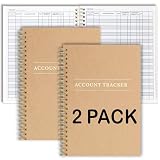
- PERFECT FOR RECORD KEEPING: The 2 Pack account ledger books are versatile and can be used to track finances, budgets, expenses, and other business or personal records. They are perfect for individuals, entrepreneurs, or small business owners who need a reliable and efficient way to keep track of their finances. With 100 pages, customers can record transactions over an extended period, making it a handy tool for financial planning and organization.
- COMPACT AND LIGHTWEIGHT: The account ledger books are compact and lightweight with each book weighing 7 ounces and measuring 8.5 x 6.25 inch, making them easy to carry around. You can take them with them in a bag or briefcase, making them ideal for on-the-go use. This feature ensures that you can access your records at any time, whether you are at work or on the move.
- DURABLE KRAFT COVER: The kraft cover is a distinguishing feature of these account ledger books. It provides a durable layer of protection that can withstand daily wear and tear, making it suitable for long-term use. Additionally, the classic, rustic appearance of the cover gives it a timeless and professional look that can fit in any setting.
- PREMIUM QUALITY: Elegant style with the words ''Account Tracker'' embossed in fancy Gold Foils. The gold coil ring binding is a practical design feature that enhances the functionality of the account ledger books. It allows pages to turn smoothly and easily, making it effortless to flip through the book while keeping pages in place. The ring binding also ensures that pages won't fall out, preventing the loss of vital information.
| Method | When income is generally recorded | When expenses are generally recorded | What timing means |
|---|---|---|---|
| Cash | When payment is received | When payment is made | Reported income and expenses generally follow cash movement. |
| Accrual | When income is earned | When expenses are incurred | Reported results can differ from cash received or paid during the period. |
For U.S. federal tax purposes, IRS Publication 583 says: “Under an accrual method, you generally report income in the tax year you earn it, even though you may receive payment in a later year.” Which method a business may or should use can depend on its facts and applicable rules; the publication is not a substitute for advice about a particular business.
Single-entry vs. double-entry bookkeeping
Single-entry and double-entry are different ways to keep records. The IRS says single-entry can be simple and practical for some small businesses; it does not say one method is right for every business.
| Approach | How it works | Practical trade-off |
|---|---|---|
| Single-entry | Records transactions in a simpler format, often centered on cash receipts and payments. | Can be simpler to maintain, but provides less detail and fewer built-in balancing checks. |
| Double-entry | Records transactions in journals and ledgers, with debits matched by credits. | Requires more structure, but provides account-level detail and a check that posted debits equal credits. |
Neither approach automatically guarantees accurate records. The choice depends on the business’s needs, circumstances, and applicable requirements.
How can a beginner learn accounting?
Learn in sequence: accounts and the equation first, then journal entries and ledgers, then trial balances and financial statements. The free Open University OpenLearn course Introduction to bookkeeping and accounting covers numerical skills, the accounting equation, double entry, T-accounts, trial balance, and profit and loss. It was first published in 2013 and updated in 2020.
Worked examples help turn the rules into a repeatable skill. An introductory textbook or practice workbook is optional; you can begin with the course and a few simple transactions, then add exercises if you want more practice.
What business owners should know about recordkeeping
Learning accounting concepts and meeting recordkeeping or tax obligations are separate tasks. IRS Publication 583 discusses records and accounting methods for U.S. federal tax purposes. Requirements and suitable accounting choices may differ with jurisdiction, business structure, inventory, and other facts. The publication is an educational starting point, not individualized tax or accounting advice.
Quick Recap
Product prices and availability are accurate as of the date/time indicated and are subject to change. Any price and availability information displayed on Amazon at the time of purchase will apply.




