Scenario analysis helps you see how a decision might perform under several plausible, internally consistent futures. It is not a prediction: it tests what could happen if specified conditions occur, so you can make a more informed choice. The ten keys below are a practical synthesis of guidance from USAID, the World Bank, the Bank for International Settlements, the Financial Stability Board and the US Environmental Protection Agency—not a universal ten-step standard.
What is scenario analysis?
Scenario analysis evaluates a decision across distinct possible states of the world. Each scenario combines assumptions about uncertain conditions—such as costs, demand, income or interest rates—and traces their implications for an outcome that matters to the decision-maker. The World Bank describes scenarios as coherent narratives built around influential, uncertain variables; USAID distinguishes scenario analysis from methods such as sensitivity analysis and Monte Carlo analysis.
The result is conditional: “If these conditions occur, this is how the choice may fare.” Scenarios do not automatically carry probabilities, and the analysis should not be presented as a forecast unless a separate forecasting method supports that claim.
How many scenarios should you use?
There is no universally correct number. Use enough scenarios to explore meaningfully different conditions relevant to the decision, but not so many that each is analyzed too superficially. In its climate-risk guidance, the Bank for International Settlements (BIS) highlights the trade-off between scenario count and analytical depth when resources are limited. That is a design consideration in that field, not a prescribed count for every analysis.
Do these 3 things before closing this tab:
1Repair Windows errors before they cause bigger problems2Fix the driver behind crashes, sound loss and screen glitches3Clear out junk files and repair common Windows errors#1 Best Overall
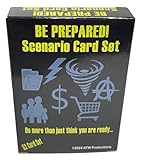
- Be Prepared! Do more than just think you are ready for the unknown with this Scenario and Planning Deck. Each scenario and through provoking card subject will guide you on the right path to getting you and your household ready for all kinds of unexpected situations that may occur.
- Subjects covering health, safety, money, food, disasters (man made and natural), and more will help you start in creating your own custom plan for meeting unexpected life challenges. How detailed you dive into your emergency and disaster plans is totally up to you. These quick and easy cards can be a casual reminder or the launching point for total preparedness.
- 52 Cards presenting Scenarios and Planning Tips. 2 of the card provide the framework for your Disaster / Emergency Planning: One of them contain a list of various Scenarios and the other is a list of Plans you may wish to consider making. These 2 cards are critical and are often referenced on the rest of the deck.
- Each Scenario / Suggestion card has a place for you to mark off if you are READY or if you still have WORK TO DO on a particular subject. This will allow you to track your level of preparedness and on a particular subject. You cross reference these with your list of Plans and Scenarios on Cards #51 and #52 for a solid basis for planning for emergencies, disasters, and the overall unknown threats life may offer.
- The Scenario / Suggestion cards include topics on how to react immediately to an emergency such as natural disasters, civil anarchy, and banking failures. There are also discussions on health, preparedness equipment, food, and other related topics. When you feel you got a topic sufficiently covered, check off the READY box and move on to the next card.
For a personal-finance decision, a small set might contrast a favorable case, a central planning case and a difficult case. Treat these as distinct assumptions, not as probability labels: “favorable” does not mean likely, and “difficult” does not mean worst imaginable. Add a scenario only when it reveals a material condition or trade-off the existing set misses.
How is scenario analysis different from sensitivity analysis?
These methods can work together, but answer different questions. Scenario analysis asks how a decision performs under coherent combinations of conditions. Sensitivity analysis asks how the result changes when one or more selected inputs vary. Monte Carlo analysis uses assumed probability distributions to simulate a range of outcomes. USAID and the World Bank discuss these as distinct approaches to uncertainty.
| Method | Question it answers | What it does not establish by itself |
|---|---|---|
| Scenario analysis | How would the decision perform under each defined set of conditions? | The probability that any scenario will occur |
| Sensitivity analysis | How much does the result change when a selected input changes? | Whether the varied inputs form a coherent future |
| Monte Carlo analysis | What range of outcomes results from repeated simulation using assumed distributions? | Whether the distributions or model assumptions are appropriate |
For example, you could compare a household budget under several internally consistent combinations of income and expenses, then vary the assumed rent increase to see how strongly that input affects the result. A simulation may add value when you have defensible distributions and need probabilistic outputs; it should not be treated as interchangeable with a set of discrete scenarios.
Rank #2

- The Worst-Case Scenario Card Game APOCALYPSE is jam-packed with 225 of the grittiest apocalyptic scenarios for players to rank.
- Match and rank five apocalyptic scenarios from 1 (Bad) to 5 (The Worst). Match correctly and score points. Score the most points...and win!
- A funny, easy-to-learn card game that is perfect for a mid-teen to adult game night. (Ages 14-Adult/3-6 Players)
- Based on the New York Times bestselling Worst-Case Scenario Survival Handbook.
- Roll the Victim die to score bonus points!
10 keys to building useful scenarios
1. Start with a decision
State the choice the analysis should inform, who needs the answer and what result could change the decision. For instance, a household considering a major purchase might ask whether the payments remain manageable under plausible changes in income and essential expenses. A scenario exercise without a decision or decision-relevant output can produce interesting stories without helping anyone choose.
Quick wins for a faster PC:
Scan for outdated or missing drivers - takes under a minuteDriver Scan →Clear out junk files and repair common Windows errorsFree Scan →Fix the driver behind crashes, sound loss and screen glitchesFind Drivers →2. Set scope and time horizon
Define what is included: the activity or decision, relevant geography, time period and outcomes you will examine. A short horizon can reduce uncertainty but may miss drivers that emerge later; a longer one can capture those drivers while adding uncertainty. BIS makes this trade-off explicit in its climate-risk application. Choose a horizon that fits the decision, and state it clearly.
3. Identify the uncertainties that matter
Focus on a manageable number of influential uncertainties rather than listing every unknown. The World Bank’s guidance frames scenario analysis around variables that are both influential and uncertain. Ask which drivers could materially change the outcome and which are already known or less consequential. Sensitivity analysis can help identify inputs worth exploring in more detail.
Rank #3

- Save the American Red Wolves: Join forces with fellow conservationists to protect the critically endangered American Red Wolf population.
- Educational Gameplay: Learn about wildlife conservation, negative stereotypes, and landowner support through immersive gameplay.
- Historical Context: Explore the history of the American Red Wolf, from their once-thriving population to their current critical status.
- Cooperative Strategy: Engage in strategic planning and teamwork to overcome challenges and achieve conservation goals.
- High Replay Value: Dynamic gameplay scenarios offer endless strategic opportunities and educational experiences for players.
4. Choose scenarios that differ meaningfully
Construct cases that expose different decision-relevant conditions, not slight variations that lead to the same conclusion. A scenario set should provide breadth without sacrificing the depth needed to analyze each case. There is no standard count that works across decisions; available data, time and analytical resources matter.
5. Keep assumptions internally consistent
Explain how the assumptions fit together and how they lead to the outcomes. If a scenario combines changes in income, expenses and borrowing costs, make clear why those changes belong together in that case. The Financial Stability Board (FSB) emphasizes documenting scenario selection, assumptions, pathways and sensitivity to parameters. A collection of unrelated “good” or “bad” input values is not, by itself, a coherent scenario.
6. Translate each scenario into measurable outcomes
Connect each narrative to variables that can inform the choice: for example, monthly cash flow, savings needed, borrowing costs or the ability to meet a target. Identify the exposures or costs that matter and how you will measure them. BIS’s climate-risk guidance uses economic variables and financial effects as examples in that specific context; the appropriate measures elsewhere depend on the decision.
Rank #4

- EXPLORE THE ISLAND OF CATAN: Settle the uninhabited island of Catan by gathering resources, building infrastructure, and nurturing trade relationships.
- STRATEGY AND COMPETITION: Compete with 2-3 opponents to expand your settlements and cities while managing resources and avoiding the robber.
- TRADE, BUILD, AND SETTLE: Use brick, wood, wheat, ore, and sheep to construct roads, settlements, and cities in your race to 10 victory points.
- REPLAYABLE AND ENGAGING: With a modular hexagonal board, no two games are the same, offering endless strategic opportunities and replayability.
- FOR FAMILIES AND STRATEGY ENTHUSIASTS: Designed for 3-4 players, ages 10 and up, CATAN 6th Edition is perfect for family game nights and friendly competition. Add the CATAN 5-6 Player Extension (sold separately) to expand your game to 5-6 players.
7. Match the analysis method to the question and data
Choose a level of detail you can support. BIS describes top-down assessment as easier to implement but less granular, while bottom-up assessment can provide more detail but make comparisons across firms harder. Those are climate-risk design considerations; in other settings, the same practical tension may arise between a simpler model and more detailed inputs. A hybrid may be appropriate when the decision requires both a broad view and detail on a few important exposures. State the method and its limits.
8. Probe assumptions and test what could change the result
Vary important inputs to learn whether the conclusion is robust or depends on a narrow assumption. EPA guidance recommends explaining and justifying key assumptions, then examining higher and lower values. FSB guidance also identifies sensitivity to parameters such as prices and customer preferences. Report which changes materially affect the outcome rather than presenting a single result as if its assumptions were certain.
9. Keep scenario, sensitivity and probability claims distinct
Label each analysis by what it actually does. A sensitivity check is not a complete scenario unless its assumptions form a coherent case. A Monte Carlo result is probabilistic only in relation to the distributions and model used. If you combine methods, explain their separate roles and do not imply that a scenario’s occurrence is likely merely because it was modeled.
What’s actually slowing this PC down?
Pick the symptom - the matching free tool is one click away.
Best Value

- Teaches Essential Life and Social Skills: Covers critical topics like personal safety, bullying, problem-solving, and smart decision-making, while actively building social skills through interactive play.
- Ages 4-10, Perfect for Families & Educators: The core game is suitable for children 4-8 years old, and the content is valuable for kids up to age 10. It's ideal for family game nights and use by educators or health professionals in classrooms or clubs.
- Multiplayer Fun: Designed for 2 to 8 players, making it excellent for both small groups and larger family or classroom settings.
- Interactive & Dynamic Play: With over 200 questions and activity cards, the game is dynamic and interactive, requiring players to move, draw, spell, and act—no additional items are needed.
- Great for Bonding: Promotes connection and meaningful conversations, but is generally recommended to be played with a "game leader" (parent or adult) to guide the important safety and life-skill discussions.
10. Communicate results with limits visible—and use them
Present the outcomes alongside the assumptions, horizon, method, sensitivities and limitations that produced them. Use the analysis to inform risk awareness, management or further investigation, rather than treating it as a decision rule that removes judgment. The FSB and BIS guidance emphasizes documenting choices and pathways; EPA likewise emphasizes transparent assumptions and sensitivity checks.
Independent reader supportYour contribution helps us test, update, and keep practical guides available for everyone.How do you turn scenarios into a decision?
- Write the decision question. Name the choice, the person or group deciding and the outcome that matters.
- Define the boundaries. Set the relevant activity, geography, time horizon and measures before selecting assumptions.
- Select consequential uncertainties. Identify the few drivers that could change the decision; use sensitivity checks to help prioritize them.
- Build a small, distinct scenario set. Describe the assumptions in each case and show how they form a coherent pathway.
- Estimate outcomes consistently. Apply the same measures and a fit-for-purpose method across scenarios so differences are interpretable.
- Stress-test important inputs. Check whether reasonable higher and lower values alter the result or the decision.
- Record implications and limits. State what the analysis supports, what it does not establish and what new information would justify revisiting the choice.
A useful output is not simply a table of outcomes. It explains which conditions create the largest downside, whether the decision remains acceptable across the cases considered, and what action or monitoring could address the risks. If the preferred choice changes between scenarios, that is decision-relevant information—not proof that the analysis failed.
What should a scenario analysis report include?
- Decision and scope: the choice being examined, audience, geography, horizon and outcomes.
- Scenario definitions: the key assumptions, why they belong together and the pathway from conditions to results.
- Method and inputs: data, model or calculation approach, level of detail and any important exclusions.
- Results and sensitivities: comparable outcomes across cases and the assumptions that most affect them.
- Limitations and use: uncertainty, what the scenarios do not predict, and how the findings may inform action or further work.
These disclosures make it possible for readers to distinguish scenario outcomes from forecasts or probabilities. The FSB’s technical supplement stresses documenting scenario selection, assumptions, pathways and parameter sensitivities; EPA guidance calls for transparent explanations and justification of assumptions.
Quick Recap
Product prices and availability are accurate as of the date/time indicated and are subject to change. Any price and availability information displayed on Amazon at the time of purchase will apply.
Recommended Free Tools




