A cement plant’s installed capacity is its annual design output—not a promise of how much it will make. The figure may describe finished cement from grinding units or clinker from kilns, and those are different products at different stages of production. To understand what a capacity number means, check its product, equipment, geography and reporting period, then compare it with actual production for the same basis.
What does installed capacity mean?
Installed capacity is the annual design output associated with equipment installed at a plant or across an industry. It describes what the equipment is designed to produce, not the amount actually produced in a particular year. Global Energy Monitor defines cement capacity by the design output of installed cement grinding units and clinker capacity by the design output of installed kilns (Global Cement and Concrete Tracker).
In cement making, the production chain is kiln to clinker to grinding to finished cement. A kiln makes clinker, an intermediate material. Grinding units process clinker, often with other materials, into finished cement. A kiln-capacity figure therefore is not a finished-cement capacity figure, and neither number alone establishes how much the plant actually produced.
What is the difference between cement capacity and clinker capacity?
| Measure | What it describes | Equipment basis |
|---|---|---|
| Installed clinker capacity | Annual design output of clinker | Installed kilns |
| Installed cement capacity | Annual design output of finished cement | Installed cement grinding units |
When reading a figure, look for the product named in the source. “Capacity” without that qualifier can be ambiguous, particularly when comparing a kiln facility with a grinding plant or an industry total.
PC Slower Than It Used to Be?
A free scan shows the junk files, broken settings and background clutter dragging Windows down - then fixes them in one click.Free scan · Windows 10 & 11Crashes, No Sound, or Screen Glitches?
Random freezes, missing sound and display glitches usually trace back to one bad driver. Find and replace yours safely.Free scan · under a minute#1 Best Overall

- WATER LEAK DETECTOR detects relative moisture content from leaks and flooding
- PINLESS MOISTURE METER measures relative moisture content in building materials
- NONDESRUCTIVE DETECTION up to 3/4-Inch deep using Electromagnetic field (EMF) technology
- USE ON DRYWALL, MASONRY, HARDWOOD, AND SOFTWOOD; calibrated for these materials only
- REVERSE-CONTRAST DISPLAY for easy viewing of reading and nine LED bars to indicate moisture range
How much cement can a plant actually produce?
Its installed capacity gives a design-based annual benchmark, not a reliable prediction of output. Actual production is the amount made over a stated period. It may be below design capacity because of demand, maintenance downtime, energy availability, regulatory constraints or operating plans. The capacity figure alone does not show which factors applied or how much the plant made.
For instance, the American Cement Association’s Yearbook 2023 reports that U.S. clinker production was 76.0 million metric tons in 2022, against clinker capacity of 93.0 million metric tons, for 81.7% utilization. This is a historical U.S. clinker example, not a measure of finished cement production or a current global rate. The association describes clinker as the primary intermediate product, which is finely ground to make cement.
Rank #2
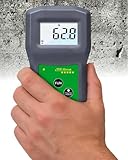
- CONCRETE MOISTURE TESTING FOR FLOORS & SLABS – Designed for contractors, inspectors and restoration professionals who need fast surface moisture detection before flooring, coating, tiling or renovation. Ideal for checking concrete slabs, floor screed, cement mortar and structural walls.
- NON-DESTRUCTIVE ELECTROMAGNETIC SENSOR – Scan concrete, plaster, gypsum and masonry without drilling or damaging the surface. Perfect for pre-installation inspections, moisture monitoring and renovation projects where surface integrity must remain intact.
- WIDE 0-70% MEASURING RANGE – Provides instant digital readings for testing concrete moisture content in slabs, subfloors and walls. Suitable for evaluating drying progress before epoxy, laminate, tile or wood floor installation.
- AUTO TEMPERATURE COMPENSATION – Automatically adjusts to ambient conditions to maintain stable readings across job sites. Helps reduce environmental influence during floor screed moisture testing and concrete moisture monitoring.
- ADJUSTABLE MATERIAL CODES – Multiple CD codes allow optimized measurement for concrete, mortar, gypsum and reference mode. Improves accuracy when checking moisture in different building materials.
How is capacity utilization calculated?
A commonly used formula is:
Capacity utilization = production ÷ installed capacity × 100
The calculation is meaningful only when production and capacity use the same product basis and a compatible time period. For example, compare clinker production with clinker capacity, not clinker production with finished-cement capacity. If the numerator covers a shorter period, the denominator must be adjusted or the production annualized, and the method should be disclosed.
Rank #3

- PREVENT MOISTURE PROBLEMS: A non-destructive analog moisture meter for instant measuring of moisture content in concrete flooring, slabs & screeds, as per ASTM F2659
- DUAL-DEPTH MEASUREMENT: Compare surface & core moisture, with a shallow depth penetration of up to 0.4" (9 mm) & deep depth up to 1.25" (30 mm); eliminate substrate influence when testing coverings
- ACCURATE MEASUREMENT: A pinless moisture meter to measure wood moisture content percentage from 5-30% & 0-100 comparative scale for other materials, with adjustment tables for wood type density
- PRE-CALIBRATED DETECTOR: Detects elevated moisture levels within most building materials & pre-calibrated to various material densities, such as wood, drywall, plaster, roofing, tile, masonry, walls, floor & ceiling
- MOISTURE MAPPING & REPORTS: The durable & ergonomic instrument can create visual test results & maps with our app; bluetooth device connectivity allows you to geotag & time-stamp reports & share photos
In an SEC-filed report, Cementos Pacasmayo describes annualizing quarterly production by multiplying it by four before comparing it with installed capacity. That is a reporting convention, not a guarantee that the remaining quarters will match the first. See the company filing for its example.
Why daily capacity is not an annual production forecast
A daily design rate cannot be treated as expected yearly production without stating the conversion convention and assumptions. Global Energy Monitor says it multiplies a reported daily capacity by 365 to express a theoretical annual maximum under continuous full operation. That arithmetic does not account for downtime or operating conditions, so it is not a forecast of achievable annual output.
Rank #4

- ✔️ QUICK, NON-DESTRUCTIVE READINGS: The C555 Concrete Moisture Meter provides fast, non-destructive preliminary moisture measurements on smooth, firm concrete to help pinpoint problem areas and determine where to place Rapid RH L6 Smart Sensors.
- ✔️ EASILY LOCATE HOTSPOTS: The C555 allows you to easily locate hotspots in your concrete slab. This information can help guide the best/vital placement of in-situ RH tests.
- ✔️ MONITORS AMBIENT CONDITIONS: Measures ambient temperature and humidity conditions so you can assess whether the environment is appropriate to install your floor.
- ✔️ MEASURES MULTIPLE MATERIALS: Measures concrete, brick and gypsum. *Please note this meter is ONLY for these materials. Measuring additional materials outside of these three will not provide accurate readings.
- ✔️ MEASURES DEW POINT: Measure dew point to easily help identify potential condensation risks.
How to compare capacity figures responsibly
Before comparing plants, company figures or national totals, check that the numbers describe the same thing:
- Product: finished cement or clinker.
- Equipment: grinding-unit capacity or kiln capacity.
- Boundary: one plant, a company, or a national industry.
- Period: annual installed capacity against annual production, or a clearly identified annualized shorter period.
- Status and date: whether capacity is operating, temporarily inactive or planned, and the date to which the figure applies.
- Utilization method: the production numerator, capacity denominator and any annualization.
Published figures are also bounded by geography and reporting date. The American Cement Association says its Plant Information Summary covers U.S. plants and includes clinker and finished grinding capacity, kiln details, fuels and cement types (Industry Information). Its sample 2022 report says capacity, grinding capacity and ownership are reported as of December 31, 2022, while fuel and cement-type information pertains to the full year (2022 Plant Information Summary sample). Those dates matter when interpreting a number or comparing it with another source.
The Tool Desk
Outbyte Driver Updater FREEScan for outdated or missing drivers - takes under a minuteDriver Scan →Outbyte PC Repair FREERepair Windows errors before they cause bigger problemsFix Now →Best Value

- HUMIDITY SENSOR: Our handy meter tool can quickly determine what level of remediation is needed to keep your family safe from black mold. High levels of dampness that go untreated are the leading cause of harmful fungus growth in the home.
- WATER LEAK DETECTOR: Finding the moisture content in your wood or drywall is the first step in early prevention. Continuously check and test suspicious water stains around the house so you can determine whether the area is wet or has already dried. Low, medium and high moisture tones and on-screen icons, Reading HOLD button
- MOISTURE READER: The mold test features large 0.3" high digits in a backlit LCD for quick and easy detecting. Our mildew scanner includes extra 8mm stainless steel pins, a protective cap that doubles as a calibration checker, and a “9V” battery.
- MOLD TESTER: For an accurate test read, stick the stainless steel pins into the surface of what you're measuring. The gauge has a broad range of 5 - 50% for wood and 1.5 - 33% for building materials such as concrete and drywall.
- GENERAL TOOLS: We're a recognized leader in designing and developing specialized precision tools dedicated to delivering exceptional customer service. We encourage artisans and DIYers to work smarter, measure better, and repair more productively.
Another example illustrates why the source and year belong beside the figure: the Cement Manufacturers Association of India page presents 541 million tonnes of installed capacity, 360.2 million tonnes of production and 66.6% utilization for 2021–22 (industry statistics). These are historical Indian cement-industry figures; the page is less direct than the American Cement Association yearbook, and its underlying chart source and definitions should be confirmed before using them for a high-stakes comparison.
Quick Recap
Product prices and availability are accurate as of the date/time indicated and are subject to change. Any price and availability information displayed on Amazon at the time of purchase will apply.




