Free tools Windows power users keep installed
One-click scans. No signup required.
The three practical harvest-time choices are to sell grain in planned increments, forward-contract a carefully chosen share of expected production, or sell now versus store after calculating the full cost of carrying grain. None is universally best: local bids, basis, production outlook, contract terms, storage access, and cash-flow needs determine which fits.
1. Make incremental sales using targets and deadlines
Instead of making one all-or-nothing sale, set a written marketing plan with price targets and dates for reviewing or selling portions of expected production. Targets can reflect production costs and cash-flow needs; the plan should also specify how much to sell at each decision point and how much production remains unpriced.
Smaller, more frequent sales spread timing decisions, but they do not guarantee a higher average price. Mississippi State Extension’s historical comparison of harvest-only sales, breakeven-linked price targets, and a mixed time-and-target approach is a planning framework, not a forecast of which method will perform best next season (Mississippi State Extension; Missouri Extension).
- Choose targets in relation to production costs and the farm’s financial needs.
- Define the share to sell at each target or scheduled review.
- Set deadlines so that waiting for a target does not leave the plan open-ended.
- Track the quantity still exposed to price changes and the timing of needed cash.
2. Forward-contract a carefully chosen portion
A forward cash contract can set a price, quantity, quality, delivery time, and delivery place before harvest. Fixing those terms can reduce uncertainty if prices fall and may avoid storage for the contracted grain. In return, the producer gives up the chance to benefit from later price or basis improvements on that quantity and takes on an obligation to deliver grain that may not yet have been produced.
#1 Best Overall

- Direct readout for 40 different grain scales
- Test high moisture grain up to 40%
- Illuminated multilingual display - English, Spanish, French, German, Italian, Portuguese, Swedish
- Includes Protective carrying case with shoulder strap
- Single-point or Precision multi-point calibration to match local elevator
Before signing, check the written terms for the delivery window, quality standards, quantity tolerances, fees, and consequences of delivering less than contracted. Production shortfalls and quality problems can make a fixed commitment difficult or costly to meet. Terms and availability vary by buyer; do not assume a contract covering all expected production suits every farm. See contract explanations from University of Tennessee Extension and University of Wisconsin Extension.
Do not confuse a basis contract with a fixed cash price
A basis contract fixes the local basis—the difference between the local cash price and the relevant futures price—but leaves the futures component to be set later. The final cash price therefore remains exposed to futures-price movement until that part is priced. A favorable basis alone does not mean the full price is locked (University of Tennessee Extension; University of Wisconsin Extension).
Rank #2

- High Precision & Consistency: Achieve accurate grain moisture readings with an industry-leading accuracy of ±0.5%, even under diverse environmental conditions. Ensure every measurement is reliable, giving you full confidence in the quality of your grains.
- Supports 25 Types of Grains: GS25A is versatile and supports the measurement of 25 different grain types, including wheat, corn, rice, coffee beans, and more. Easily switch between grains to get precise moisture content, tailored to your specific crop.
- User-Friendly & Portable Design: The lightweight, compact design and intuitive LCD display make GS25A easy to carry and operate in the field or storage. The straightforward interface allows anyone to perform accurate measurements with minimal setup.
- Automatic Temperature Compensation: With built-in automatic temperature compensation, GS25A ensures consistent and precise measurements, regardless of changes in ambient temperature, making it ideal for both indoor and outdoor use.
- Long Battery Life & Convenient Power Options: Powered by 4 AAA batteries and an additional CR-2032 battery (Package does not include batteries), GS25A is designed for extended field use. Stay productive without the constant worry of battery replacement.
3. Compare selling at harvest with the full cost of storage
Selling at harvest can provide cash sooner and avoid carrying costs. Storing grain may preserve the option to sell later, potentially benefiting from a stronger local basis or futures carry. But a later cash price must cover all costs and risks incurred while holding the grain; a seasonal pattern is not a promise of a better bid.
Calculate the storage hurdle
Compare the current local cash bid with a realistic expected later cash value using the relevant futures month and local basis information. Include the costs of facility use, interest on the grain’s value, drying, shrinkage, handling, and possible quality deterioration. If those costs exceed the expected improvement in later value, storage may not pay.
Rank #3

- 𝟐𝟐 𝐆𝐑𝐀𝐈𝐍𝐒 𝐒𝐔𝐏𝐏𝐎𝐑𝐓 – The grain moisture meter is specifically designed to measure the moisture content of 22 different grains, including wheat, maize, japonica rice, and soybean. This device ensures high accuracy with its advanced multi-point calibration system, which guarantees reliable results.
- 𝐋𝐎𝐖 𝐏𝐎𝐖𝐄𝐑 𝐂𝐎𝐍𝐒𝐔𝐌𝐏𝐓𝐈𝐎𝐍 – Our seed moisture tester is engineered for long-lasting use, operating on a 9V battery that lasts up to one year. It features an automatic shutdown function to conserve battery life, making it an economical choice for continuous use. Whether testing flaxseed, almonds, or cashews, this tester ensures that users can efficiently manage their resources while obtaining precise moisture readings with minimal power consumption.
- 𝐀𝐔𝐓𝐎𝐌𝐀𝐓𝐈𝐂 𝐓𝐄𝐌𝐏𝐄𝐑𝐀𝐓𝐔𝐑𝐄 𝐂𝐎𝐌𝐏𝐄𝐍𝐒𝐀𝐓𝐈𝐎𝐍 – This moisture meter for seeds comes equipped with automatic temperature compensation, ensuring that readings remain accurate regardless of environmental changes. This feature makes it especially useful in varying weather conditions, providing reliable moisture data for seeds like jute seed, raspberry seed, and red bean.
- 𝐋𝐀𝐑𝐆𝐄 𝐑𝐀𝐍𝐆𝐄 𝐄𝐑𝐑𝐎𝐑 𝐂𝐎𝐑𝐑𝐄𝐂𝐓𝐈𝐎𝐍 – The automatic moisture analyzer is built with large range error correction to deliver highly accurate moisture readings across a broad spectrum of grains and seeds. This feature ensures that even extreme moisture content variations are correctly measured, reducing the possibility of errors.
- 𝐋𝐂𝐃 𝐃𝐈𝐒𝐏𝐋𝐀𝐘 – The MT-22 moisture tester is designed with an easy-to-read LCD display, providing a quick and clear view of the moisture content of grains and seeds such as sorghum, millet, and rapeseed. This straightforward interface allows for fast results, making it ideal for users who need to make rapid decisions. Whether for field or lab use, this moisture tester offers simplicity and efficiency, streamlining moisture measurement processes.
Basis is local cash price minus the relevant futures price, and it differs by location and market conditions. Harvest basis is often weaker and may strengthen later, but University of Wisconsin Extension cautions that this tendency does not hold every year. Local elevator capacity and demand can also affect bids (University of Wisconsin Extension; Illinois farmdoc).
As a historical illustration—not a current quote or a general storage result—University of Wisconsin Extension showed expected cash prices of $4.89 to $4.93 per bushel for a Wisconsin example covering January through June 2021. The four-cent span applies only to that source’s example and period (University of Wisconsin Extension).
Rank #4
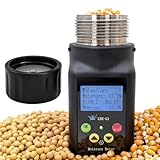
- AGRICULTURAL GRAIN CHECKS: This portable corn moisture tester and grain moisture meter supports on-farm reference checks for farmers, grain handlers, and grain or feed processors
- 25 CROP PROFILES: Select the matching profile for corn, wheat, soybeans, paddy rice, barley, oats, sorghum, and other supported crops before each measurement
- CONSISTENT SAMPLE PREPARATION: Use a representative sample, fill the clean and dry chamber evenly, and tighten the cap securely without overtightening for more consistent readings
- AUTOMATIC TEMPERATURE COMPENSATION: Built-in ATC adjusts the displayed result for sample temperature; for better consistency, let the meter and sample reach similar temperatures before testing
- USER-ADJUSTABLE CORRECTION: When a trusted reference method shows a consistent difference, use the correction setting to adjust the displayed value; the setting remains saved after power-off
Use condition information for what it can tell you
A grain moisture meter can help assess grain condition, but it does not predict prices or establish whether storage will be profitable. Storage economics still depend on local bids, carrying costs, and quality risk.
How to compare the three strategies
| Decision factor | Incremental sales | Forward cash contract | Sell now or store |
|---|---|---|---|
| Futures-price exposure | Remains on unsold grain until each sale. | Fixed for the contracted quantity under the agreed price terms. | Selling fixes the current cash value; storing leaves later value exposed to market movement. |
| Basis exposure | Depends on the cash price and basis when each portion is sold. | Depends on the contract’s stated price terms. | Current sale uses today’s local bid; stored grain remains exposed to future local basis. |
| Production and delivery obligation | No delivery obligation beyond each completed sale. | Contracted quantity and quality must be delivered as agreed. | Selling transfers grain now; storage requires maintaining grain condition until sale. |
| Storage and finance costs | Depends on when unsold grain is held and for how long. | May avoid storage for contracted grain, subject to delivery arrangements. | Must be calculated for the expected holding period, including interest and quality-related costs. |
| Potential upside retained | Remains on the unsold share. | Later price gains on contracted grain are generally not captured under fixed-price terms. | Stored grain may benefit from a higher later cash value, but gains are not assured. |
| Cash-flow timing | Can be spread across planned sales. | Depends on delivery and payment terms in the contract. | Harvest sale can bring proceeds sooner; storage delays the sale. |
Build the decision around your farm’s numbers
- Establish the production and cash-flow picture. Estimate expected production, identify any amount that should remain uncommitted until production is clearer, and note when the farm needs sale proceeds.
- Get local bids and written terms. Ask buyers for current cash bids, basis information, delivery windows, quality requirements, and contract fees. Current local prices and storage rates cannot be inferred from general seasonal guidance.
- Compare net outcomes, not headline prices. For a storage decision, subtract the full expected carrying cost from the later value you are considering. For a contract, weigh reduced price uncertainty against delivery risk and foregone upside.
- Set amounts and dates. Record the quantity assigned to each strategy, target prices or review dates, and the remaining unpriced quantity. Revisit the plan when production expectations, bids, or cash needs change.
Extension planning guidance supports using targets, deadlines, and smaller sales as tools for organizing decisions, not as guarantees of better returns (Missouri Extension; Delaware Extension).
Quick Recap
Best Value

- Professional Grain Moisture Meter: Quickly measure moisture (%), weight (g), density (g/L), and temperature (℃) of 20+ grains. Featuring a 3~35% moisture range, ±0.5% accuracy, and ≤0.2% repeatability, results are precise in just 10 seconds;
- Easy Calibration for Accurate Weighing: Use the 200g weight to quickly verify before each weighing. The simple calibration process guarantees precise, dependable results every time;
- Enhanced Temperature Compensation: This grain tester utilizes advanced variable frequency capacitive technology with automatic thermistor compensation for precise measurements during grain procurement and storage;
- Dual Power Options: Our Grain Moisture Meter can be powered by either 4 AA batteries or via USB plug, providing flexibility for short or long-term use whether you are on the go or need extended measurement sessions;
- Package Contents: 1 Grain Moisture Meter, 1 Portable Aluminum Case, 1 x 200g Calibration Weight, 4 AA Batteries, 1 Power Adapter, 1 Small Brush, 1 Chute Bucket, 1 Sampler;
Product prices and availability are accurate as of the date/time indicated and are subject to change. Any price and availability information displayed on Amazon at the time of purchase will apply.




