The best performance appraisal form is the one that matches the review’s purpose, timing and job. A form should organize evidence, ratings, employee comments and next steps; it cannot replace a candid review conversation. The samples below cover objective reviews, annual and quarterly cycles, self-appraisals, 360-degree feedback, promotion decisions and online workflows.
Providers change download links, file formats and registration requirements. Confirm current access, editing permissions and compatibility before adopting any template.


As an Amazon Associate I earn from qualifying purchases.
Performance appraisal form samples at a glance
This list counts distinct templates or purpose-specific variants, not separate Word, PDF or spreadsheet versions. Similar templates from different providers remain separate options because their fields and workflows may differ.
| # | Sample or template | Best for | Cadence or trigger | Format and useful fields |
|---|---|---|---|---|
| 1 | Acas objectives-based appraisal form | Employees with agreed objectives | Annual or objective checkpoint | Downloadable document; objectives, outcomes and discussion notes |
| 2 | Acas manual-workers appraisal form | Frontline and practical roles | Any scheduled review | Document form; observable duties and role-specific evidence |
| 3 | Acas promotion-potential form | Promotion or succession decisions | When advancement is being considered | Document form; suitability and potential, separate from current-performance scoring |
| 4 | Acas self-appraisal form | Employee preparation | Before a review meeting | Document form; employee’s account of achievements and issues |
| 5 | Acas appraisal-scheme feedback form | Improving the review process | After an appraisal cycle | Document form; feedback on the scheme itself |
| 6 | Smartsheet annual performance review | Full-year contribution reviews | Annual | Editable office or cloud document; strengths, development, goals, ratings and comments |
| 7 | Smartsheet quarterly review | Frequent goal tracking | Quarterly | Editable template; progress, obstacles, support and revised objectives |
| 8 | Smartsheet mid-year review | Course correction | Mid-year | Editable template; interim results, feedback and updated priorities |
| 9 | Smartsheet 360-degree review | Multi-rater feedback | Planned 360 cycle | Template category; input from manager, peers, direct reports or others |
| 10 | Smartsheet manager review | People managers | Annual or periodic | Editable template; leadership, team results and development actions |
| 11 | Smartsheet general employee review | Broad employee populations | Organization’s normal cycle | Editable template; goals, competencies, strengths and improvement areas |
| 12 | MIT narrative appraisal form | Evidence-rich discussions | Annual or scheduled review | Paragraph-based form; examples, accomplishments and expectations |
| 13 | MIT numerical appraisal form | Consistent category ratings | Annual or scheduled review | Rating-scale form; defined categories plus explanatory comments |
| 14 | AIHR general performance review | Standard employee reviews | Annual or periodic | Downloadable example; goals, competencies, feedback and action planning |
| 15 | AIHR manager performance review | Supervisors and managers | Annual or periodic | Downloadable example; leadership behaviors and team outcomes |
| 16 | AIHR 90-day review | New hires and probationary periods | First 90 days | Downloadable example; ramp-up, expectations, support and next goals |
| 17 | AIHR self-evaluation | Employee reflection | Before a review | Downloadable example; accomplishments, challenges and development needs |
| 18 | AIHR 360-degree template | Feedback from several perspectives | Dedicated 360 cycle | Downloadable example; rater observations and behavior-focused feedback |
| 19 | FirstHR annual review form | Year-end reviews | Annual | Downloadable example; performance, goals and comments |
| 20 | FirstHR quarterly review form | Short review cycles | Quarterly | Downloadable example; current progress and corrective actions |
| 21 | FirstHR 90-day form | Probation or onboarding | 90 days | Downloadable example; role fit, training and early objectives |
| 22 | FirstHR self-evaluation form | Employee-led preparation | Before a review | Downloadable example; self-reflection and evidence |
| 23 | FirstHR manager form | Manager assessments | Annual or periodic | Downloadable example; leadership and team-management criteria |
| 24 | FirstHR 360 form | Multi-source feedback | Dedicated 360 cycle | Downloadable example; comments from multiple rater groups |
| 25 | SHRM performance review form template | Organizations wanting a mainstream framework | Organization’s review cycle | Template; performance factors, comments and development discussion |
| 26 | Asana performance evaluation template | Goal-oriented teams | Annual or recurring | Template; objectives, accomplishments, feedback and future goals |
| 27 | Zoho Forms performance evaluation form | Teams collecting reviews online | Any configured cycle | Customizable online form; productivity, skills, feedback and documentation |
Choose a form by review purpose
Reviewing agreed objectives and results
Use an objectives-based form when the employee and manager set measurable work expectations at the start of the period. Record the objective, evidence of the result, context that affected delivery and the agreed next action. Acas’s objectives form is designed for this use.
#1 Best Overall
Assessing everyday performance in frontline roles
Manual, service and operational jobs often produce observable evidence rather than office-style project documents. Start with Acas’s manual-workers form, then replace generic competencies with safety, quality, customer, attendance or output standards that genuinely belong to the role.
Separating promotion potential from current performance
A strong performer is not automatically ready for a larger role. Use a promotion-potential form when the decision concerns future scope, readiness and development needs. Keep that assessment distinct from the routine review of the employee’s current job.
Rank #2

- Professional Employee Warning Notice Forms:Employee warning notice forms are designed for documenting employee behavior attendance violations and corrective actions helping supervisors and HR teams maintain clear and consistent workplace records
- Widely Applicable:This disciplinary action forms uses carbonless duplicate paper to instantly create copies without messy carbon sheets providing accurate documentation for both management and employees
- Standard Letter Size 8.5 x 11 Inch 50 Sets:Warning Notice Forms sized 8.5 x 11 inch for daily HR documentation and employee evaluation
- Organized Carbonless Duplicate Book with Numbers:Each carbonless duplicate book includes 50 Sets (100 Sheets) 2-part forms with red sequential numbers improving tracking organization and accountability for employee discipline and performance records
- Easy Use Forms with Writing Board:Employee warning notice forms feature top flip binding clean tear perforation and a built in backing board allowing smooth writing during meetings reviews or on site use
Preparing an employee self-appraisal
A self-appraisal gives the employee a structured account of achievements, obstacles and support needed. It should be completed before the meeting and discussed during it, rather than filed as a substitute for manager feedback. Acas, AIHR and FirstHR offer self-evaluation variants.
Recommended Free Tools
Running annual, mid-year and quarterly reviews
Annual forms can cover the complete period, strengths, development and next-year goals. Mid-year and quarterly forms should be shorter: focus on progress, changed priorities, resources and immediate support. Smartsheet, FirstHR and other collections provide variants for each cadence.
Rank #3
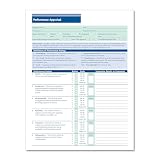
- HR & EMPLOYEE MANAGEMENT: Make employee performance evaluations easier, more efficient, and less stressful by using the Performance Appraisal Form by ComplyRight. Such a documentation process also helps employers validate employee promotions as well as protect the employer against potential termination disputes during a lawsuit.
- EMPLOYEE PERFORMANCE: Make the performance review process a more consistent, time-saving procedure. This employee evaluation form allows the employer to communicate their expectations easily and effectively, while providing the employees a tangible way to access their progress.
- APPRAISAL FORM: The performance evaluation form features an easy-to-understand 100-point rating scale that ranges from outstanding to unsatisfactory for 11 key performance factors, such as productivity, job knowledge, and creativity. It has a large comments section to provide a detailed explanation to employees to support their performance ratings.
- PACKAGING/DIMENSIONS: Rated as "Excellent" by HR professionals, this employee performance appraisal form measures 8-1/2” wide and 11” long and is sold in a pack of 50 sheets. It also includes a ComplyRight tips sheet for optimal, compliant use.
- COMPLYRIGHT: At ComplyRight, our mission is to free employers from the burden of tracking and complying with the complex web of federal, state, and local employment laws. ComplyRight is the market leader in government-compliant products such as tax forms, tax software, HR products and services, labor law solutions, and health insurance claim forms.
Collecting 360-degree feedback
A 360 form gathers observations from several perspectives, such as a manager, peers and direct reports. Define the purpose first—development, coaching or a specific capability review—and explain confidentiality and how comments will be used. Do not combine anonymous comments and high-stakes pay decisions without a clear policy.
Narrative, numerical or blended forms?
MIT Human Resources distinguishes paragraph-based assessments from forms that assign ratings to categories. Narrative forms preserve context and examples; numerical scales make comparisons easier but can create false precision. A blended form usually works well: use a clearly defined scale for required categories and require an example or comment for each material rating.
Rank #4
- Professional Employee Warning Notice Forms:Employee warning notice forms are designed for documenting employee behavior attendance violations and corrective actions helping supervisors and HR teams maintain clear and consistent workplace records
- Carbonless Performance Appraisal Form System:This performance appraisal form uses carbonless duplicate paper to instantly create copies without messy carbon sheets providing accurate documentation for both management and employees
- Standard Employee Discipline Action Sheet Size:Employee discipline action sheet measures eight point five by eleven inches standard US letter size making it easy to file copy and store in office folders binders and cabinets
- Organized Carbonless Duplicate Book with Numbers:Each carbonless duplicate book includes 50 Sets (100 Sheets) 2-part forms with red sequential numbers improving tracking organization and accountability for employee discipline and performance records
- Easy Use HR Forms with Writing Board:Employee warning notice forms feature top flip binding clean tear perforation and a built in backing board allowing smooth writing during meetings reviews or on site use
Whichever approach you choose, use the same form for employees in the same job category within a department or area. Define what each rating means in observable terms, and train managers to apply the scale consistently.
Fields every useful appraisal form should capture
- Review context: employee name, role, department, reviewer and the period covered.
- Expectations: current job description, objectives and role-specific standards.
- Evidence: accomplishments, work products, outcomes and specific examples.
- Criteria: job-relevant competencies or behaviors, with definitions for any numerical ratings.
- Employee voice: self-reflection, comments, obstacles and requested support.
- Development: improvement priorities, learning actions, resources and owners.
- Next period: performance goals, development goals, milestones and check-in dates.
- Recordkeeping: discussion date, acknowledgments and any required HR routing.
How to adapt a template safely
- Start with the role. Review the current job description and remove criteria the employee cannot reasonably control.
- Set the purpose and cadence. Select annual, quarterly, 90-day, self-appraisal, 360 or promotion fields before editing wording.
- Define evidence standards. Tell reviewers to cite dates, outputs, customer results or other verifiable examples.
- Explain ratings. Write behavioral definitions for each level and test them with managers before rollout.
- Add follow-through. Include goals, support, owners and dates; a score without an action plan rarely changes performance.
- Pilot and standardize. Test the form with one job group, fix ambiguous fields and then use one consistent version for comparable roles.
- Check access and privacy. Confirm download permissions, editing compatibility, retention rules and who can view submitted feedback.
Common mistakes to avoid
- Using office-oriented competency language for manual or frontline work.
- Mixing promotion potential into a routine rating without explaining the separate decision.
- Making employees sign a form and treating the signature or score as proof of a meaningful conversation.
- Collecting 360 feedback without a defined purpose, rater guidance or a plan for sensitive comments.
- Forcing managers to complete every field when a shorter check-in would better fit a quarterly cycle.
- Changing rating definitions between departments, which makes scores impossible to interpret fairly.
When an online workflow is worth considering
A printable or editable document is often sufficient for a small team. An online workflow becomes more useful when you need reminders, permissions, multiple raters, searchable records or consistent reporting. Zoho Forms provides a customizable online performance-evaluation workflow with fields for productivity, skills, feedback and documentation. Treat it as a collection service, not as a replacement for your organization’s criteria or review conversation.
Final selection checklist
- Does the form match the decision: current performance, development, promotion or multi-rater feedback?
- Is the cadence appropriate for the amount of evidence available?
- Are criteria specific to the employee’s role and level?
- Can the reviewer cite concrete examples rather than impressions?
- Does the employee have space to respond?
- Are goals, support and dates recorded for the next period?
- Will comparable employees use the same rating definitions?
- Can your team access, edit, store and retrieve the form securely?
Frequently Asked Questions
Should every employee use the same performance appraisal form?
Employees in the same job category should generally use the same core form and rating definitions. Add role-specific criteria or separate variants for materially different work, such as frontline operations and people management.
Is a numerical rating better than written feedback?
Neither is universally better. Numerical scales support consistency when definitions are clear, while narrative comments provide context. A blended form that pairs ratings with specific examples is often the most practical choice.
Can a signed appraisal form replace the review meeting?
No. A signature records acknowledgment or receipt, not agreement or proof that a useful discussion occurred. The manager and employee still need to discuss evidence, expectations and next steps.
Quick Recap
Product prices and availability are accurate as of the date/time indicated and are subject to change. Any price and availability information displayed on Amazon at the time of purchase will apply.




