Quick wins for a faster PC:
Scan for outdated or missing drivers - takes under a minuteDriver Scan →Repair Windows errors before they cause bigger problemsFix Now →Fix the driver behind crashes, sound loss and screen glitchesFind Drivers →What is often called “yuan devaluation” is usually a depreciation: a market-driven fall in the renminbi’s value. In strict usage, devaluation means an official lowering of a currency’s value under a fixed or managed parity. China has a managed floating exchange-rate framework, so the distinction matters: weakening does not by itself mean officials have reset the exchange rate.
How China’s exchange-rate system works
The People’s Bank of China (PBOC) describes the framework as a managed float based on market supply and demand, with reference to a basket of currencies. Its stated approach gives markets influence over exchange-rate formation while allowing policy guidance of expectations and action to avoid overshooting. The yuan is therefore neither freely floating nor rigidly pegged to the U.S. dollar. In a 2010 statement, the PBOC said: “Starting from July 21, 2005, China has moved into a managed floating exchange rate regime based on market supply and demand with reference to a basket of currencies.” PBOC, June 19, 2010.
The term “yuan” commonly refers to the renminbi (RMB), China’s currency. Exchange-rate discussions may focus on the bilateral rate against the U.S. dollar or on broader indexes measuring the RMB against a basket. Those measures can move differently: the RMB might weaken against the dollar while moving less against a basket, for example, if other currencies also weaken against the dollar.
Why the yuan can weaken
There is rarely one cause behind a currency move. Market expectations, policy choices, trade and capital flows, and movements in other currencies can interact, and their relative importance changes over time.
#1 Best Overall
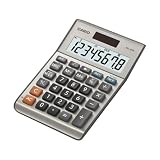
- LARGE EIGHT-DIGIT DISPLAY – Clear and easy-to-read 8-digit display, perfect for everyday calculations and ensuring accurate results in home or office settings.
- TAX & CURRENCY EXCHANGE FUNCTIONS – Effortlessly handle tax calculations and convert home currency to other currencies for easy financial management.
- GENERAL PURPOSE CALCULATOR – Ideal for a wide range of applications, from basic math to business and personal use, with memory keys for quick storage and recall.
- USER-FRIENDLY KEYBOARD – Easy-to-use layout, featuring square root, percent calculation, and simple functions that make it perfect for everyday tasks.
- COMPACT & PORTABLE DESIGN – Space-saving design that fits easily on any desk or in a briefcase, making it ideal for both home and office use.
Interest rates and monetary policy
When returns on yuan assets look less attractive relative to returns elsewhere, investors may have greater incentive to hold foreign-currency assets. Interest-rate differences can influence cross-border flows and exchange-rate expectations, but they do not mechanically determine the exchange rate: investors also weigh risk, expected returns, policy signals, and other factors.
Growth, demand, and inflation
Slower growth, weak domestic demand, or low inflation can shape expectations about China’s economy and affect the currency. Prices matter as well as the nominal exchange rate. If Chinese prices rise more slowly than prices among trading partners, the RMB can depreciate in real terms even when nominal exchange-rate movements are smaller. The IMF has linked China’s relatively low inflation with real exchange-rate depreciation and stronger exports. IMF, 2025 Article IV consultation.
Trade, capital flows, and confidence
Trade and current-account balances influence the supply of and demand for foreign currency. Capital flows can add pressure or offset it, while confidence in economic conditions and policy can affect whether investors and businesses prefer to hold yuan or foreign currency. A large trade surplus alone does not fix the exchange rate: financial flows, expectations, and policy also matter.
Rank #2

- Ad Free
- Online Currency Exchange Calculator
- 33 Currencies available in the Exchange Calculator
The U.S. dollar, other currencies, and policy signals
A broad move in the U.S. dollar can change the RMB’s bilateral value against the dollar and its value against a basket in different ways. The currencies of China’s trading partners also matter to basket measures. In China’s managed system, the PBOC’s fixing and communication about expectations can influence the exchange-rate path, but they operate alongside market supply and demand.
What’s actually slowing this PC down?
Pick the symptom - the matching free tool is one click away.
The IMF reported substantial CNY depreciation pressure from November 2024 through May 2025, followed by an easing of that pressure after May trade talks. That chronology describes a period of pressure and subsequent easing; it does not establish a single cause for every currency move. IMF, report on the 2025 Article IV consultation, 2026.
What a weaker yuan can mean for households and businesses
The consequences depend on who is exposed, how prices are set, and how quickly contracts adjust. A currency move does not affect every household or company in the same way.
Rank #3

- Check your calculations thanks to the calculator's inbuilt serial impact roller printer that enables you to monitor your inputs and retains ongoing records. This two-color printer with a four-key memory prints red and black ink at up to 2.3 lines per second onto the included roll of paper.
- Printing calculator offers 12-digit LCD display for convenient viewing. 4-key memory keeps often-used figures accessible for faster calculations. Clock and calendar functions help maintain schedules.
- Easy-to-use solution for all of your basic math needs. Streamline financial calculations with currency conversion, tax calculation, and item counter functions. 1-year manufacturer limited warranty.
- Dimensions: 2.2"H x 6.4"W x 9.1"D. Package content: AC adapter, paper roll, user manual.
- Powered by any standard AC outlet, eliminating the need for expensive batteries. Decimal switch, rounding switch, percent, sign change, backspace, double zero, and grand total functions help you solve a variety of mathematical problems.
Exporters may gain price competitiveness
If exporters pass a weaker yuan through to foreign-currency prices, their goods may become less expensive for overseas buyers, potentially supporting export volumes. The benefit depends on pricing decisions, contracts, imported inputs, and buyer demand. The IMF connected real depreciation with stronger exports, while warning that relying on exports is less viable as a way to sustain robust growth and can worsen external imbalances. In its 2025 consultation, the IMF projected a Chinese current-account surplus of 3.3% of GDP for 2025; that was a projection, not a final national-accounts result. IMF, 2025 Article IV consultation.
Imported goods and inputs can cost more
A weaker yuan can raise the domestic-currency cost of imported goods and production inputs. Households may face higher prices for some imported products, while businesses that depend on foreign materials or equipment may see costs rise. How much of a currency move reaches buyers depends on invoicing, existing contracts, hedging, pricing choices, and demand.
Outdated Drivers Are Slowing You Down
One free scan finds every outdated or missing driver and matches the right update for your exact hardware.Free scan · exact hardware matchPC Slower Than It Used to Be?
A free scan shows the junk files, broken settings and background clutter dragging Windows down - then fixes them in one click.Free scan · Windows 10 & 11Foreign-currency debt can become more burdensome
For a borrower earning yuan but owing dollars or another foreign currency, depreciation increases the yuan value of that liability if it is not hedged. The effect varies with the borrower’s currency revenues, debt terms, and hedging arrangements. It should not be assumed that every Chinese company or household has the same exposure.
Rank #4

- Dual power ways: Solar power or 1 AA battery (Battery Included) , energy saving and convenient.
- Adopt Japanese LCD screen, 12 digits, display data clearly.
- Support +/-(negative),%,√ calculation; Rounding off & decimal place setting; CE/C (part/all clear), MC/MR/M+/M- (memory) key.
- Auto shut-down in 8min if no further operation.
- Big ABS plastic button, offer accurate positioning and comfortable texture, support >1 million times press.
Inflation, adjustment, and financial conditions
Depreciation can support adjustment when domestic prices are weak, but a rapid or disorderly fall may unsettle confidence and financial conditions. In its 2024 Article IV analysis, IMF staff argued that greater exchange-rate flexibility could help absorb external shocks and counter disinflationary pressures. This is a policy assessment, not a guarantee about the effect of any single exchange-rate move. IMF, 2024 Article IV consultation.
Independent reader supportYour contribution helps us test, update, and keep practical guides available for everyone.What recent figures say—and what they do not
The available figures below describe reported conditions in 2025. They are not live exchange rates or forecasts for October 2026.
| Measure | Reported figure | What it refers to |
|---|---|---|
| CFETS RMB Exchange Rate Index | 96.77 at end-September 2025 | The PBOC said the index was down 4.63% from end-2024. It also described the RMB’s first-three-quarter movements against a basket as two-way and the exchange rate as basically stable. PBOC, 2025 |
| Nominal effective exchange rate | 1.0% lower through October 2025 than its 2024 average | An IMF observation in its 2026 report on the 2025 Article IV consultation; it is not a spot-rate quote. IMF, 2026 |
| Real effective exchange rate | 3.7% lower through October 2025 than its 2024 average | An IMF observation that reflects, in part, lower inflation in China than in trading partners. IMF, 2026 |
| Current-account surplus | 3.3% of GDP projected for 2025 | An IMF projection in its 2025 consultation, not a final reported national-accounts outcome. IMF, 2025 |
The basket index, nominal effective exchange rate, and real effective exchange rate are different measures, so their figures should not be treated as interchangeable. Nor do the reported numbers alone show what caused a particular move or what will happen next.
How to think about different exchange-rate paths
A market-led depreciation, an official policy reset, and relative stability would have different implications. The outcome would depend on speed, predictability, pass-through into prices, investor response, and conditions in China and abroad; the comparison below is analytical, not a prediction.
| Possible path | Potential trade-off |
|---|---|
| Market-led depreciation | A gradual, predictable move may give exporters and importers time to adjust. A sharp move could raise import costs quickly or unsettle confidence; the effect on inflation and monetary-policy room would depend on price pass-through and broader conditions. |
| Official policy reset | A clear reset could alter expectations abruptly. Its consequences would depend on how it was communicated, whether markets saw it as orderly, and how trading partners and investors responded. |
| Relative stability | Stability can reduce uncertainty for firms with cross-border costs or revenues, but it does not remove pressure from differences in inflation, interest rates, trade, or capital flows. Policy choices to maintain stability can also shape the room available for other objectives. |
For all three paths, potential spillovers to trading partners and external imbalances matter. A more competitive exchange rate may support exports, but the IMF’s assessment is that export reliance is a less viable route to sustained robust growth.
Quick Recap
Product prices and availability are accurate as of the date/time indicated and are subject to change. Any price and availability information displayed on Amazon at the time of purchase will apply.




