What’s actually slowing this PC down?
Pick the symptom - the matching free tool is one click away.
Qualcomm’s acquisition of Arduino is more than a move into maker hardware: it gives the chipmaker a familiar route from classroom experiments and prototypes to its industrial edge-AI platform. The first clear example is the Arduino UNO Q, which pairs a Qualcomm Linux-capable processor with a separate real-time microcontroller. The strategy could broaden access to Qualcomm technology, but it also raises a harder question: can Arduino preserve its open, multi-vendor identity while becoming part of a Qualcomm-centered commercial ecosystem?
What Qualcomm’s Arduino deal means
Qualcomm Technologies announced an agreement to acquire Arduino on October 7, 2025, presenting the deal as a way to widen developer access to its computing, AI, connectivity and industrial-IoT technologies. Arduino’s current FAQ describes the company as part of the Qualcomm family, and Qualcomm later referred to the acquisition as completed. The companies did not disclose the purchase price in the cited announcement. Qualcomm’s announcement · Arduino’s acquisition FAQ · Qualcomm’s 2026 industrial-IoT release
Arduino says it will keep its independent brand, mission, tools and support for hardware from multiple semiconductor vendors. That makes the deal different from simply replacing Arduino’s existing boards with Qualcomm chips. Its commercial logic is broader: Qualcomm gains a recognized development environment and community, while Arduino gains a route to more capable silicon and a larger industrial technology portfolio.
Qualcomm has said Arduino’s community includes more than 33 million active users. That is Qualcomm’s figure, not an independently audited count. The audience matters because it spans students, educators, hobbyists, prototypers, startups and embedded developers—people who may encounter a Qualcomm platform through a board and familiar tools long before they work on an industrial product.
Quick wins for a faster PC:
Scan for outdated or missing drivers - takes under a minuteDriver Scan →Repair Windows errors before they cause bigger problemsFix Now →#1 Best Overall
![Arduino Uno REV3 [A000066] - ATmega328P Microcontroller, 16MHz, 14 Digital I/O Pins, 6 Analog Inputs, 32KB Flash, USB Connectivity, Compatible with Arduino IDE for DIY Projects and Prototyping](https://m.media-amazon.com/images/I/515P6aYSP4L._SL160_.jpg)
- ATmega328P Microcontroller: Powered by the reliable ATmega328P, running at 16 MHz with 32KB of flash memory, 2KB SRAM, and 1KB EEPROM, offering ample resources for a wide range of basic to advanced electronics projects.
- 14 Digital I/O Pins & 6 Analog Inputs: Features 14 digital I/O pins (6 of which support PWM output) and 6 analog inputs (10-bit resolution), providing flexible options for sensors, motors, and other external components.
- USB Connectivity for Easy Programming: The built-in USB port allows for direct programming and serial communication, enabling a simple connection to your computer for sketch uploading and debugging through the Arduino IDE.
- Compatible with Arduino IDE: Full compatibility with the Arduino IDE ensures easy access to a vast array of libraries, code examples, and community-driven projects, making the Uno a great choice for both beginners and experienced makers.
- Widely Used in Education & Prototyping: The Arduino Uno is a standard in educational environments, widely used for learning and teaching electronics and programming. It's perfect for prototyping, robotics, IoT projects, and more.
Why Arduino is useful to Qualcomm
Qualcomm has long sold advanced processors and connectivity technology into markets where manufacturers, device makers and specialist engineering teams make the buying decisions. Those capabilities can be difficult for a newcomer to explore. Arduino offers a lower-friction entry point: boards, libraries, examples, documentation and a large developer community.
That creates a potential path from experimentation to commercial use. A developer can test an idea on accessible hardware, then consider a more capable Dragonwing platform or Qualcomm’s other deployment tools if the project needs to scale. Qualcomm’s wider strategy also includes Edge Impulse, for embedded AI development, and Foundries.io, for embedded Linux deployment and device lifecycle management. Qualcomm frames the combination as a route from prototype to deployment; that is a strategic ambition, not evidence that any Arduino project can move directly into production.
In effect, Arduino can serve as distribution for a developer ecosystem as well as a hardware business. It helps make Qualcomm’s edge-computing portfolio tangible through familiar tools and projects. Whether that translates into durable commercial adoption depends on the quality of the software, documentation, supply and support—not just the reach of the Arduino name.
UNO Q shows what changes technically
The UNO Q, introduced alongside the acquisition announcement, is not a conventional low-power Arduino board. It combines a Qualcomm Dragonwing QRB2210 application processor with an STMicroelectronics STM32U585 microcontroller. The division of labor is central: the QRB2210 runs Debian Linux for higher-level applications, while the MCU runs Arduino code on Zephyr OS for timing-sensitive work such as reading inputs and controlling peripherals. Arduino UNO Q documentation · UNO Q datasheet
Rank #2
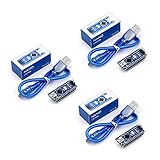
- Original ATmega328P CH340 chip is used. Improved new version CH340G Replace FT232RL.
- LAFVIN Nano V3.0 card is 100% compatible with the Nano card, and fully compatible with Windows, Mac and Linux operating system.
- Works the same as original Nano, runs perfectly on programming software.
- Using Atmel Atmega328P-AU MCU, Support ISP download; Support USB download and Power.
- LAFVIN Nano CH340 controller is a compact board similar to the R3 board, smaller and breadboard-friendly than Diecimila.
| Part | UNO Q specification | What it is for |
|---|---|---|
| Application processor | Qualcomm Dragonwing QRB2210; four Arm Cortex-A53 cores, up to 2.0 GHz; Adreno 702 GPU | Linux applications, networking, user interfaces and higher-level processing. These specifications do not establish how quickly any particular AI model will run. |
| Real-time microcontroller | STMicroelectronics STM32U585; Arm Cortex-M33, up to 160 MHz; 2 MB flash and 786 KB SRAM | Arduino firmware and more predictable control of sensors, GPIO and actuators. |
| Memory and storage options | 2 GB LPDDR4X RAM with 16 GB eMMC, or 4 GB LPDDR4X RAM with 32 GB eMMC | The larger configuration gives Linux more room for concurrent services, camera streams and larger workloads; it does not guarantee that a given model will fit or perform well. |
| Operating systems | Debian Linux on the application processor; Arduino Core on Zephyr OS on the MCU | Two computing environments on one board, with separate roles and software considerations. |
The processor also supports camera, audio, display, USB and MIPI interfaces. The board’s architecture lets developers combine Python or Linux applications with Arduino firmware, rather than asking a single microcontroller to do everything. But Linux is not, by itself, a hard-real-time operating system: timing-critical motor or safety-related control should be designed around the MCU and validated for the application.
Arduino’s January 2026 announcement added the 4 GB/32 GB version to the lineup. Arduino’s guidance positions it for more demanding multitasking and standalone Linux use, while the 2 GB version targets lighter projects. Those are vendor recommendations, not universal performance guarantees. Arduino’s 4 GB UNO Q announcement
How App Lab fits into the software strategy
Arduino App Lab is presented as an integrated environment for combining Arduino sketches, Python applications, Linux-side software, AI models and modular components called Bricks. It is designed to help coordinate work across the UNO Q’s processor and MCU, with Edge Impulse integration included in Qualcomm and Arduino’s stated edge-AI workflow.
- Gather data: collect or provide sensor, audio or image inputs for the intended application.
- Put control where it belongs: write MCU firmware for peripheral handling and timing-sensitive behavior.
- Build the higher-level application: use Python or other Linux software on the QRB2210 for networking, interfaces and broader processing.
- Add an AI task: use App Lab, Edge Impulse or other supported tools to develop and integrate a model, checking its runtime and hardware requirements.
- Prototype locally, then plan deployment separately: test the complete device behavior on the board. If it is to become a product, address updates, security, support and fleet operations as their own engineering work.
App Lab is not a replacement for the full Arduino toolchain. Arduino says UNO Q remains compatible with Arduino IDE and Arduino CLI; App Lab adds an integrated route for combining Linux, Python, Arduino and AI workflows. Arduino UNO Q getting-started page
Outdated Drivers Are Slowing You Down
One free scan finds every outdated or missing driver and matches the right update for your exact hardware.Free scan · exact hardware matchPC Slower Than It Used to Be?
A free scan shows the junk files, broken settings and background clutter dragging Windows down - then fixes them in one click.Free scan · Windows 10 & 11Rank #3

- Powerful: The Arduino Nano V3.0 Board Microcontroller Built with ATmega328P and CH340 chips instead of FT232, Improved new version CH340G Replace FT232RL, making it ideal for beginners
- Seamless Compatibility: Fully compatible with Arduino Nano, supporting Arduino IDE, ISP programming and USB download. Works seamlessly with Windows, Mac, and Linux operating systems for a hassle-free experience.
- Versatile I/O & Compact Design: Features 14 digital I/O pins (6 PWM outputs), 6 analog inputs, a 16MHz quartz oscillator, USB-C power socket, ICSP port, and reset button. Its compact, breadboard-friendly design ensures easy handling and integration.
- Flexible Power Supply Options: Supports multiple power sources, including USB-C, 6-12V unregulated external power, or 5V regulated external power. The Nano board intelligently switches to the higher voltage source automatically—no jumper selection required.
- Excellent Communication Capabilities: Designed for seamless communication with PCs and arduino microcontrollers, the Nano board is fully compatible with multiple operating systems and offers stable and reliable performance for a variety of projects.
Qualcomm’s broader developer stack also includes Qualcomm AI Hub, which offers a Qualcomm-targeted model and optimization workflow, and Foundries.io for embedded Linux deployment and fleet management. These services may be useful for teams targeting Qualcomm hardware or managing devices at scale, but their existence does not make App Lab or UNO Q a turnkey production system. Teams should confirm current terms, capabilities and pricing directly with the providers before making a commercial decision. Qualcomm AI Hub · Foundries.io · Edge Impulse
Why edge AI is attractive—and what a prototype does not prove
Edge AI means processing some data on or near the device instead of sending every input to a remote cloud service. For vision, audio, robotics and industrial monitoring, local inference can reduce response time, limit bandwidth use, improve privacy for some workloads and keep functions available when connectivity is intermittent.
Those benefits come with engineering trade-offs. Models may need quantization, conversion or redesign to fit the board’s memory and processing resources. Sustained video or AI workloads can behave differently from short demonstrations because of power and thermal limits. Local inference also does not eliminate the need to secure a device, manage model and software updates, handle telemetry or plan for intermittent connectivity.
A development board can demonstrate inference without establishing that it is suitable for a production fleet. Commercial deployment may require validated boot and update processes, regulatory compliance, a reliable component supply, long-term software support and operational tooling. The UNO Q is a prototyping platform; Qualcomm’s claimed path toward production should be evaluated against the requirements of the specific product.
Rank #4

- START CODING WITH THE ELEGOO UNO R3: Connect the included USB cable, upload your first sketch, and build sensor, motor, display, and automation projects, making it a practical controller for maker desks, classrooms, coding clubs, and robotics labs
- ATMEGA328P CORE FOR EVERYDAY PROJECTS: A 16 MHz clock, 32 KB flash, 14 digital I/O pins with 6 PWM outputs and 6 analog inputs provide a versatile foundation for LEDs, buttons, relays, servos, displays and sensors
- RELIABLE USB PROGRAMMING AND CLEAR WIRING: The ATmega16U2 USB interface supports sketch uploads and serial communication, while clearly labeled headers help simplify connections to jumper wires, shields and modules
- POWER AND EXPAND YOUR WAY: Run the board from USB or a recommended 7-12 V external supply, then add compatible shields and modules for data logging, automation, robotics, test fixtures and custom electronics projects
- BOARD AND USB CABLE INCLUDED: Comes with 1 ELEGOO UNO R3 development board and 1 USB-A to USB-B data cable; breadboard, sensors, shields and power adapter are not included, and younger learners should work with an experienced adult
What “open source” means after the acquisition
Arduino says its open-source approach continues. Its FAQ says the Arduino IDE, hardware schematics, tooling and libraries released under open-source licenses remain available, and the company says it will continue supporting multiple semiconductor vendors. These commitments matter to existing users and to developers concerned that ownership could narrow Arduino’s ecosystem. Arduino’s FAQ on Qualcomm ownership
That does not make every part of the UNO Q or Qualcomm’s wider platform open source. The Dragonwing SoC is proprietary, and the processor’s GPU, image-processing and AI components, firmware, binary drivers and vendor-specific software may include proprietary elements. Open board schematics also do not guarantee that a board can be reproduced if key components are unavailable or their documentation is restricted. Likewise, an open-source IDE does not make every model repository, cloud service or deployment platform open source.
For a project with strict openness or portability requirements, check the license and access terms for each layer: board design files, operating system, kernel and drivers, firmware, libraries, AI models and deployment services. Arduino’s stated continuity is meaningful, but it is not a blanket guarantee that Qualcomm-specific components can be independently modified or replaced.
Independent reader supportYour contribution helps us test, update, and keep practical guides available for everyone.Which developers are likely to benefit?
UNO Q is a fit for Linux plus hardware control
- Projects that need Linux and a separate MCU for predictable peripheral control.
- Developers who want to combine Python, Arduino code, networking and local vision or audio processing.
- Robotics or interactive projects that need a camera, display or networked application alongside direct hardware control.
- Prototypes where a compact combination of single-board-computer functions and microcontroller control is useful.
A conventional Arduino is better for simpler electronics
For basic sensors, LEDs, relays, simple actuators, low-power operation or beginner electronics, a conventional microcontroller board such as the Arduino UNO R4 WiFi may be simpler and more suitable. Adding Linux, storage and a second processor can be unnecessary cost and complexity when the project does not need them. Arduino UNO R4 WiFi
Best Value

- Maximum performance: the Pro micro microcontroller development board runs at 5 V/16 MHz and supported by IDE V1.0.1 for smooth programming. Suitable for Arduino.
- Versatile connections: Pro micro with 4 x 10-bit ADC pins, 12 x digital I/Os and serial Rx and Tx hardware connections, you have all the ports you need.
- Easy programming: Pro micro simply connect the motherboard to the on-board micro USB port and program it. If it is not detected, just install the driver.
- Multifunctional I/O: Pro micro there are 54 digital input/output pins available, including analogue inputs/outputs, as well as interfaces such as PWM, SPI, I2C etc., which offer a wealth of hardware connection options.
- Good compatibility: the seamless integration with the Arduino IDE and the extensive development tools and libraries ensure a smooth learning curve and make it a good choice for beginners.
A general-purpose SBC may suit Linux-first work
A Raspberry Pi-class computer may be preferable when a broad general-purpose Linux ecosystem, existing software, accessories or tutorials matter more than Arduino integration. A conventional SBC may not provide UNO Q’s integrated Arduino-oriented real-time MCU, so precise peripheral control can require a separate microcontroller. Raspberry Pi
Choose an MCU-only board when Linux adds no value
For battery-powered sensor nodes, lightweight firmware, predictable control or cost-sensitive devices without camera, audio, Python or local AI needs, an ESP32, STM32 or other microcontroller platform may be the more efficient choice. Edge Impulse can also be considered separately from UNO Q; its role as an embedded model-development platform is not, by itself, a reason to choose a particular board.
Costs and practical trade-offs
Arduino announced price increases effective July 6, 2026, attributing them to rising memory-component costs. Its listed U.S.-dollar prices after that date were $59 for the 2 GB UNO Q and $79 for the 4 GB model. Those are U.S. prices and may differ by region, tax, shipping, stock or reseller; check the current listing before purchase. Arduino’s pricing announcement · Arduino’s U.S. 4 GB product page
The 4 GB configuration costs more but offers additional RAM and eMMC storage for more concurrent Linux services or local data. It is not automatically the right choice for every AI application: model compatibility, accelerator support, memory use, power and thermal behavior still need to be checked. The 2 GB version may be adequate for lighter workloads, but selecting it solely on price can constrain Linux applications that need more memory.
UNO Q also has a steeper learning curve than a classic Arduino. Developers must understand two processors, two software environments, Linux storage and networking, communication between the processors, and the division between high-level software and real-time control. For a first electronics project, that complexity can obscure the fundamentals.
The main risks for Qualcomm, Arduino and developers
- Platform dependence: App Lab, optimized models and deployment tools may make Qualcomm-specific workflows convenient, but can also make later hardware changes more difficult. Multi-vendor Arduino support is a stated commitment; the practical degree of portability depends on each project’s dependencies.
- Community trust: Arduino’s value rests partly on openness and vendor neutrality. Developers will judge the acquisition by how the company handles documentation, tool access and support when community priorities differ from Qualcomm’s commercial interests.
- Driver and maintenance quality: Debian support does not, on its own, establish that every driver, firmware component or board feature is open, upstreamed or maintainable over a product’s lifetime. Those details need to be evaluated for the relevant use case.
- Model and workload limits: A model demonstrated on one configuration may not fit or run acceptably on another. Camera bandwidth, accelerator support, RAM and sustained thermals all matter.
- Supply and lifecycle exposure: Proprietary silicon can create component availability and lifecycle risks even when board design files are published. Commercial product teams should assess sourcing and support horizons before relying on a development board.
- Price and scope creep: A more capable board can encourage teams to add Linux and AI where a simpler MCU would meet the requirement at lower cost and power.
What to watch as the strategy develops
The key test is whether Qualcomm can expand Arduino’s reach without making Arduino’s tools and community feel like a funnel into a single-vendor stack. Useful indicators include future support for non-Qualcomm processors, the openness and documentation of board software, the depth of App Lab’s offline and standard-toolchain workflows, and the quality of long-term support.
For businesses, the consequential signals are less about AI demonstrations than about deployment: how well Edge Impulse and AI Hub integrate with real projects, whether Foundries.io or other tools can manage updates securely, what support terms are available, and whether components remain available for the expected product life. Those details will determine whether UNO Q is mainly an accessible prototype board or a credible first step in a broader commercial pipeline.
Quick Recap
Product prices and availability are accurate as of the date/time indicated and are subject to change. Any price and availability information displayed on Amazon at the time of purchase will apply.
Free tools Windows power users keep installed
One-click scans. No signup required.




