Recommended Free Tools
Yes—the pressure on removable storage is real, but it does not mean every USB drive or memory card has risen by the same amount. NAND Flash, the storage technology inside these products, is in a tight market as AI and data-center buyers compete for supply. That upstream squeeze is reaching consumer products unevenly: old inventory and discounts can keep some prices down, while replenishment costs push others higher.
What has actually become more expensive?
The strongest evidence is upstream, not a universal price index for the products on store shelves. NAND chip and wafer prices feed into manufacturers’ contract prices, then module makers’ costs, brand pricing and, eventually, retail transaction prices. Those are different stages: a forecast for contract prices does not mean a particular SD card’s checkout price will rise by the same percentage.
TrendForce forecast NAND Flash contract prices to rise 70–75% quarter over quarter in Q2 2026, citing AI-server demand and constrained supply (TrendForce, March 31, 2026). In July, it said the market remained undersupplied through 2026. TrendForce’s Q3 forecast was a slower 10–15% quarterly increase, not a return to falling prices (Tom’s Hardware, July 2026).
Retail products can lag those changes by weeks or months. A seller may still have stock bought at earlier costs, absorb some of a supplier increase, discount an older model or let a promotion expire. Higher costs may also prompt a brand to change the product mix rather than raise every price. Recent reporting describes weak consumer demand for USB drives and memory cards as higher costs make price increases harder to pass on (Tom’s Hardware, July 2026).
Free tools Windows power users keep installed
One-click scans. No signup required.
#1 Best Overall

- Full-size SD card, 64GB SDXC flash memory card 2 pack. Not compatible with mobile phones due to physical dimensions
- Class 10 speed rating ensures even and sustained video recording performance for 4K UHD and full HD videos.
- SDXC card Read speed: 60MB/s, Write speed: 10MB/s, allowing quick picture shooting and file transfer
- USB 3.0 flash drive with minimum read speed up to 70MB/s. Backward-compatible with USB 2.0 and transfer much faster
- Gum size usb flash drive with 64GB capacity meets your daily needs in work, school, at home and while travelling. Digital storage for photos, music, videos, files and data transfer.
Samsung’s US listings illustrate why snapshots need context, not what the whole market costs. Prices observed in August 2026 included $39.99 for a 128GB USB Type-C drive, shown out of stock, and $79.99 for a 256GB USB Type-C drive. Its BAR Plus listing showed $31.99 for 64GB, $39.99 for 128GB, $79.99 for 256GB and $145.99 for 512GB. These are manufacturer-listed prices, not a market average or proof of how much any one model has risen (Samsung 128GB Type-C listing; Samsung 256GB Type-C listing; Samsung BAR Plus listing).
Capacity, NAND type, controller, performance rating, endurance, warranty, bundled reader and retailer inventory all affect price. A 1TB card or professional UHS-II card is not a like-for-like comparison with a basic 64GB card. Nor is a current shelf price directly comparable to an old promotional price or manufacturer MSRP.
How AI demand reaches a USB stick or SD card
AI systems do not generally use consumer SD cards as their storage. Data centers instead buy high-capacity enterprise SSDs and high-performance memory and storage configurations for datasets, checkpoints, inference and data pipelines. The connection to removable storage is indirect: suppliers allocate investment, production capacity and attention among products with different costs and margins.
Rank #2
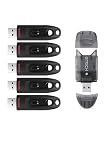
- 5 Pack SanDisk Ultra USB 3.0 32 GB thumb drives
- Comes with (1) eTECH Memory Card Reader
- Easy-to-use password protection for your private files
- Plug and Play, No Driver Needed
- Backward compatible with USB 2.0
- Data-center customers place large orders for enterprise storage and memory.
- Suppliers prioritize products with stronger demand and higher returns, while existing fabrication capacity is constrained.
- Module makers and removable-storage brands face tighter availability or higher input costs.
- Retail prices can rise when less-expensive existing inventory is depleted and products are replenished.
TrendForce has described suppliers prioritizing HBM and advanced-layer 3D NAND, alongside constraints on existing fab space and ongoing DRAM capacity expansion (TrendForce, June 16, 2026). This is not a claim that every NAND die in an enterprise SSD could simply be put in an SD card. NAND products differ in generation, package, controller, firmware, endurance and qualification. The relevant link is shared industry capacity and supplier priorities.
Do these 3 things before closing this tab:
1Fix the driver behind crashes, sound loss and screen glitches2Clear out junk files and repair common Windows errors3Scan for outdated or missing drivers - takes under a minuteRAM and NAND are related pressures, not the same market
“RAM” usually means DRAM; HBM, a type of DRAM used with AI accelerators, is not interchangeable with NAND Flash. SSDs, USB drives, SD cards and microSD cards primarily use NAND. The markets can still compete for capital, engineering resources, packaging and manufacturing investment, but a price increase in one category does not translate mechanically into the same increase in the other.
The distinctions matter when reading headlines. TrendForce’s reported increases for SLC NAND concern a specialized flash category, not ordinary consumer cards. It said cumulative contract-price increases for NOR Flash and SLC NAND exceeded 100% in the first half of 2026; its July outlook projected SLC NAND prices 120–170% higher in the second half than in the first (TrendForce, June 16, 2026; TrendForce, July 13, 2026). Those figures do not forecast the price of a typical TLC microSD card.
Rank #3

- Full-size SD card, 64GB SDXC flash memory card 2 pack. Not compatible with mobile phones due to physical dimensions
- Class 10 speed rating ensures even and sustained video recording performance for 4K UHD and full HD videos.
- SDXC card Read speed: 60MB/s, Write speed: 10MB/s, allowing quick picture shooting and file transfer
- USB 3.0 flash drive with minimum read speed up to 70MB/s. Backward-compatible with USB 2.0 and transfer much faster
- Gum size usb flash drive with 64GB capacity meets your daily needs in work, school, at home and while travelling. Digital storage for photos, music, videos, files and data transfer.
Why the old “storage gets cheaper” assumption broke
NAND markets have historically moved in cycles: oversupply pushes prices down, manufacturers reduce or constrain output, and prices recover before capacity and production catch up again. Buyers grew accustomed to more capacity for less money. This time, earlier production reductions and limited near-term capacity expansion coincided with new AI and data-center demand. Meanwhile, weaker consumer-electronics demand makes it harder for manufacturers to justify rapid investment solely for lower-margin retail products.
TrendForce’s July 21, 2026 update described NAND as undersupplied during 2026 and forecast supply growth could outpace demand in 2027, with constraints potentially easing in the second half of that year (TrendForce, July 21, 2026). That is a forecast, not a promise of a specific retail price drop. AI spending, new capacity, yields, device demand and inventory can all alter the path.
Quick wins for a faster PC:
Clear out junk files and repair common Windows errorsFree Scan →Scan for outdated or missing drivers - takes under a minuteDriver Scan →Which removable-storage products face the most pressure?
Exposure is not uniform, and the following is a risk ranking based on product characteristics rather than a guaranteed price forecast.
Rank #4

- Full-size SD card, 16GB SDHC flash memory card 2 pack. Not compatible with mobile phones due to physical dimensions
- SDHC card Read speed: 60MB/s, Write speed: 10MB/s, allowing quick picture shooting and file transfer
- Class 10 speed rating ensures even and sustained video recording performance for full HD videos
- USB 3.0 flash drive with minimum read speed up to 70MB/s. Backward-compatible with USB 2.0 and transfer much faster
- Gum size usb flash drive with 32GB capacity meets your daily needs in work, school, at home and while travelling. Digital storage for photos, music, videos, files and data transfer.
More exposed
- Large-capacity SD and microSD cards, and high-capacity USB drives, which rely on more storage capacity per product.
- High-speed cards for demanding video and burst-photo workloads, including professional UHS-II products, where the performance specification and validation add costs.
- Newer, denser NAND products and specialized industrial or embedded flash with narrower supply options.
- SLC- or MLC-based products, particularly where endurance or specialized requirements limit substitution. The SLC price increases cited above apply to that category, not to all consumer cards.
Potentially less exposed
- Basic, lower-capacity consumer cards and slower models.
- Older generations still in retailer inventory.
- Promotional bundles or brands choosing to defend market share.
A lower sticker price does not establish that a product is a good fit. It may reflect slower writes, lower endurance, a narrower warranty or a dubious listing. Conversely, a high price can reflect a premium speed tier or an included reader rather than an across-the-board rise in the cost of NAND.
Independent reader supportYour contribution helps us test, update, and keep practical guides available for everyone.Why SD-card listings can look especially irrational
Capacity tiers do not scale linearly, and comparing different tiers can create a false impression of a sudden price jump. Speed labels also describe different things: a high sequential-read figure does not guarantee the sustained write performance a camera needs to record video reliably. “Up to” claims depend on the card, host and reader used.
Before buying, check the camera or device manual for supported capacity, bus interface and required speed class. A UHS-II card can operate in a UHS-I host that supports the card, but it will not deliver UHS-II performance there. SDXC support and the host’s file-system handling also matter; compatibility is device-specific, not something to assume from the card label alone.
Crashes, No Sound, or Screen Glitches?
Random freezes, missing sound and display glitches usually trace back to one bad driver. Find and replace yours safely.Free scan · under a minuteWindows Errors? Fix Them Before They Spread
Repair common Windows errors and clear accumulated junk for a smoother, more stable PC - no reinstall needed.Free scan · no reinstallBest Value
![[3 Pack] Card Reader for Android,Micro SD Card to USB Adapter, TF Card Reader with Mini Size for Camera Memory Card Reader, Wansurs Card Reader for PC Laptop (Black)](https://m.media-amazon.com/images/I/41RhdTHPfHL._SL160_.jpg)
- Hidden Design: The Micro SD/TF card slot adopts a hidden design and is embedded in the USB plug, which can minimize the volume and protect the memory card at the same time.
- Stable Work: The shell is made of aluminum alloy, which has a longer service life. The new chip and circuit design can minimize heat generation and ensure the stability and reliability of data transmission.
- Portable: Ultra-light and ultra-small, the lanyard hole design can be easily connected with keychains or electronic devices, preventing loss and portability.
- Scope of Application: Applicable to all USB 2.0 standard ports, providing 480Mbps read and write speed, compatible with USB 3.0 ports.
- Compatible Devices: Compatible with all mainstream operating system USB port, such as TV, portable audio, notebook, computer, car system, etc.
Should you buy now or wait?
Buy now when storage is a real near-term need
- Your device is unusable or materially limited without additional storage.
- You need a card for an imminent trip, shoot, project or workload.
- You have identified the required capacity and speed class, and the current price is acceptable compared with recent prices for that exact model.
- You need storage for work or irreplaceable media—but still keep separate backups.
Waiting may make sense for a discretionary upgrade
- Your existing card works and you are upgrading only for convenience.
- The premium price is driven mainly by a speed tier your device or workload cannot use.
- You can temporarily use an existing drive, computer or cloud service and the purchase is months away.
Do not buy years of removable storage just because prices might rise. Flash is cyclical, and TrendForce’s possible second-half 2027 easing is uncertain. Stockpiled cards can fail, become obsolete or go unused; one card is never a backup. Keep important data in at least two additional locations.
How to avoid a false bargain
- Verify compatibility. Check the device manual for SD, SDHC, SDXC or SDUC support, maximum capacity, UHS interface, Video Speed Class and Application Performance Class requirements. Match the card to the workload, especially for sustained video recording or continuous recording.
- Buy from a credible channel. Prefer the manufacturer or an authorized retailer. Marketplace listings can change sellers while keeping reviews; confirm the seller, exact model number, warranty and return terms.
- Be skeptical of implausible capacity or speed. Unusually cheap high-capacity cards may be counterfeit or misrepresented. A card can report the claimed capacity yet fail during sustained writing, making it riskier than a card that is merely slow.
- Test before trusting it. Run a full-capacity write/read verification on a new card before using it for important files. Keep the receipt and warranty details.
- Choose for the job. Ordinary file transfer may not need a premium speed tier. Cameras and drones need the specified sustained performance; continuous recording needs an endurance-focused card, not just the highest advertised read speed. For backups, use a separate storage device and a second copy rather than relying on one flash drive.
What could change the outlook?
Prices could ease sooner if new NAND capacity comes online, yields improve, AI spending cools, device demand weakens or inventories build. They could remain under pressure if data-center expansion continues, large buyers secure more supply, or consumer products receive lower allocation priority. Retailers can also discount older stock even when new replenishment costs more. That is why a market-wide shortage can coexist with a particular card still being on sale.
Quick Recap
Product prices and availability are accurate as of the date/time indicated and are subject to change. Any price and availability information displayed on Amazon at the time of purchase will apply.




