Recommended Free Tools
Biogas can be used to make hydrogen when it contains enough methane for the chosen reforming process and is cleaned to protect the reformer, catalyst and downstream equipment. Raw biogas is not automatically reformer-ready: its methane and carbon dioxide proportions vary by source, and contaminants such as hydrogen sulfide and siloxanes can damage equipment or impair catalyst performance.
What makes biogas a potential hydrogen feedstock?
Biogas is produced from organic waste streams, including landfills and digesters. For conventional steam-methane reforming, methane (CH4) is the useful feed. Carbon dioxide (CO2) is also a major component, while trace contaminants can affect whether the gas is suitable for a particular plant.

The U.S. Department of Energy’s 2017 report gives these orientation ranges, adapted from Rasi et al. (2007) and other cited studies. They are not guaranteed specifications for an individual site:
| Biogas source | Methane (CH4) | Carbon dioxide (CO2) |
|---|---|---|
| Landfill gas | 44–68% | 24–40% |
| Sewage digester gas | 58–63% | 34–39% |
| Farm digester gas | 55–58% | 28–37% |
The DOE notes that composition can vary seasonally, particularly at landfills where waste contains higher organic fractions from yard waste. Feedstock, site conditions and operating conditions all make a site-specific gas analysis more useful than relying on a typical range. U.S. Department of Energy, Biofuels and Bioproducts from Wet and Gaseous Waste Streams (2017).
#1 Best Overall

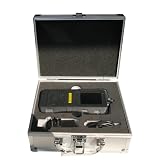
- Detection type : natural diffusion or (external pump suction)
- Detection principle : electrochemical or catalytic, infrared
- Detection accuracy : 3% FS
- Suitable temperature : -20 -50 (-4 F-122 F)
- Humidity : 0-95% R.H non-condensing
How steam reforming turns methane into hydrogen-rich gas
Steam-methane reforming (SMR) uses high-temperature steam and heat to react with methane. In the simplified reaction given by the DOE, methane and water form carbon monoxide and hydrogen:
CH4 + H2O (+ heat) → CO + 3H2
The reformer output is hydrogen-rich synthesis gas, not necessarily hydrogen purified to the specification required by a vehicle, industrial process or other end use. A facility may need additional conversion and separation stages. Performance observed with a pure methane feed should not be assumed to apply unchanged to raw biogas, which also contains CO2 and potentially harmful trace constituents. U.S. Department of Energy, “Hydrogen Production: Natural Gas Reforming”.
Independent reader supportYour contribution helps us test, update, and keep practical guides available for everyone.Which contaminants can make biogas unsuitable as-is?
Required treatment depends on the actual gas, the reformer and catalyst, and the equipment downstream. Important contaminants include:
- Hydrogen sulfide (H2S): It is toxic and corrosive, and can poison catalysts. DOE describes scrubbers and iron sponge, which uses iron oxide, among common cleanup approaches. DOE, 2017.
- Siloxanes: These can occur in gas associated with wastewater, landfills, personal-care products, health care and industry. Combustion can turn them into silicon dioxide deposits that damage combustion equipment; reforming studies also identify siloxanes as potential catalyst-affecting contaminants. DOE, 2017.
- Other trace constituents: Depending on the source, gas may contain water vapor, nitrogen, oxygen, ammonia, carbon monoxide, hydrocarbons, halides or particulates. A cleanup train may need to address some or several of these species. DOE, 2017.
In one experimental study, researchers tested a model gas containing 55/45 CH4/CO2, H2S, a hydrocarbon mixture and a siloxane contaminant over a nickel-based reforming catalyst. They reported that combined poisoning increased coke formation rates. That result shows why mixtures and contaminants matter under the tested conditions; it is not a universal performance estimate for every reactor. Experimental study of biogas contaminants and nickel-based reforming catalyst poisoning.
Windows Errors? Fix Them Before They Spread
Repair common Windows errors and clear accumulated junk for a smoother, more stable PC - no reinstall needed.Free scan · no reinstallOutdated Drivers Are Slowing You Down
One free scan finds every outdated or missing driver and matches the right update for your exact hardware.Free scan · exact hardware matchQuick Recap
Rank #4
- Detection type : natural diffusion or (external pump suction)
- Detection principle : electrochemical or catalytic, infrared
- Detection accuracy : 3% FS
- Suitable temperature : -20 -50 (-4 F-122 F)
- Humidity : 0-95% R.H non-condensing
Rank #3

- 🚀 SENSITIVE: Carbon Monoxide Gas Analyzer 0-1000ppm with 1ppm resolution. H2 interference compensated sensor.
- ⚛️ DETECT: CO Electrochemical nano-GAS sensor. Comes CALIBRATED with signed CERTIFICATE.
- 🎆 ALARMS: Adjustable audio, visual, and vibration alarms.
- 💪 STRONG: Water-resistant, dustproof, and explosion-proof.
- 🕵️ TRUST: ** 1 year limited warranty ** Arrives with calibration and QA certificate ** 100% product test and verification in the USA
How to assess and prepare biogas for a reformer
- Characterize the gas at the site. Measure methane, CO2, moisture, H2S, siloxanes and other source-relevant contaminants. Do not assume landfill gas and digester gas share the same impurity profile.
- Set limits for the selected process. Obtain validated impurity limits from the reformer and catalyst supplier, and account for the required final hydrogen specification. The cited sources do not establish a universal acceptable H2S or siloxane threshold.
- Design cleanup around the measurements. H2S treatment may use scrubbers or iron sponge; other treatment may target siloxanes, sulfur species, moisture or additional contaminants. The sequence and media should follow the gas analysis and engineering design, not a generic “biogas grade” label. DOE, 2017.
- Verify treated gas quality. Check cleanup performance with appropriate measurement methods and detection limits. Equipment type alone does not prove the outlet gas meets the process limits. A DOE cleanup workshop report describes a demonstration where measured sulfur and halogen concentrations were below the instruments’ detection limits and siloxanes were below that demonstration’s detection limit; those project-specific findings are not guarantees for other systems. U.S. Department of Energy, biogas cleanup workshop report.
Product prices and availability are accurate as of the date/time indicated and are subject to change. Any price and availability information displayed on Amazon at the time of purchase will apply.




