Lean Six Sigma is a structured approach to improving a defined process by combining Lean’s focus on waste and flow with Six Sigma’s focus on variation and process control. Teams use it to understand how work performs, identify causes of problems, test changes, and sustain improvements—not to guarantee savings or shortcut certification.
What Lean Six Sigma means
Lean Six Sigma brings together two related improvement approaches. Lean seeks to reduce waste, standardize work, and improve flow. Six Sigma seeks to reduce variation and keep process performance under control. The approaches overlap; combining them is useful when a process problem involves both inefficient flow and inconsistent results.


The aim is to improve outcomes that matter to customers and the organization. That requires examining the actual process rather than assuming a solution in advance. The American Society for Quality (ASQ) summarizes the distinction as: “Lean focuses on waste reduction, whereas Six Sigma emphasizes variation reduction.” ASQ’s Lean Six Sigma overview explains how the approaches fit together.
What DMAIC is and how its five phases work
DMAIC stands for Define, Measure, Analyze, Improve, and Control. ASQ describes it as a data-driven quality strategy for improving processes, including existing processes that do not meet performance standards or customer expectations. It can also be used outside a formal Six Sigma initiative. Each phase builds evidence for the next, helping teams avoid jumping to a fix before they understand the problem.
#1 Best Overall
- Define: State the problem, the process boundaries, the customer requirements, and a measurable goal. A vague goal such as “make the service better” is harder to evaluate than a defined outcome tied to a specific process.
- Measure: Establish how the process currently performs. Choose relevant measures and collect trustworthy data so the team has a baseline against which to assess change.
- Analyze: Use process knowledge and evidence to identify plausible causes of the gap between current and desired performance. A symptom is not necessarily the cause.
- Improve: Develop changes that address supported causes, then test them. The test helps establish whether a proposed change improves the process before it becomes standard practice.
- Control: Monitor the changed process and define what to do if performance drifts. Controls help keep an improvement from fading after the project ends.
ASQ’s Six Sigma tools and techniques guide describes DMAIC as a data-driven strategy whose phases build toward long-term solutions.
When to emphasize Lean, Six Sigma, or both
Choose the approach based on the problem, the data available, and the level of analysis needed. These are practical emphases, not mutually exclusive programs or a mandatory sequence.
Rank #2

- Six Sigma: A Complete Step-by-Step Guide: A Complete Training & Reference Guide for White Belts, Yellow Belts, Green Belts, and Black Belts
- Product Type: ABIS_BOOK
- The Council for Six Sigma Certification
| Problem signal | Useful emphasis | Examples of relevant methods |
|---|---|---|
| Visible waiting, unnecessary movement, excess inventory, or poor flow | Lean practices can help expose waste and improve flow. | 5S, value-stream mapping, visual controls, and standardization |
| Defects, unstable outcomes, or substantial variation | Six Sigma methods can help investigate variation and control process behavior. | Statistical analysis, control charts, and statistical process control |
| A process has both flow problems and inconsistent outcomes | Lean Six Sigma can combine the two emphases. | Use mapping and waste analysis alongside appropriate measurement and control tools. |
ASQ notes that implementation may begin with Lean and apply more technical statistical tools if problems remain. That is guidance, not a rule that every organization must follow.
Tools used in Lean Six Sigma
Tools are most useful when chosen to answer a project question. A map can show where work waits; customer input can clarify what matters; process data can help distinguish ordinary fluctuation from a meaningful change. ASQ lists tools and practices including DMAIC, 5S, the seven wastes, value-stream mapping, flow, visual workplace practices, voice-of-customer techniques, Gantt charts, brainstorming, and nominal group technique. The tools are not exclusive to Six Sigma; their systematic use in an improvement effort is what matters.
Do these 3 things before closing this tab:
1Scan for outdated or missing drivers - takes under a minute2Repair Windows errors before they cause bigger problems3Fix the driver behind crashes, sound loss and screen glitchesRank #3
- Value-stream mapping: A pencil-and-paper map of current material and information flow, followed by a future-state map. It can help teams see handoffs, delays, and opportunities to improve flow.
- 5S and visual workplace practices: Ways to organize and make work conditions visible, useful when the team needs to address workplace organization or expose waste.
- Voice-of-customer techniques: Methods for clarifying customer needs and requirements before setting a project goal.
- Process mapping: A way to make steps and handoffs visible so the team can examine how work actually moves through a process.
- Control charts and statistical process control: Methods for studying process behavior over time and monitoring whether performance changes or drifts.
- Failure mode and effects analysis: A structured way to examine potential failures and their consequences as part of understanding process risk.
- Brainstorming, nominal group technique, and Gantt charts: Methods that can support idea generation, group input, and project planning when those are the team’s needs.
ASQ’s tools guide provides its list of process-improvement methods and explains value-stream mapping.
What case studies show—and what they do not
ASQ publishes project examples that illustrate possible outcomes, but each figure belongs to its specific case. They are not estimates of the average return, success rate, or likely savings from Lean Six Sigma across organizations. The case collection does not establish a generalizable figure for those outcomes.
Rank #4
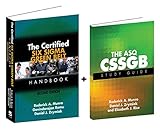
- The Certified Six Sigma Green Belt Handbook This reference manual is designed to help those interested in passing the ASQ's certification exam for Six Sigma Green Belts and others who want a handy reference to the appropriate materials needed to conduct successful Green Belt projects
- The Certified Six Sigma Green Belt Handbook + ASQ CSSGB Study Guide (Set)
- Nursing shift change: In an ASQ case about an anonymous hospital, the average nursing shift report took 43 minutes before improvement work; the team improved the process sigma level from 0.7 to 3.3. ASQ does not state a publication year for the listing.
- SeaDek stockouts and delivery: ASQ reports 14 major stockouts in 2014 and one in 2015, more than $250,000 in materials cost savings, and on-time delivery rising from 44 percent to 95 percent in 2015.
- Samarco Mining iron ore pellets: An ASQ case example reports more than $2 million in annual savings from a low-energy pellet project. The collection identifies the team as a finalist in ASQ’s 2015 awards, but does not separately date the reported annual savings.
- Polypropylene extrusion: An ASQ case example reports that average scrap fell from 1.19 percent to 0.60 percent, total scrap declined by 55 percent, and annual savings exceeded $300,000. The opened case page does not state a publication year.
These are ASQ-published examples, not independent estimates of typical results. Read the project context before using any case figure to set expectations for a different process. The examples are available in ASQ’s case-study collection.
Independent reader supportYour contribution helps us test, update, and keep practical guides available for everyone.Training and certification are separate from improvement results
Training can support learning, but it does not itself prove that a person has passed a certification exam or that a process-improvement project will succeed. ASQ’s certification catalog describes Yellow Belt as foundational for people new to Six Sigma or with a small role, Green Belt as a role supporting or working under a Black Belt, and Black Belt as a professional level involving thorough DMAIC understanding and team leadership.
When accessed on October 8, 2026, ASQ displayed exam fees of $434 for Yellow Belt, $483 for Green Belt, and $585 for Black Belt. Fees can change; check the ASQ certification catalog for current information. ASQ also lists The Certified Six Sigma Black Belt Handbook, Fourth Edition as a preparation resource. Its displayed list price was $150 and member price $105 on October 8, 2026; catalog availability and prices can change. ASQ states that taking a course or using preparation materials does not constitute or imply successful exam completion. See ASQ’s Six Sigma certification preparation page.
Quick Recap
Product prices and availability are accurate as of the date/time indicated and are subject to change. Any price and availability information displayed on Amazon at the time of purchase will apply.




