Recommended Free Tools
Data analytics is the practice of collecting, preparing, examining, and interpreting data so that patterns can answer a question or support a decision. Most introductions sort that work into four types: descriptive, diagnostic, predictive, and prescriptive. Each type answers a different question, and the types are used together more often than they are used in isolation.
What data analytics means
Data analytics is an umbrella term. It covers any systematic work that turns raw records into information a person can act on, whether that is a household tracking card spending or a company forecasting demand for next quarter.


The National Institute of Standards and Technology (NIST) describes analysis as statistical and logical techniques applied systematically to describe, evaluate, interpret, and produce meaningful information from data. Microsoft’s introduction to data analysis frames the work as gathering, cleaning, and modeling data to reveal insights for decisions. Both descriptions point to the same core idea: the value lies in the answer or decision, not in the data itself.
You will see “data analysis” and “data analytics” used interchangeably. Some writers reserve “analytics” for the more systematic or model-driven end of the work, but there is no universal boundary between the two terms. This article uses them as overlapping labels.
#1 Best Overall
The four types of data analytics
The four-type framework is a practical way to sort analytical questions. It is not a legal or formal standard, and different publishers draw the lines slightly differently. Treat it as a map of question types rather than a rigid ladder of techniques.
Descriptive analytics: what happened?
Descriptive analytics summarizes observed and historical data. It answers questions such as how much was sold last month, what the average monthly grocery bill was over the past year, or how a key metric changed from one quarter to the next. Dashboards, pivot tables, and summary reports are typical outputs.
Descriptive work establishes what is observed. It does not explain why the numbers moved, and it does not predict what comes next.
Diagnostic analytics: why did it happen?
Diagnostic analytics investigates contributing factors. An analyst who sees a sales drop drills down by product, store, region, and time period to find where and when the decline concentrated, then checks which other factors coincided with it, such as a price change, a stock shortage, or a competitor promotion.
Diagnostic findings are explanations to be tested, not proof. Two things that moved together may share a cause, or one may have caused the other, or both may be driven by something the data does not capture. Good diagnostic work says which explanation the evidence supports and which alternatives remain open.
Predictive analytics: what might happen?
Predictive analytics uses historical and current data, often with statistical or machine-learning models, to estimate future outcomes. A typical example is forecasting next month’s demand from previous sales patterns, or estimating the probability that a loan payment will be late.
A forecast estimates an outcome. It does not explain the outcome by itself, and it does not tell you what to do about it. Predictions are only as reliable as the data behind them and the assumption that the future will resemble the past in the ways the model captured.
Prescriptive analytics: what should we do next?
Prescriptive analytics combines predicted possibilities with goals, constraints, and uncertainty to recommend an action. NIST’s Research Data Framework (RDaF), Revision 2 (Special Publication 1500-18) labels this category as “Techniques for answering the question, ‘What should we do next?'” An inventory recommendation that balances expected demand against storage space, budget, and the cost of running out of stock is a typical example.
Quick wins for a faster PC:
Repair Windows errors before they cause bigger problemsFix Now →Fix the driver behind crashes, sound loss and screen glitchesFind Drivers →Rank #3
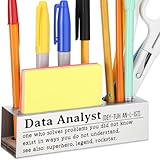
- Perfect Gift for Data Analysts – A fun and unique desk sign for business intelligence experts, data scientists, and analytics professionals.
- Bold & Readable Design – High-contrast lettering ensures visibility on any desk, making it an instant conversation starter.
- Compact & Lightweight – Small enough to fit any workspace without taking up too much room but big enough to make an impact.
- Durable & Long-Lasting Material – Made with premium materials to withstand daily office use while maintaining its sleek look.
- Great for Any Occasion – Ideal for birthdays, work anniversaries, promotions, or just a fun appreciation gift for number crunchers
Prescriptive output is only as good as the objective and constraints it is given. If the goal is defined narrowly, or a constraint is left out, the recommendation can be mathematically optimal and still wrong for the business. IBM’s guidance on prescriptive analytics notes that deployed recommendation models also need monitoring and refinement as conditions change.
Comparing the four types
The table below compares the types on the dimensions that matter when you choose an approach. The categories are complementary rather than competing.
| Dimension | Descriptive | Diagnostic | Predictive | Prescriptive |
|---|---|---|---|---|
| Core question | What happened? | Why did it happen? | What might happen? | What should we do next? |
| Time orientation | Past and current | Past | Future | Future, guiding a present decision |
| Typical output | Summary, report, dashboard | Explanation or set of contributing factors | Forecast or probability estimate | Recommended action or plan |
| Data and methods | Historical records, aggregation, visualization | Segmented data, comparisons, exploratory analysis | Historical data and statistical or machine-learning models | Predictions plus objectives, constraints, and optimization methods |
| Uncertainty and validation | Limited to data quality and completeness | Requires testing competing explanations | Requires model validation and checks on accuracy | Requires sensitivity to assumptions and ongoing monitoring |
| Extra inputs needed | None beyond the data | Hypotheses about possible causes | Relevant predictive variables | Explicit goals, limits, and trade-offs |
Source taxonomies are not identical. NIST’s broader classification of analysis methods also includes exploratory, evaluative, correlational, and statistical methods, while the four-question framework used in business settings sorts work by the decision it supports. Both are useful, but they should not be confused.
How the four types fit together
The types are often used in sequence, but they are not a required order. A team may begin with a prescriptive question and then work backward to the descriptive facts it needs. A descriptive dashboard may trigger a diagnostic investigation that never reaches a forecast.
Do these 3 things before closing this tab:
1Scan for outdated or missing drivers - takes under a minute2Clear out junk files and repair common Windows errors3Fix the driver behind crashes, sound loss and screen glitchesRank #4
The National Academies of Sciences, Engineering, and Medicine’s 2017 report Strengthening Data Science Methods for Department of Defense Personnel and Readiness Missions warns against using correlation to imply causation. It also cautions against treating exploratory analysis as if it were a validated predictive model. Keeping those boundaries clear is what makes the four types trustworthy when they are combined.
Independent reader supportYour contribution helps us test, update, and keep practical guides available for everyone.Worked examples
A retail business
This is an illustrative scenario, not a report of any particular company’s results. A retailer’s weekly report shows that sales declined over the last four weeks. That is descriptive analytics. Analysts then break the decline down by product category, store, and week and compare it with pricing changes and local events. That is diagnostic analytics, and it suggests which explanation deserves testing.
Next, a forecast estimates demand for the coming month based on past patterns, which is predictive analytics. Finally, a recommendation sets inventory levels that balance the forecast against storage capacity, the purchasing budget, and the cost of stockouts. That is prescriptive analytics. The recommendation is only as sound as the forecast and the constraints behind it.
A household budget
The same logic applies to personal money. Suppose you export twelve months of bank and card transactions into a spreadsheet and total each category. The totals tell you what you spent (descriptive). Sorting the dining category by month shows that it rose in certain seasons, and comparing those months with your work schedule suggests why (diagnostic).
If you project your monthly cash flow using the last year’s income and expenses, you have a rough forecast of whether you will have surplus cash next quarter (predictive). Deciding how much to move into savings or debt repayment, given your goals, emergency fund, and required bills, is a prescriptive question. A spreadsheet can help with each step, but it cannot choose your goals for you.
The analytics workflow
A beginner-friendly workflow applies to most projects, whether the output is a summary or a model. Microsoft’s process, Intel’s description of preprocessing and model work, and IBM’s guidance on deployment together suggest the following sequence.
Quick Recap
- Define the question and the decision it should inform. Write down who will act on the answer and what they could do differently.
- Collect data that covers the variables relevant to that question, and note what the data does not record.
- Clean and prepare the data. Remove duplicates, fix inconsistent categories and dates, and document every transformation so the work can be repeated.
- Explore the data with summaries and charts before committing to a method.
- Analyze with methods suited to the question: summaries for descriptive work, comparisons and tests for diagnostic work, and statistical or machine-learning models for predictive work.
- Validate the results. For forecasts, test accuracy on data the model did not see. For explanations, check whether alternative causes fit the evidence equally well.
- Interpret and visualize the findings, and state the limitations plainly.
- Use the findings to inform the decision. For models that will run repeatedly, set up monitoring and schedule reviews of their assumptions.
Limits to keep in mind
- Correlation does not establish cause. A diagnostic finding needs a test or a stronger argument before it becomes a conclusion.
- A forecast estimates an outcome; it does not guarantee one, and it can fail when conditions change.
- A prescriptive recommendation is optimal only for the goals and constraints it was given. Changing either can change the answer.
- Data quality limits every type of analysis. Missing records, inconsistent definitions, and biased collection all carry through to the output.
- Analytics does not require artificial intelligence. Many useful analyses are descriptive or diagnostic and rely on simple statistics and careful comparison.
- No single tool is right for every project. The choice depends on the question, the amount and type of data, and the audience who will use the result.
Sources and dates
- NIST, Research Data Framework (RDaF), Revision 2, Special Publication 1500-18 (definitions of analysis methods and question framing).
- National Academies of Sciences, Engineering, and Medicine, Strengthening Data Science Methods for Department of Defense Personnel and Readiness Missions (2017), covering the taxonomy and cautions about correlation and model interpretation.
- Intel, “What Is Data Analytics?” (publication date not stated on the page reviewed).
- Microsoft, “What Is Data Analysis? Processes and Software” (publication date not stated on the page reviewed).
- IBM, “What Is Prescriptive Analytics?” (page viewed October 2026; the original publication date was not confirmed).
- Southern New Hampshire University, “What Is Data Analytics?” (a public-health example involving vaccine data and planning).
Product prices and availability are accurate as of the date/time indicated and are subject to change. Any price and availability information displayed on Amazon at the time of purchase will apply.




