A tax year is the annual accounting period whose income and expenses you report on a tax return. For most individuals in the United States, it is the calendar year, January 1 through December 31. The tax year decides which transactions belong on a return. The filing deadline is a separate date, and the two are often confused.
This guide covers U.S. federal rules as described by the Internal Revenue Service (IRS). State, local, and non-U.S. tax systems can use different periods, so check with the relevant tax authority if you are subject to one.

How the IRS defines a tax year
The IRS describes a tax year as an annual accounting period for keeping records and reporting income and expenses. You use it to work out taxable income. Think of it as the bookkeeping window: money earned and spent inside that window is reported on the return for that window, no matter when the return is actually sent in. The IRS explains the term on its “Tax years” page on IRS.gov.
The three types of tax year
| Type | Period covered | Who typically uses it | Key condition |
|---|---|---|---|
| Calendar tax year | 12 consecutive months, January 1 through December 31 | Most individuals; many businesses | The default period for individuals |
| Fiscal tax year | 12 consecutive months ending on the last day of a month other than December; IRS guidance also recognizes a 52- or 53-week year that need not end on a month’s last day | Eligible businesses; individuals only if they keep their books and records on that basis | Must meet IRS eligibility rules |
| Short tax year | Fewer than 12 months | Taxable entities that do not exist for an entire tax year, or that change their accounting period | Arises only in these specific circumstances |
Fiscal year versus the federal government’s fiscal year
A business fiscal tax year is not the same thing as the federal government’s fiscal year. The IRS glossary defines the government’s fiscal year as running from October 1 of the previous calendar year through September 30 of the year it is named for. A fiscal tax year is chosen by a taxpayer and can end in any month except December, subject to the rules above.
Do these 3 things before closing this tab:
1Scan for outdated or missing drivers - takes under a minute2Clear out junk files and repair common Windows errors3Fix the driver behind crashes, sound loss and screen glitches#1 Best Overall

- 【2026-2027 Monthly Planner】26-27 monthly planner pages from jul 2026-dec 2027 with 18 months of monthly pages for easy academic planning. 2026 planner come with months tabs for quick navigation. Size 7.6" X 9.6" suit for your backpack
- 【18 Monthly Pages】Monthly view pages of this monthly planner 2026 contain lined daily blocks/ notes section/ holidays listed/ past & next calendar. Calendar notebook is designed with a clean, monthly layout. Planner monthly offers a full overview of the whole school year
- 【Monthly Note Pages】Monthly calendar planner with well organized notes page for each month review.Layouts contain monthly goals/ tasks/ important dates/ 1 note page. —ideal for those who appreciate a streamlined, easy-to-use format without the weekly pages
- 【Extra More Pages】Planner book printed on 100GSM paper for reducing ink through. Contains: Personal Information | 4 page Important Contacts | 2 Contact pages | 2 Passwords pages | 13 Notes pages | 2026-2028 Yearly Overview & Holiday
- 【Perfect Design】Agenda book cover is made of waterproof durable PP material; Sturdy twin-wire binding that allows it to lay flat when opened; Elastic closure band to keep planners securely closed;Pocket for convenient to hold some cards and receipts; Perfect student planner for school
Who uses which tax year
Individuals
Individuals generally use the calendar year. IRS Publication 538 (Accounting Periods and Methods) says an individual can use a fiscal year only if the individual maintains books and records on that basis. In practice, most individual filers never make a choice; their tax year is simply the calendar year.
Businesses
Businesses may use a calendar year or an eligible fiscal year. Some entity types are subject to required-year rules that limit their choice, so check the rules for your entity type in Publication 538 and the instructions for your return before choosing.
Rank #2

- Be Organized in 2026-2027 & Make Sure Each Month Is A Joy: The beautiful monthly planner with top binding by ZICOTO is here for you to help you get the most out of your time! Running from March 2026 till December 2027, the calendar and to-do list notebook helps you to plan smart and manage your time effectively - enjoy less stress & more free time!
- Super Easy To Stay On Top Of Things: Thanks to the straightforward monthly view of the monthly calendar planner 2026-2027 planning ahead is easy & efficient, making it a breeze for you to keep track of your appointments, birthdays, business meetings, kids’ baseball practice and more - don’t forget to schedule some pampering “me-time” for yourself
- Increase Your Productivity & Achieve Your Monthly Goals: What a life-changing hack to boost your productivity & transform each month into an organizational masterpiece! Plan your to do’s, monthly goals & tasks and write down all important dates so you never forget about deadlines or events; there is also plenty of space for personal notes & (motivational) reminders
- Gorgeous Design: The monthly calendar & planner is not only a genius extension of your brain, but also stands out with its modern design and top binding! A beautiful sage green matched with a clean font - a premium planning tool & lovely eye-catcher in one!
- The Perfect Size For Smooth Planning: With a compact size of 8.5x10.95” and a handy design, the monthly planner fits into your bag nicely and compactly, so you always have all the information ready at hand! It even provides a practical back pocket for you to keep additional notes, shopping lists & more
How a business adopts its tax year
According to IRS guidance, a business generally adopts a tax year by filing its first income tax return using that period. The following steps reflect that guidance:
- Confirm whether your entity type is required to use a particular tax year. Review Publication 538 and the instructions for the return you will file.
- Choose a period that matches how your books are kept, and make sure it is eligible for your entity type.
- Adopt the year by filing your first income tax return using that period. Filing an extension request, applying for an employer identification number (EIN), or paying estimated taxes does not, by itself, adopt a tax year.
- If you already have an adopted tax year and want to change it, you generally need IRS approval. Request it on Form 1128, subject to the exceptions described in IRS guidance and the form’s instructions.
Tax year versus filing date
The tax year is the period whose income and expenses are reported. The filing date is the deadline for submitting the return. A return filed in 2026 can cover a 2025 tax year, so the two dates do not match.
What’s actually slowing this PC down?
Pick the symptom - the matching free tool is one click away.
Publication 509 (Tax Calendars) lists April 15, 2026, as the filing date for calendar-year individual filers. That date applies to the return covering calendar 2025. For fiscal-year filers, the general rule in Publication 509 is the 15th day of the fourth month after the fiscal year ends, adjusted for weekends and holidays. Some entity types have different due dates, so confirm the rule for your form.
| Tax year | Period reported | Filing date under the general rule |
|---|---|---|
| Calendar year 2025 (individual) | January 1, 2025, through December 31, 2025 | April 15, 2026, as listed in Publication 509 (2026) |
| Fiscal year ending June 30, 2026 | July 1, 2025, through June 30, 2026 | October 15, 2026, under the general fiscal-year rule; entity-specific dates may differ |
Deadlines are set each year and can be changed by special relief, so confirm the current IRS calendar before you file.
Quick Recap
Best Value

- 2026-2027 MONTHLY PLANNER – From July 2026 - December 2027, this planner 2026-2027 covers 18 months of monthly pages, great for an easy year-round planning and organizing. The size is 9" x 11", suitable for your backpack or work bag.
- PROFESSIONAL DESIGN - One month per two-page spread with ruled daily blocks, to-do & notes section, and is tabbed to allow quick turning, each month includes monthly review page & to-do listing page
- MORE USEFUL PAGES - 2026-2027 yearly overview/personal informations/contact pages/important date and line notes pages.
- TABS & POCKET - Each month is separated with laminated tabs, Inner pocket to store loose items like tickets, cards, papers etc
- PREMIUM THICK PAPER - This monthly planner 2026 2027 is white paper, thicker at 20% than normal, the paper of this planner is ink-proof and is designed to avoid feathering. Archival-quality pages made from acid-free paper, resistant from damage by light and air.
Rank #4
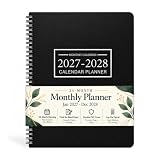
- 2027-2028 MONTHLY PLANNER - This January 2027 - December 2028, 9" x 11" Suitable for multi-scene writing requirements. This monthly calendar is lightweight and convenient to carry around for planning, scheduling and tracking. This monthly calendar is a great way to improve your time management skills and double your productivity!
- THOUGHTFUL DESIGN - Each square of the planner 2027-2028 is 1.93 "x1.77" Extra large size for easy writing and perfect for long range planning! Each pages has MINI CALENDARS for all months. Holiday markers throughout the year put appointments, deadlines, birthdays, U.S. holidays and other important dates at a glance.
- QUALITY MATERIALS - Sturdy black cover, PVC cover material makes it long-lasting, waterproof and wear-resistant, thickened paper is not easy to penetrate the ink and is produced in an environmentally friendly way.This 2027-2028 monthly planner is perfect for work, study and home use.
- FEATURES - 9" x 11" Monthly Calendar Page | 2027-2028 Yearly Overview | Holidays | note column | Portable | Durable | Waterproof
- ENHANCED PLANNNING - Planning ahead for time efficiency Planning a whole year's schedule for important days, such as vacations and anniversaries, not forgetting every important point, and preparing surprises in advance to make birthdays ceremonial.
Common points of confusion
- The year you file is not automatically your tax year. Returns filed in 2026 usually report a prior tax year.
- The federal government’s fiscal year is not a business tax year. It runs October 1 through September 30 (IRS glossary).
- A short tax year is not a planning choice. It arises only when an entity does not exist for a full year or changes its accounting period.
- State tax years may differ. Check your state revenue agency for its own period and deadlines.
Limits of this guide
- This guide summarizes IRS guidance, including Publication 538, which was last revised in January 2022. Check the IRS website for later changes before applying its detailed rules.
- Publication 509 deadlines apply to the years they name. Earlier or later years may have different dates.
- This guide does not determine whether a particular taxpayer is eligible for a given accounting period or an exception to a required-year rule. Those questions depend on the facts of each case and may require a qualified tax professional.
Product prices and availability are accurate as of the date/time indicated and are subject to change. Any price and availability information displayed on Amazon at the time of purchase will apply.




