Intel Foundry is Intel’s chip-manufacturing and related-services business. It makes chips for Intel’s own product groups and is also building a business that manufactures and packages chips for outside customers. For people buying laptops, servers, or other devices, the effects are indirect: manufacturing capacity, process technology, packaging, and supply-chain geography can influence which products arrive, when they arrive, and how they perform. A foundry’s name or process-node label alone, however, does not tell you whether a particular device is a good buy.
What does Intel Foundry do?
Intel Foundry manufactures semiconductors and offers services that help customers design and produce them. Its customers include Intel’s own product groups as well as outside companies seeking wafer production, advanced packaging, or related design support.
Intel describes its “internal foundry” model as separating manufacturing accountability and economics from the product units that use the chips. In principle, an Intel product group engages with the manufacturing organization much as a fabless company engages with an independent foundry. The stated aim is greater transparency about manufacturing costs, performance, and service for internal and external customers. This is an organizational model, not a claim that Intel’s product groups are independent companies.
The broader “systems foundry” offer Intel describes includes more than fabrication: process technology, advanced packaging, design enablement, intellectual-property support, and access to electronic design automation (EDA) tools and partners. Those pieces matter because a chip has to be designed for a manufacturing process and then assembled into a usable package; wafer production is only one part of getting a finished component into a product.
Quick wins for a faster PC:
Scan for outdated or missing drivers - takes under a minuteDriver Scan →Clear out junk files and repair common Windows errorsFree Scan →#1 Best Overall

- Paperback with picture of the two inventors.
- 5 x 8
What is Intel 18A, and what is its status?
Intel 18A is one of Intel’s manufacturing processes. Intel reported in June 2026 that 18A entered production in 2025 and that its compatible enhancement, Intel 18A-P, had entered risk production. “Risk production” is a development and manufacturing milestone; it does not by itself establish broad, high-volume availability.
Intel’s fourth-quarter 2025 earnings-call comments said the company was shipping its first 18A products, that yields were improving, and that more work remained to ramp supply. Yield—the share of manufactured chips that meet the required specifications—can affect how many usable chips a factory produces and the cost of supplying them. Intel’s comments are company-reported progress, not an independently audited yield dataset.
Rank #2
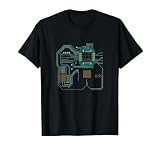
- Computer Hardware Technology design. Computer processor design, great for IT computer technicians, software engineers, or any engineer that deals with microprocessors. This funny computer scientist shows a CPU or circuit board.
- CPU Electronic Chip Circuit Board Gift. Ideal for computer science students, software developers, administrators and all who like to work with computers.
- Lightweight, Classic fit, Double-needle sleeve and bottom hem
What Intel says 18A-P changes
| Intel-reported comparison | Intel’s June 2026 claim | How to read it |
|---|---|---|
| Performance at the same power, versus Intel 18A | 9% higher performance | Intel-reported process comparison; not an independent benchmark of finished products. |
| Power at the same performance, versus Intel 18A | 18% lower power | Intel-reported alternative comparison; the 9% performance and 18% power figures describe different conditions, not a combined result. |
| Thermal resistance, versus Intel 18A | 20–40% improved | Intel-reported technical comparison, not a measurement of device temperature in every product. |
| Via resistance, versus Intel 18A | 10–30% improved | Intel-reported technical comparison; it does not directly state a laptop’s speed or battery life. |
These figures come from Intel’s June 16, 2026 technical announcement, “Intel Foundry Details Process Milestones and Future Innovation at VLSI Symposium.” They are vendor claims about process technology, not independent comparative test results. Real-world performance and power also depend on chip design, product configuration, cooling, and workload.
Does Intel make chips for other companies?
Yes. Intel has announced plans to make chips for outside customers, but an announced design or customer relationship should not be mistaken for proof that a product is already being manufactured at volume.
Rank #3

- Thermal conductivity > 6.5 W/m-k.
- Thermal resistance 0.0016 k-in/W.
- Working Temperature: -30/280°c.
- Each pack includes 1 gram high performance thermal paste/grease.
- Can be applied for cooling the interface of cooler heatsink and Computer Processor CPU GPU IC Chips, etc.
- Microsoft: Intel announced that Microsoft had selected a chip design it planned to produce on Intel 18A.
- AWS: Intel announced plans for an AI fabric chip on 18A and a custom Xeon 6 chip on Intel 3. Intel described the arrangement as a multi-year, multi-billion-dollar framework covering products and wafers.
- Defense programs: Intel has described U.S. defense-industry access to 18A and packaging through the RAMP-C and Secure Enclave initiatives. Intel announced completion of the RAMP-C program on July 28, 2026.
The Microsoft and AWS announcements establish customer plans and relationships, not the production status or shipment volume of each chip. Intel’s fourth-quarter 2025 earnings-call comments also described active engagement with potential 14A customers and said supplier decisions could occur across the second half of 2026 and first half of 2027. Those were anticipated decision windows, not confirmation that customers selected the process.
Why might a foundry matter to someone buying a chip or device?
It can affect which products reach the market
A manufacturing process can influence chip design choices, power and performance characteristics, and the pace at which a product can be supplied. But production milestones and available factory capacity are not the same thing as guaranteed supply of a particular processor or laptop. Intel’s fourth-quarter 2025 comments explicitly noted that further work was needed to ramp 18A supply.
Rank #4

- 🍭 MOLD SIZE: This mold has 4 cavities. The cavity capacity 1.1 ounces. Please do not use with hard candy. This mold is NOT dishwasher safe and should be cleaned by hand. The molds are not suitable for children under 3.
- 🧁 GET CREATIVE: Create goodies for parties such as birthdays and baby showers or delicious wedding favors. Make candies for holidays such a Valentines Days or Christmas. Unleash your inner artist and use the molds to make custom soaps, bath bombs or wax melts.
- 🍩 BE PROFESSIONAL: Create expert looking confections with the addition of our candy cups in a variety of colors and sizes, our high-quality lollipop sticks and clear cello bags. Take your chocolate molding to a new level with our exclusive Chocolatier's Guide, which explains how to melt, mold, and paint chocolate.
- 🍰 CYBRTRAYD: We are a company dedicated to providing confectionery and soap making tools. We want to provide you with quality tools to make your creative process as easy and fun as possible. Our experts are here to help. Your satisfaction is important to us. Contact us with any quality issues or concerns.
Packaging can affect the finished chip
Advanced packaging connects or combines chip components into a finished package. It is part of Intel’s systems-foundry offer, and Intel has discussed work to improve packaging quality and yield. Packaging capability can matter to chip designers, but an announcement about a capability does not establish that every customer product uses it or that it will improve a consumer device in a particular way.
Geography may matter to supply resilience, but it is not a delivery promise
Intel’s U.S. manufacturing activity and government supply-chain programs are relevant context for buyers concerned about where chips are made. They do not, on their own, guarantee that a specific device will be available, delivered on time, or unaffected by disruptions. A consumer generally needs product- and supplier-specific evidence to assess those risks.
Outdated Drivers Are Slowing You Down
One free scan finds every outdated or missing driver and matches the right update for your exact hardware.Free scan · exact hardware matchWindows Errors? Fix Them Before They Spread
Repair common Windows errors and clear accumulated junk for a smoother, more stable PC - no reinstall needed.Free scan · no reinstallBest Value

- LOW ENERGY HIGH PERFORMANCE MINI PC - The Intel Core Ultra 5 125U is part of the Ultra 5 lineup, using the Meteor Lake architecture with BGA 2049. Intel Hyper-Threading technology is available and effectly doubles the core-count of the P-Cores, to a total of 14 threads. Core Ultra 5 125U has 12 MB of L3 cache and operates at 1300 MHz by default, but can boost up to 4.3 GHz, depending on the workload. With a TDP of 15 W, the Core Ultra 5 125U consumes very little energy but outputs high performance efficiency
- 32GB DDR5 RAM + 512GB SSD - The K15 mini computer is equipped with Dual 16GB (Total 32GB) SO-DIMM DDR5 4800MHz memory sticks. 512GB PCIE 4.0 SSD Drive with 3x M.2 2280 Expansion slots. Each slot capable of reading up to 8TB. (24TB MAX)
- QUAD SCREEN 4K DISPLAY SUPPORT - K15 Mini PC support 4-screen 4K/8K output via HDMI 2.1 (8K@60Hz), DisplayPort 1.4 (4K@60Hz), and USB Type-C Transfer speed (supporting PD3.0/DP1.4/DATA). Ideal for gaming, video editing, and multitasking, it provides expansive and crisp multi-display support
- OCULINK PORT - The Oculink port on the rear interface enables higher bandwidth capabilities, better frame rates and lower lag. The standard also operates at PCIe x4 speeds, compared to Thunderbolt's x3. Gamers and content creators can benefit from Oculink's higher bandwidth, resulting in better performance and lower lag for eGPU setups
- DUAL NIC FAST 2.5GBE + WIFI 6E + BT 5.2 - Dual Ethernet 2.5GbE LAN port design provides more applications, such as firewall, multichannel aggregation, soft routing, file storage server. Built-in WIFI 6E / Bluetooth 5.2 is more stable and efficient to connect multiple wireless devices such as projector, printer, monitor, speakers and etc
Process names do not replace product-level comparisons
Intel says Core Ultra Series 3 processors were its first products manufactured using Intel 18A, making the family a downstream example of the process. That statement does not mean every Intel processor or laptop uses 18A. For any particular laptop, check the exact processor and manufacturer’s specifications for that model; then compare independent workload benchmarks, power behavior, price, availability, and software support. A process-node label alone cannot establish a product’s value.
Independent reader supportYour contribution helps us test, update, and keep practical guides available for everyone.How to assess Intel Foundry against alternatives
A useful foundry comparison requires evidence on several dimensions, not just a roadmap announcement or a claimed process advantage. For a buyer evaluating the wider semiconductor supply chain—or an investor assessing the business—look for:
- Production maturity: Is the process in development, risk production, or demonstrated ongoing production?
- Yield and capacity: Are there credible, comparable figures for usable-chip yield and available output, or only general company statements?
- Design readiness: Are the design tools, intellectual property, and customer engineering support ready for the intended chip?
- Packaging capability: Can the foundry provide the packaging the design needs at the required quality and scale?
- Customer evidence: Is a customer considering a process, has it announced a design, or is there evidence of products shipping in volume? These are materially different stages.
- Supply-chain fit: Does manufacturing geography, supplier access, or a particular resilience requirement matter for the customer?
- Total economics: What are the full costs, including design adaptation, production, packaging, and the risk of delays?
Intel’s public statements provide milestones and claims about its own business, but they do not supply a balanced, independent comparison of foundry yields, pricing, or performance against competitors. Those comparisons should not be inferred from Intel’s announcements alone.
What Intel’s announcements mean for buyers today
Intel Foundry matters because the way Intel manufactures chips—and its success in attracting and supplying outside customers—can shape product availability, chip design options, and supply-chain choices. The current evidence supports a distinction: Intel reported 18A production and first-product shipments, while its statements on improving yields and ramping supply show that manufacturing scale remains an important part of the story. Outside-customer announcements demonstrate intended engagements, not by themselves proven volume production.
For a household choosing a computer, the practical decision remains at the device level: compare the exact model’s tested performance, battery or power behavior, price, availability, and support. Foundry developments provide useful context, not a substitute for that comparison.
Quick Recap
Product prices and availability are accurate as of the date/time indicated and are subject to change. Any price and availability information displayed on Amazon at the time of purchase will apply.




