GST recordkeeping depends on the country. For an Indian GST-registered person, keep accounts that substantiate supplies, stock, input tax credit and tax payable or paid, together with the invoices, vouchers and other source documents that support those accounts. India’s ordinary retention period is tied to the due date for the annual return—not simply to the date of a transaction. Canada and Singapore use different rules, so the India-focused checklist below should not be applied to them.
What documents should you keep for GST compliance?
In India, the practical test is whether your records let you explain what the business bought and sold, what happened to its goods, how it calculated tax and input tax credit, and how the figures in its returns connect to individual transactions. The Central Goods and Services Tax Act, 2017 (CGST Act) identifies accounts for production or manufacture, inward and outward supplies, stock, input tax credit availed, and output tax payable and paid. The CGST Rules add transaction documents and registers that help substantiate those accounts.
As an Amazon Associate I earn from qualifying purchases.
Section 35(1) of the CGST Act says: “Every registered person shall keep and maintain, at his principal place of business, as mentioned in the certificate of registration, a true and correct account of—”. The Act and Rules set the framework; which supporting documents apply depends on the business and its transactions. A retailer, manufacturer, service provider, importer and business making reverse-charge supplies will not necessarily have identical files.
Sales and outward supplies
- Keep tax invoices or bills of supply, as applicable, and credit notes or debit notes connected with sales.
- Retain delivery challans and other records that show the outward supply and help explain how goods or services were supplied.
- Keep the records needed to understand the transaction and its tax treatment, rather than retaining an invoice detached from the entry it supports.
Purchases and inward supplies
- Keep supplier tax invoices or bills of supply, along with credit notes, debit notes and delivery challans received.
- Retain relevant documents for imports and reverse-charge supplies. Keep enough supporting material to show what was received and how the transaction was accounted for.
- Link purchase documents to the accounting entries and any input tax credit claimed against them.
Tax and input tax credit
- Maintain accounts of tax payable, tax collected and tax paid, as well as input tax and input tax credit availed.
- Preserve the invoices and source records that support the tax and credit entries. A return figure should be traceable back to the underlying transactions and documents.
- Keep records that explain adjustments, including relevant credit or debit notes, so the resulting tax figures are understandable.
Stock and movement of goods
Maintain stock accounts that let you follow goods through the business. The records should account for opening balance, receipts, supplies and closing balance, and should also explain losses, theft, destruction, write-offs, gifts and free samples where these occur. Retain relevant delivery and movement documents, including e-way bills where applicable. These records help explain differences between purchases, sales and the goods still held by the business.
#1 Best Overall

- AN EASY & EFFICIENT WAY TO CONTROL YOUR FINANCES: Created for both small business and personal use, this horizontal accounting ledger book has spacious pages to log payments and deposits, so that you can monitor your finances and spot errors easily.
- LARGE FORMAT LEDGER WITH PLENTY OF WRITING SPACE: This accounting book ledger comes in a large format, measures 10 by 7 inches, and has 129 pages with 3,100 entry lines total.
- TRACK ACTIVITY IN MULTIPLE ACCOUNTS WITH JUST ONE BOOK: This accounting log book will be perfect if you want to track activity in multiple accounts. To do so, use the dedicated column to add the bank account number every time you make a record.
- PREMIUM DESIGN FOR COMFORTABLE DAILY USE: This accounting journal book has a durable eco-leather hardcover, thick 120gsm paper, sturdy elastic closure, pen loop, ribbon bookmark, and back pocket for extra notes, checks, and receipts.
- 60-DAY MONEY-BACK GUARANTEE: We will exchange or refund your small business log book if you aren’t satisfied with your business bookkeeping ledger for any reason. Reach out to us via message to refund your monthly accounting ledger book.
Advances, payments and refunds
Keep separate accounts for advances received, advances paid and advances adjusted. Retain relevant receipt vouchers, payment vouchers and refund vouchers. The supporting records should make it possible to follow an advance from its receipt or payment through its later adjustment or refund, where applicable.
Returns, reconciliations and registers
Retain filed returns and reconciliations alongside the records that explain the reported totals. Keep relevant registers for tax and documents, as well as records of advances and stock. The aim is to preserve the connection between source transactions, the accounts and the figures reported—not just a collection of final return files. These supporting records are part of the practical file for a period: they help explain how individual entries add up to the totals reported.
How long do you need to keep GST records?
For India, section 36 of the CGST Act generally requires records to be kept until 72 months have expired from the due date for furnishing the annual return for the year to which the records relate. The starting point is the annual return’s due date for the relevant year, not the transaction date. That distinction means “six years from the transaction” is not an accurate general description of the Indian rule.
What’s actually slowing this PC down?
Pick the symptom - the matching free tool is one click away.
A longer period can apply. If records relate to an appeal, revision, other proceeding or specified investigation, they must be retained until one year after final disposal or until the ordinary statutory period expires, whichever is later. A business should identify whether records are connected to such a matter before disposing of them; the ordinary period alone may not be sufficient.
Rank #2

- Refined Financial Management: Our ledger books for bookkeeping can be used to track personal bills and budgets and serve as book keeping log for small business.Helps you keep track of your expenses and income for effective financial planning.
- Adequate Ledger Entries: Dimensions are 8.4 x 6.1 inches, making it easy for you to take anywhere. This accounting ledger comes with 3304 entry spaces (120 pages) so you can record all your financial information in one place, with easier access to track transaction types and dates.
- Elegant & Exquisite Design: Our ledger notebook adopts a classic waterproof material cover, which is not easy to wear. Gold double spiral binding makes flipping through easy. This bookkeeping book is also designed with practical inner pockets and bookmark elastic bands.
- Flexible & Thick Paper: Our accounting book is made of 100gsm non-bleeding paper, perfect for fountain pens, ballpoint pens and other pen types. Convenient to write on, so you no longer have to worry about bleeding ink.
- Perfect For Gift Giving: As you would expect, the cover of the book keeping book is beautifully designed with gold foil lettering and floral patterns. Perfect as a gift for parents and friends, or as a business ledger for small business.
How the rule differs in Canada and Singapore
These are jurisdiction-specific comparisons, not alternative ways to calculate an Indian retention period.
| Jurisdiction | Ordinary period and clock | Possible extension or qualification |
|---|---|---|
| India | 72 months after the due date for furnishing the annual return for the year to which the records relate. | For records connected to an appeal, revision, other proceeding or specified investigation, retain until one year after final disposal or the ordinary period, whichever is later. |
| Canada | The CRA says the usual GST/HST period is six years from the end of the year to which the records relate. | Longer retention may apply in some circumstances. |
| Singapore | IRAS says GST records must be kept for at least five years from the end of the accounting period. | The stated minimum is tied to the accounting-period end. |
Do not choose a retention period just because a business operates in a country commonly described as having “GST.” Confirm the applicable country’s rules and the relevant dates. For Canada, the tax is commonly referred to as GST/HST; its period above is not the Indian section 36 calculation. Singapore’s period likewise uses its own accounting-period reference point. When comparing rules, check both the duration and the event that starts the clock, as well as whether a proceeding or other circumstance extends it.
Do you need to keep GST invoices and receipts?
Yes, where they support the business’s GST accounts or tax treatment. For an Indian business, retain invoices or bills of supply, credit and debit notes, delivery challans, relevant receipt, payment and refund vouchers, and e-way bills where applicable. Keep records for both sides of transactions: documents issued for outward supplies and documents received for inward supplies, imports or reverse-charge transactions as relevant.
Free tools Windows power users keep installed
One-click scans. No signup required.
A receipt or invoice is not useful compliance evidence if it cannot be connected to the entry it supports. Organize source documents with transaction details and accounting records so that a reviewer can follow the amount, the goods or service, and the related tax or credit treatment. Keep reconciliations and filed returns with the supporting records they explain. The exact supporting material varies with the transaction and taxpayer circumstances.
Rank #3

- Easy To Track Your Finances: HAUTOCO accounting ledger book keeps you on top of your expenses and income! Help you keep your money organized, spend well, and set and achieve financial goals
- Premium Material: The A5 accounting ledger book has a total of 120 pages and 2040 lines of entries. It is made of 100gsm thick paper to reduce ink leakage; it is equipped with a waterproof and sturdy PP cover to protect the inner pages
- Practical Design: Compact 8.3 x 6.2'' expense tracker notebook is easy to carry and features information pages, 2025 calendar, yearly financial goals page, and PVC pocket for storing important tickets and loose items
- Manage Your Finances Effectively: Undated accounting books with number, date, description, account, payment or deposit amount, and total balance. You will be able to easily analyze your financial activities and quickly prepare accurate financial statements
- Ideal For Small Business or Personal Use: An accounting log journal can track your business or personal financial status. With a clear record of transactions, you can find unnecessary expenses or fraudulent charges
How should you organize paper and electronic GST records?
For India, the rules address where records are kept, including the registered principal place of business and related places of business. Storage location should be checked against the current rule text, the taxpayer’s registration and the business’s circumstances rather than assumed from a generic filing practice.
Electronic records require more than saving files in a folder. Indian rules call for proper electronic backups and require information to be capable of restoration within a reasonable time after accidental or natural destruction. As a practical workflow, organize records by accounting period and transaction type, preserve the source invoice or voucher with its related entry, maintain a backup and check that files can still be opened and retrieved.
Canada’s CRA guidance is different: electronic records must remain electronically readable throughout the retention period. CRA Memorandum 15-1, marked September 2026, encourages secure cloud accounting, regular backups and formats compatible with CRA audit tools. Those are Canadian guidance points and should not be treated as Indian statutory requirements.
The Tool Desk
Outbyte PC Repair FREEClear out junk files and repair common Windows errorsFree Scan →Outbyte Driver Updater FREEFix the driver behind crashes, sound loss and screen glitchesFind Drivers →A workable filing sequence
- Group records by period. Use the relevant accounting or tax period so source documents, accounts and returns can be reviewed together.
- Separate transaction classes. Keep outward supplies, inward supplies, stock movements, tax and credit records, advances, and vouchers identifiable.
- Connect evidence to entries. Retain invoices, challans, vouchers and other source material with enough detail to trace the related accounting entry and reported amount.
- Preserve return support. Store filed returns and reconciliations with the records that explain their reported totals.
- Protect and test electronic files. Keep proper backups and periodically confirm that records can be restored, opened and produced in readable form.
- Review before disposal. Check the applicable retention clock and whether any appeal, revision, proceeding or specified investigation calls for a longer period.
A ledger book or paper folders can be optional organizational aids for businesses that work with paper accounts and documents; neither is a substitute for the records required by the applicable rules. Electronic organization can also be useful, provided the files remain backed up, retrievable and readable under the relevant jurisdiction’s requirements. These are filing choices, not products or methods required or endorsed by tax authorities.
Rank #4

- PU Leather Cover with Gold Foil: Ledger book features a finely textured black pebbled PU leather cover with exquisite gold foil stamping. This not only provides a non-slip, wear-resistant feel but also exudes a luxurious and sophisticated look. The durable material protects the inner pages from damage and is suitable for various scenarios, including business office work and personal finance.
- Portable Size: Columnar book 7 x 9.25 inches, is compact and space-saving, easily fitting into a briefcase, tote bag, or backpack. Whether for business trips, field reconciliation, or everyday carry, it allows for recording income and expenses anytime.
- Large Capacity: Record per book contains 50 sheets of 80g double-sided offset paper. Each page features 30 clear lines of writing and a 3-column categorization layout. Double-sided color printing ensures clear and smudge-proof text. The notebook includes a marker bar for quickly marking important items or reconciliation points. With a total of 1500 writing positions, it meets daily, monthly, and even annual accounting needs, eliminating the need for frequent notebook replacements.
- Eye-friendly Inner Pages: Budget book's inner pages feature a soft, eye-friendly green background with double-sided color printing, effectively reducing visual stimulation from strong light reflection. This minimizes eye fatigue even during extended writing sessions, reflecting a healthy and thoughtful design consideration, making it suitable for those who frequently keep track of their expenses.
- Comfortable Writing Experience: Logs book's spacious line spacing provides ample space for writing, allowing for clear categorization of income, expenses, and balances, resulting in more organized budgeting. It also ensures clear and neat handwriting, enhancing writing fluency and overall page neatness.
What are the common GST recordkeeping mistakes?
- Starting the clock from the wrong date. India’s ordinary period runs from the due date for the relevant annual return, not the transaction date.
- Using another country’s period. India, Canada and Singapore describe different retention clocks. Do not combine them into one rule.
- Keeping returns without their supporting trail. Preserve the source documents, accounts and reconciliations needed to explain reported totals.
- Ignoring non-sale stock movements. Loss, theft, destruction, write-offs, gifts and free samples can affect the stock account and should be explainable where they occur.
- Saving files without a recovery plan. A record that has been lost, cannot be restored, or cannot be opened may not be practically available when needed.
- Deleting records while a matter remains open. Records related to proceedings or specified investigations may need to be retained beyond the ordinary period.
- Assuming every business needs the same documents. The relevant source records depend on the taxpayer’s activities and transactions, including whether imports, reverse-charge supplies or goods movements are involved.
How to apply this checklist to your business
Start by confirming the country and the GST regime that applies to the records. For an Indian GST-registered person, map the business’s transactions to the core accounts: production or manufacture where relevant, inward and outward supplies, stock, input tax credit availed, and output tax payable and paid. Then identify the invoices, notes, challans, vouchers, e-way bills, registers and return reconciliations that substantiate those accounts.
Finally, record the retention end date using the applicable statutory trigger and flag any records connected to an appeal, revision, proceeding or specified investigation. Because the statutory framework and the relevant documents depend on current rules, taxpayer category and transaction type, confirm the current Indian Act and Rules for the business’s circumstances. This checklist is general information, not individualized tax advice.
Frequently Asked Questions
How long do I need to keep GST records?
It depends on the jurisdiction. In India, the ordinary period is until 72 months have expired from the due date for furnishing the annual return for the year the records relate to. Records connected to an appeal, revision, other proceeding or specified investigation may need to be kept longer. Canada’s usual GST/HST period is six years from year-end, while Singapore requires at least five years from the accounting-period end.
Do I need to keep GST invoices and receipts?
Keep invoices, bills of supply, credit and debit notes, delivery challans, and relevant receipt, payment and refund vouchers when they support your GST accounts or tax treatment. For India, also retain relevant e-way bills where applicable and supporting records for inward and outward supplies, imports and reverse-charge transactions.
Best Value
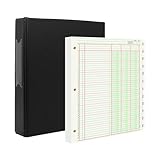
- [A Value Set]: Our Accounting Ledger Paper notebook comes with 100 sheets/200 pages ledger papers and a PU leather 3 ring binder. Extra Movable Monthly Tabs
- Thick Paper: These 3 column ledger paper are 100 gsm, Can be written smoothly to prevent ink bleeding. Both sides can be used
- [Size]: The size of the columnar pad paper is 8.5" X 11". The black 3-ring binder can be used for 8.5X11 refill paper
- [3-Ring Binder & Movable Monthly Tabs]: Binder accounting ledger notebook can be added, deleted, and re-arranged pages easily. The month tabs make it easy to organize the same months from different years
- Application: The ledger paper notebook is perfect for bookkeeping, accounting or other numeric data. it can be used by accountants, teachers, student
Do I need to keep GST records electronically or on paper?
The relevant rules depend on the country. In India, electronic records require proper backups and must be capable of restoration within a reasonable time after accidental or natural destruction. A practical approach is to organize by period and transaction type, link source documents to entries, and confirm that files remain retrievable and readable. Check current rules for storage location and your circumstances.
Can I discard records as soon as the ordinary retention period ends?
Not necessarily. In India, records related to an appeal, revision, other proceeding or specified investigation must be retained until one year after final disposal or the ordinary statutory period expires, whichever is later. Check whether a matter affects the records before disposing of them.
The Bottom Line
Bottom line: For Indian GST compliance, keep the accounts for supplies, stock, tax and input tax credit together with the invoices, notes, challans, vouchers, e-way bills where applicable, registers, returns and reconciliations that explain them. Count the ordinary 72-month period from the relevant annual return due date, and check for proceedings that may extend retention. Confirm your jurisdiction and current rules before applying this checklist.
Do these 3 things before closing this tab:
1Scan for outdated or missing drivers - takes under a minute2Repair Windows errors before they cause bigger problems3Fix the driver behind crashes, sound loss and screen glitchesQuick Recap
Product prices and availability are accurate as of the date/time indicated and are subject to change. Any price and availability information displayed on Amazon at the time of purchase will apply.




