Biden’s “$11 billion push” was not a single new grant or check. It was the semiconductor research-and-development portion of the CHIPS and Science Act, signed in August 2022. On February 9, 2024, his administration announced more than $5 billion in expected investments in research, development, and workforce efforts as part of putting that broader program into action. The aim was to strengthen U.S. chip capabilities in a strategic competition with China—not to promise a quick or complete U.S. victory.
Why the United States treated chip research as a strategic issue
Semiconductors are essential to products and systems ranging from artificial intelligence and communications to automobiles, medical devices, industrial infrastructure, and defense. The U.S. policy concern was not simply that the country needed more factories. It also had gaps in domestic production, advanced packaging, shared research infrastructure, commercialization pathways, and specialized workers.
In its February 2024 fact sheet, the Commerce Department said the United States produced less than 10% of global semiconductor supply and none of the most advanced chips at that time. That is a dated administration assessment, not a current measurement of U.S. capacity. The underlying concern was that concentrated production abroad could leave U.S. businesses and critical systems exposed to supply disruptions.
The policy also targeted a “missing middle”: the costly steps between laboratory research and high-volume manufacturing. Universities and smaller firms may develop promising ideas but lack access to the equipment, pilot lines, expertise, or capital needed to prove that a process can scale. The R&D effort was designed to help bridge that gap.
#1 Best Overall

- Complete and practical package: The package contains more than 400 components, which can help you complete interesting and simple electrical experiments.
- Clear and sturdy packaging: Each component is classified and packaged and placed in a transparent box with clear labels on it, making it easy to find components.
- Humanized design: The package includes a power module and a USB data cable, and the components can be directly plugged into the breadboard, which is more convenient without soldering.
- The quality of components is reliable.
- Compatible with STM32,Raspberry Pi,Arduino and so on.
How the $11 billion fits into the CHIPS funding
The headline’s $11 billion refers to statutory semiconductor R&D funding under the CHIPS framework. It is distinct from both the February 2024 announcement and the much larger manufacturing-incentive effort. The Congressional Research Service describes the main Commerce semiconductor programs as roughly $50 billion, while the broader statutory semiconductor funding package is commonly described as approximately $52.7 billion. Those figures use different accounting scopes.
| Funding figure | What it refers to |
|---|---|
| $39 billion | Manufacturing incentives and related financing intended to encourage U.S. semiconductor facilities. Source: Congressional Research Service. |
| $11 billion | Semiconductor R&D and related ecosystem programs, including research, prototyping, packaging, metrology, and workforce-related activity. Source: Congressional Research Service. |
| Approximately $52.7 billion | A commonly used description of the broader statutory semiconductor funding package; it is not interchangeable with the approximately $50 billion Commerce program total. Source: Congressional Research Service. |
The more than $5 billion announced by the administration on February 9, 2024, was an expected investment in R&D and workforce needs within the larger statutory effort. It was not a newly enacted $11 billion appropriation or a claim that $5 billion had all been spent that day. See the Commerce Department’s announcement.
What the R&D program was meant to build
The CHIPS R&D effort has four main components. Together, they address research access, chip assembly, measurement, and the handoff from innovation to production.
Rank #2

- All-in-One Electronics & Coding Starter Kit: Learn the fundamentals of electronics, coding, and circuit design with the Horizon Uno board (Arduino-compatible), LEDs, sensors, and specialty components — everything you need to start building.
- Includes Step-by-Step Video Lessons: Gain lifetime access to a full online video course created by robotics engineers. Each lesson walks you through real-world projects, coding examples, and clear explanations designed for beginners. Each kit comes with a unique access code to access on our course website. The course includes lectures, labs, projects and problem sets.
- High-Quality Components for Reliable Learning: Each kit includes premium parts for accurate circuit performance — from durable resistors and sensors to jumper wires and LEDs — ensuring a frustration-free learning experience.
- Perfect for Students, Educators & Hobbyists: Ideal for classrooms, STEM programs, and self-learners. The Horizon Uno Kit makes it easy for beginners to grasp the fundamentals of electricity, coding logic, and microcontroller programming.
- Learn, Build & Innovate with Horizon Robotics Lab: Backed by an experienced team of engineers and educators, Horizon Robotics Lab is dedicated to making robotics and electronics education accessible, inspiring learners to build cool projects and bring ideas to life.
National Semiconductor Technology Center
The National Semiconductor Technology Center (NSTC) is intended as a public-private research and prototyping network, connecting government, companies, universities, equipment suppliers, workers, customers, and investors. Its purpose is to give participants access to facilities, equipment, and expertise that can be expensive to maintain independently; shorten the path from research to commercial production; and support domestic design and manufacturing capabilities.
The Tool Desk
Outbyte Driver Updater FREEScan for outdated or missing drivers - takes under a minuteDriver Scan →Outbyte PC Repair FREERepair Windows errors before they cause bigger problemsFix Now →The NSTC is a network and capability-building effort, not a single factory. Its value will depend on whether researchers and companies can use its facilities and turn work done there into viable products and processes. The Commerce Department’s CHIPS implementation strategy describes the program’s main R&D components.
National Advanced Packaging Manufacturing Program
Advanced packaging combines chips or chip components into a system, using approaches such as chiplets, 2.5D and 3D integration, and high-bandwidth connections. As performance gains increasingly depend on integrating components as well as shrinking transistors, packaging has become a strategic capability in its own right.
Rank #3

- BUILD BREADBOARD CIRCUITS AND MINI PROJECTS - Create LED indicators, button inputs, traffic-light sequences, light-activated circuits, RGB effects and buzzer alarms for electronics practice, classroom demonstrations and maker projects
- 235 PARTS FOR REPEATABLE EXPERIMENTS - Includes a 400-tie-point solderless breadboard, power module, jumper wires, Dupont wires, potentiometer, buttons, LEDs, resistors, capacitors, diodes, transistors, buzzers and light-sensitive components
- LEARN HOW CORE COMPONENTS WORK - Use the 74HC595 to expand outputs, the 4N35 optocoupler to explore signal isolation, PN2222 transistors to switch loads and 1N4007 diodes for polarity protection and rectification experiments
- POWER AND REWIRE PROJECTS QUICKLY - Use the breadboard power module for selectable 3.3 V or 5 V rails, while rigid jumpers and female-to-male leads simplify connections; use a suitable 6.5–9 V DC input and do not exceed 9 V
- COMPONENT KIT WITH CLEAR EXPECTATIONS - A controller board, programming cable and wall power adapter are not included; use a compatible microcontroller for coded projects and follow the current tutorial, datasheets and wiring guidance
Strengthening domestic packaging research and production could help U.S. firms develop and commercialize systems without relying on overseas capacity for every stage. It would not, by itself, eliminate international dependencies across materials, equipment, or manufacturing.
CHIPS Metrology Program
Metrology is the measurement and characterization used to develop, manufacture, and verify semiconductor materials and devices. Better measurement science, standards, and process-control methods can help manufacturers detect defects, compare results, and move new technologies toward reliable production.
Crashes, No Sound, or Screen Glitches?
Random freezes, missing sound and display glitches usually trace back to one bad driver. Find and replace yours safely.Free scan · under a minutePC Slower Than It Used to Be?
A free scan shows the junk files, broken settings and background clutter dragging Windows down - then fixes them in one click.Free scan · Windows 10 & 11Semiconductor-focused Manufacturing USA institutes
The law authorized up to three semiconductor-focused Manufacturing USA institutes intended to connect research with production. Their role includes technology commercialization and workforce development, helping translate discoveries into usable manufacturing capability while training people for specialized work.
Rank #4

- All products are tested for stability, consistency and reliability,Ensure product excellence
- Save time with this handy box full of the most practical and common electronic components
- Easy to store: Each different component is packaged in a plastic bag, Resistors values are stamped with the according value
- Electronic components set include: diodes, resistors, transistors, LED diodes, electrolytic capacitors, ceramic capacitors
- Electronics component kit: This is a great assortment of components for electronic professionals or enthusiasts
Why China was the benchmark—and what “beat China” leaves out
The Biden administration framed semiconductor investment as a way to compete with China and reduce strategic vulnerabilities. Congressional Research Service analysis describes China’s broader state-led approach, which includes government financing and industrial-policy support, alongside efforts to build domestic capabilities across the semiconductor supply chain. The competition involves more than research funding: it spans design, manufacturing equipment, materials, fabrication, packaging, and talent.
“Beat China” is a political shorthand, not a measurable outcome defined by the $11 billion program. The United States and China do not have identical programs or directly comparable funding totals, and leadership differs by segment. A country can be strong in some areas while relying on foreign suppliers in others. The policy’s practical test is whether it improves capabilities that matter to U.S. industry and national security, not whether one headline figure establishes an overall winner.
For the U.S. strategy and China context, see the Congressional Research Service overview of semiconductor competition.
Best Value
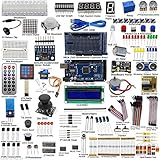
- This is an upgrade complete Arduino starter kit designed for beginners and electronic hobbyists.
- With more than 33 projects, it is esay and convenient for you to learn Arduino and programming. If you need the guide of the projects, just email us after you getting the mega2560 starter kit..
- The starter kit will make a great gift for any to-be engineers, or anyone looking to get a jump start in the world of microcontrollers and programming. Hundreds of tutorials and guides can be found online and the range of projects that can be created with an Arduino is vast
- This kit comes with everything that the average beginner Arduino project requires, plus more, 50 kinds of different electronic components, more than 180 components, such as Arduino Mega2560, 1602 LCD display are included. It has enough variety to learn most of what can be done with the arduino and electronics in general
- The kit is a great help for you learning electronics! Lots of little bits to start doing Arduino things
What had happened by 2026
The effort had moved from legislation into implementation, but the available milestones do not establish that the United States had already overtaken China or completed the transformation the law sought.
- Commerce’s FY2024 Annual Performance Report said roughly $3 billion had been committed to R&D opportunities during FY2024. A commitment is not the same as money fully spent or a completed facility. The report is available at Commerce’s FY2024 Annual Performance Report.
- NIST’s CHIPS R&D funding page listed opportunities in 2025 and 2026, indicating that implementation continued beyond the initial announcements. See NIST’s CHIPS R&D funding opportunities.
- NIST’s CHIPS page listed a June 2026 award of $250 million to I-Pulse for development of novel silicon-carbide semiconductors. An award is a project milestone, not proof that the technology has reached commercial production. See NIST’s CHIPS for America page.
Congressional Research Service material on FY2025 funding also lists about $1.03 billion for the NSTC, $23 million for metrology, and $25 million for Manufacturing USA institutes. These are FY2025 allocation figures, not a summary of all spending since enactment. Details are in CRS’s FY2025 CHIPS funding analysis.
How to judge whether the push is working
Funding announcements alone cannot show whether the policy is delivering durable industrial capacity. More useful tests track whether the programs create access and results over time:
- Research-to-production: Are supported technologies advancing from research through pilot lines into commercial manufacturing?
- Domestic capability: Are U.S. strengths improving in advanced packaging, measurement, materials, and process development?
- Use of shared infrastructure: Are companies, universities, and smaller firms using NSTC and related facilities, and does that access lower the cost of R&D?
- Commercialization: Are projects producing prototypes, licensing deals, startups, patents, or manufactured products?
- Workforce: Are training programs producing qualified technicians, engineers, and process specialists at a pace that matches industry needs?
- Resilience and coordination: Is dependence on concentrated foreign production falling in strategically important categories, while the United States coordinates effectively with allies?
- Cost effectiveness: Are public facilities and awards generating capability that would otherwise be underprovided, rather than duplicating existing public or private resources?
What the investment cannot guarantee
Semiconductor R&D is a long-term effort, and federal funding cannot ensure that promising research becomes a profitable product. The program also cannot replace the roles of Taiwan, South Korea, Japan, and Europe across the full supply chain, or remove U.S. dependence on imported equipment, chemicals, materials, and finished chips.
Quick wins for a faster PC:
Fix the driver behind crashes, sound loss and screen glitchesFind Drivers →Clear out junk files and repair common Windows errorsFree Scan →Execution brings trade-offs. Moving money quickly can conflict with oversight and technical due diligence. Shared facilities can accelerate research while raising questions about access to sensitive technology. Concentrating on leading-edge chips may leave vulnerabilities in mature-node chips used in automobiles, industry, power systems, and defense. Domestic production can improve resilience but cost more than a globally optimized supply chain.
Other risks include facilities that are built but underused, overlapping programs, worker shortages, projects that fail to scale, and intellectual-property terms that discourage participation. Government may also back technologies that do not prove commercially competitive. Whether these risks materialize depends on implementation and market outcomes, not on the statutory allocation alone.
Quick Recap
Product prices and availability are accurate as of the date/time indicated and are subject to change. Any price and availability information displayed on Amazon at the time of purchase will apply.




