What’s actually slowing this PC down?
Pick the symptom - the matching free tool is one click away.
A contract electronics manufacturer (CEM) performs production work for another company, turning supplied or procured components into boards, subassemblies, servers, or—in some arrangements—rack-scale systems. In the AI server supply chain, it connects component suppliers with the company selling or deploying the equipment. Its exact responsibilities depend on the contract: the label alone does not establish who designs the system, buys every part, validates the finished server, or provides customer support.
Where contract manufacturing fits in the AI server supply chain
AI hardware passes through specialized stages before it reaches a data center: chip design, semiconductor fabrication and packaging, memory and other component supply, board and subassembly production, server and rack integration, and deployment. A CEM generally works in the production and integration stages, after key components have been designed and made.
The Bank of Italy’s 2026 paper describes packaged GPU modules moving to server makers, which integrate complete servers and racks with networking, mechanical, electrical, and cooling components. A manufacturer may handle one stage or several, depending on the product and customer arrangement.
How the business labels differ
- OEM: An original equipment manufacturer sells equipment under its own brand.
- ODM: An original design manufacturer builds custom equipment for another company’s brand and may also take responsibility for product design.
- CEM: A contract electronics manufacturer is hired to carry out manufacturing work, often to a customer’s design or specification.
These are descriptions of roles, not mutually exclusive corporate identities. One company can provide different services for different customers. The Bank of Italy paper names Quanta Computer/QCT, Wiwynn, Inventec, and Foxconn/Hon Hai as server ODM examples, and Dell Technologies, HPE, and Lenovo as server OEM examples. These are examples from that paper, not a complete roster or ranking.
Windows Errors? Fix Them Before They Spread
Repair common Windows errors and clear accumulated junk for a smoother, more stable PC - no reinstall needed.Free scan · no reinstallOutdated Drivers Are Slowing You Down
One free scan finds every outdated or missing driver and matches the right update for your exact hardware.Free scan · exact hardware match#1 Best Overall
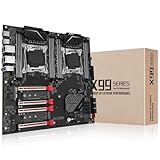
- Intel dual CPU sockets: This C612 server chip motherboard is designed with dual CPU sockets, which can support Intel Core i7 5th/6th generation processors and Xeon E5 V3/V4 series processors on LGA 2011-3 socket. (Note: If only one CPU is installed, please install it in the right slot, and the graphics card needs to be installed in the bottom two slots.)
- DDR4 4-channel memory slot: The memory slot of the LGA 2011-3 motherboard is designed with four channels, which can install 8 memory. It supports effective frequencies of 2133/2400MHz, and the maximum capacity is 256GB. (Non-ECC memory is not compatible when using E5 V4 series processors)
- PCIe 3.0 protocol standard: Equipped with 4 PCIe 3.0 X16 graphics card slots (with steel case). The transfer rate can reach 15.754 GB/s using one graphics card, and the performance can be improved by at least 50% by using two graphics cards. Equipped with dual M.2 hard disk slots, it can achieve fast reading even if multiple programs are running
- Stable power supply: use 24+8+8pin standard power supply interface (need to use a dedicated power supply for dual server motherboards), 12 (CPU) + 4 (memory) + 1 (C612 chip) phase power supply. Precise modularization provides good heat dissipation and makes the program run more stably
- Strong expandability: The X99 motherboard is equipped with multiple expansion interfaces to ensure that the motherboard has more room for improvement. These include 4*USB 3.0 ports, 4*USB 2.0 ports, 10*SATA 3.0 ports, 4*3pin sys fan, 2*4pin CPU fan. Besides, dual network ports allow your computer to do more things
What the manufacturer coordinates
Parts and build readiness
Assembly depends on the required components being available. NVIDIA says its contract manufacturers cannot start assembly until all needed parts have arrived. Materials may come directly from NVIDIA, from stock NVIDIA holds on consignment, or from other suppliers. If one part is late, components that arrived earlier may have to wait.
This means a factory’s production plan is not simply a matter of assigning workers or machines. It also depends on whether the full set of components for a given build is ready.
Rank #2

- Rigorously Tested for Perfect Performance Every product is 100% tested before shipping to ensure stable operation and flawless performance, so you can start using it immediately without any concerns.
Allocation and production capacity
When parts are constrained, the platform owner may decide how to allocate them across manufacturing sites. NVIDIA describes this as a critical-material allocation problem: a site’s ability to build a particular subassembly, along with its throughput once parts arrive, affects how much it can produce.
Capacity and availability can therefore interact. More factory capacity does not by itself resolve a shortage of a required component, while available components do not guarantee output if the relevant site lacks the capacity or throughput to process them.
Quick wins for a faster PC:
Scan for outdated or missing drivers - takes under a minuteDriver Scan →Clear out junk files and repair common Windows errorsFree Scan →Fix the driver behind crashes, sound loss and screen glitchesFind Drivers →Rank #3

- AMD socket sTR5 supports up to 96-core CPUs: Ready for AMD Ryzen Threadripper PRO 9000 & 7000 WX-Series Processors and AMD Ryzen Threadripper 9000 & 7000 Series Processors.
- Ready for Advanced AI PC: Designed for the future of AI computing, with the power and connectivity needed for demanding AI applications
- CPU and memory overclocking: Support for up to 1TB ECC R-DIMM DDR5 memory modules (1DPC)
- Robust Power & Thermal Design: 20 power stages with two 8-pin power connectors for the CPU, massive VRM cooling, chipset and M.2 heatsinks, and M.2 thermal pad.
- Ultrafast Connectivity: Three PCIe 5.0 x16 slots, one PCIe 4.0 x16 slot, two USB4 (40Gbps) ports, 10 Gb & 2.5 Gb LAN ports, four M.2 slots, front USB 20Gbps Type-C ports, and SlimSAS NVMe support.
Assembly, testing, and quality
Contracted work can include assembly, testing, and packaging. NVIDIA’s fiscal 2025 Form 10-K says it engages independent subcontractors and contract manufacturers—including Hon Hai Precision Industry, Wistron, and Fabrinet—to perform those activities for its final products. The filing describes NVIDIA’s own supplier relationships; it does not establish that each named company performs every stage or builds every AI server.
NVIDIA also says it uses supplier expertise in quality control, assurance, reliability, and testing. Do not assume that a manufacturer is responsible for final system validation, firmware, warranty, or customer support unless the specific contract or another reliable source establishes that scope.
Rank #4

- Ready for advanced AI PCs: Designed for the future of AI computing, with the power and connectivity needed for demanding AI applications
- Intel LGA1851 socket: Ready for Intel Core Ultra 9, 7, and 5 desktop processors
- Robust performance: 16+2+1+2 teamed power stages, ProCool II power connectors, high-quality alloy chokes and durable capacitors
- Future-proofed connectivity: Thunderbolt 4, 10Gb & 2.5Gb Ethernet, two PCIe 5.0 PCIe slots with full support for next-gen graphics cards, one PCIe 5.0 M.2 and three PCIe 4.0 M.2 slots and a USB 20Gbps front-panel header
- Exclusive AI and overclocking technologies: AI Overclocking, AI Cooling II, AI Advisor and NPU boost
Timing and work in process
NVIDIA uses the term Time of Ownership for the time between a manufacturing site receiving material and that material leaving as part of a subassembly or product. This company-specific measure illustrates why component timing and work in process matter; it is not established as a universal industry standard.
Independent reader supportYour contribution helps us test, update, and keep practical guides available for everyone.Why the scope varies by system
“AI server” can refer to equipment assembled at different levels: a board, a compute tray, a complete server, or a rack-scale system. The contract determines which of those the manufacturer builds and where its responsibility ends.
The Tool Desk
Outbyte Driver Updater FREEScan for outdated or missing drivers - takes under a minuteDriver Scan →Outbyte PC Repair FREEClear out junk files and repair common Windows errorsFree Scan →Best Value
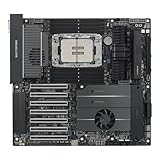
- Ready for Advanced AI PC: Designed for the future of AI computing, with the power and connectivity needed for demanding AI applications
- Intel LGA 4710-2 socket: Ready for Intel Xeon? 600 Processors for Workstation
- CPU and memory overclocking: The performance of ECC R-DIMM DDR5 memory (1DPC) is further enhanced by the exclusive NitroPath DRAM technology
- Ultrafast connectivity: 7 PCIe 5.0 x16 slots, Dual Intel E610-XAT2 10Gb LAN, 4 M.2, MCIO, 2 SlimSAS, and USB4? and USB 20Gbps Type-C
- Server-grade IPMI remote management: Hardware and software-level with a dedicated LAN port link to AST2600 BMC controller, plus a real-time monitoring and management software – ASUS Control Center Express
For scale, NVIDIA’s 2026 description says one GB200 NVL72 compute tray requires two Grace CPUs, four Blackwell GPUs, and 32 HBM3e stacks. That is a configuration example for this named system, not a typical bill of materials for AI servers generally. The same NVIDIA source characterizes the supply chain it created for Vera Rubin as twice as large as Grace Blackwell; that is NVIDIA’s description of its own product supply chain, not an industry-wide statistic.
An older NVIDIA announcement from 2017 described OEM and ODM partners using the HGX reference architecture to design qualified GPU-accelerated systems for hyperscale data centers. It illustrates how a reference design can inform partner products, but it concerns the Volta/Tesla V100 era and should not be read as a current product lineup.
How to assess a manufacturer’s role
When comparing manufacturing arrangements or evaluating who does what, seek clear answers to these questions. The available sources do not support a ranked vendor comparison.
- Build scope: Is the company making a subassembly, a complete server, or a rack-scale system?
- Design responsibility: Is it building to a customer’s specification, or also taking on product design?
- Materials: Who procures critical components, and which parts are customer-supplied or held on consignment?
- Testing and quality: Which tests and quality responsibilities are included, and where does the manufacturer’s responsibility end?
- Capacity and location: Which sites can perform the required build, and what throughput is available?
- Supply changes: How does the arrangement handle changing component availability and allocation?
These questions matter because a manufacturer’s name or broad industry label does not, by itself, reveal its exact role in a particular AI server program.
Quick Recap
Product prices and availability are accurate as of the date/time indicated and are subject to change. Any price and availability information displayed on Amazon at the time of purchase will apply.




