Probably not at the level of estimated hardware production cost. A 1996 industry estimate put the Nintendo 64’s 1997 system production cost at $162, while contemporary reporting gave its U.S. launch retail price as $199.95. That comparison suggests the console was priced above its estimated production cost, but it does not establish how much Nintendo received or whether it made a profit on each unit.
What the period figures show
| Figure | What it represents | Source and qualification |
|---|---|---|
| $162 | Estimated Nintendo 64 system production cost for 1997 | Dataquest industry estimate dated December 23, 1996; not a Nintendo disclosure or audited cost. Los Angeles Times report on Dataquest’s estimate |
| $199.95 | Reported U.S. launch retail price | United Press International report dated December 27, 1996; this is a retail price, not Nintendo’s wholesale revenue. UPI report |
The figures point in one direction: the N64 was not apparently being sold below the estimated cost of producing the system. But subtracting $162 from $199.95 does not yield Nintendo’s profit per console. Retailers may retain part of the selling price, and the production estimate does not establish Nintendo’s complete costs for distribution, marketing, warranty service, or other expenses.
| # | Preview | Product | Price | |
|---|---|---|---|---|
| 1 |

|
Nintendo 64 Console, Premium Bundle (Renewed) | $162.99 | Buy on Amazon |
| 2 |

|
Nintendo 64 System - Video Game Console (Renewed) | $126.12 | Buy on Amazon |
| 3 |
|
Nintendo 64 (Renewed) | $169.98 | Buy on Amazon |
| 4 |

|
Nintendo 64 System - Video Game Console | $90.00 | Buy on Amazon |
| 5 |

|
N64 System with Controller, Hookups, and Mario 64 Game (Renewed) | $216.60 | Buy on Amazon |
Why the estimate is not a profit figure
The $162 number is an analyst estimate for system production, not a company-reported accounting figure. The $199.95 number is a reported retail price. Those are different kinds of figures, so the comparison is useful as an indication of pricing relative to estimated hardware cost, not as a calculation of Nintendo’s unit margin.
No N64-specific Nintendo disclosure of per-console hardware cost, wholesale receipts, or profit or loss is established by the available period reporting. The precise answer to “Did Nintendo lose money on each N64?” is therefore unknown; the strongest supported conclusion is that the console’s retail price was above a contemporary estimate of its production cost.
What’s actually slowing this PC down?
Pick the symptom - the matching free tool is one click away.
#1 Best Overall
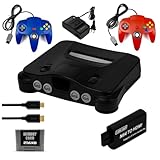
- Nintendo 64 Console (Black): Retro gaming console in a sleek black finish.
- Two Controllers (Red & Blue): Includes two vibrant controllers for multiplayer gaming.
- 256KB Memory Card: Save your game progress easily with ample storage.
- HDMI Adapter: Modern connectivity for easy setup with today’s TVs
- Power Adapter: Essential power supply included for immediate play.
Do cartridge costs change the answer?
No. A March 1996 Los Angeles Times article reported that N64 cartridge media cost more than $25 per cartridge, including license, compared with $10–$15 for a CD-ROM. That comparison concerns the cost of making game media, not the N64 console itself. It may help explain a disadvantage for software publishers or a difference in game economics, but it does not show whether Nintendo sold the hardware at a loss.
What Nintendo later said about hardware sold below cost
In a 2006 briefing about Wii and Nintendo’s Wii business plan, Nintendo president Satoru Iwata cautioned against treating below-cost hardware sales as automatic: “Some take it for granted nowadays that video game hardware is sold below cost, at least initially, but I don’t think it should be regarded as common sense.” His remarks offer general context about hardware pricing, but they are not evidence of the N64’s per-unit economics. Nintendo’s 2006 briefing
Independent reader supportYour contribution helps us test, update, and keep practical guides available for everyone.What about the $250 figure?
A March 1996 Los Angeles Times article described the N64 as a “$250 Nintendo 64,” reflecting pre-launch reporting. That figure should not be confused with the $199.95 U.S. launch retail price reported later in 1996. The dates and contexts differ, and neither retail figure is Nintendo’s wholesale receipt.
Quick Recap
Best Value
- Nintendo 64 game console
Rank #4
- 64-Bit Graphics
- Cartridge based game system (no scratched games!)
- Excellent game library available (over 300)
- Inexpensive compared to newer gaming systems
Rank #3
- Sleek Black N64 Console: A classic Nintendo 64 reimagined in a bold black finish, blending retro charm with a modern aesthetic.
- Two Vibrant Controllers: Jump straight into multiplayer fun with a red and blue controller included, perfect for head-to-head gaming sessions.
- Save & Store with Ease: The included 256KB memory card gives you plenty of space to save game progress across your favorite titles.
- Modern Display Ready: An HDMI and cable are included, delivering a clean, high-quality connection to today's TVs right out of the box.
- Everything You Need to Play: Complete with a power and all essentiala, this is ready for instant setup — ideal for nostalgic fans and curious newcomers alike.
Product prices and availability are accurate as of the date/time indicated and are subject to change. Any price and availability information displayed on Amazon at the time of purchase will apply.
Do these 3 things before closing this tab:
1Fix the driver behind crashes, sound loss and screen glitches2Clear out junk files and repair common Windows errors3Scan for outdated or missing drivers - takes under a minute



