If you sell gold or silver that you hold as an investment, the sale is generally a taxable event for a U.S. individual. A gain is taxed as a capital gain, and a loss can be deducted as a capital loss. The complication is classification. Bullion and most coins fall under the IRS collectibles framework, so a long-term gain can be taxed at up to 28%, a maximum rate that is higher than the rates that apply to most other long-term capital gains. Your actual result depends on how long you held the metal, your basis, your taxable income, and the account or product that holds it.
This guide covers general U.S. federal income tax for individual investors. It does not address state or local taxes, non-U.S. tax systems, dealers, gifts, inheritances, estates, or the tax bill of any specific person. Rules and references are current as of October 2026.
Do you owe tax when you sell gold or silver?
Usually, yes, if the sale produces a gain. IRS Publication 544 treats gold, silver, gems, stamps, and coins as capital assets, except when a dealer holds them for sale. Publication 525 applies this directly to investment items: when bullion or investment coins are sold, a gain is taxable as a capital gain and a loss is deductible as a capital loss. That deductibility is the key difference from personal-use property, where a loss generally cannot be deducted.
A sale at a profit is not the only taxable event. Any sale or exchange of the metal is a disposition, so the same calculation applies whether you sell coins to a dealer, sell through a brokerage, or trade one holding for another.
The Tool Desk
Outbyte Driver Updater FREEFix the driver behind crashes, sound loss and screen glitchesFind Drivers →Outbyte PC Repair FREERepair Windows errors before they cause bigger problemsFix Now →#1 Best Overall

- Authentic Solid Gold Bars - Each set includes 3 solid gold bars made from real 10K or 14K gold. Certified for purity and authenticity, these bars are ideal for collectors, investors, or those looking for a timeless, tangible asset.
- Premium Craftsmanship & Finish - Our gold bars are expertly crafted with a high-polish finish and clear stamping, showcasing the karat value and weight. Elegant and durable, they offer a luxurious feel perfect for display or secure storage.
- Ideal for Gifting or Investment - Whether you're marking a special occasion or diversifying your portfolio, these gold bars make a unique and valuable gift. Great for anniversaries, birthdays, or as a smart financial hedge against inflation.
- Compact, Secure & Easy to Store - Each bar is compact yet substantial, designed for discreet and efficient storage. Includes secure packaging to maintain quality and prevent tarnishing during handling or long-term storage.
- Trusted Quality with Certificate of Authenticity - Buy with confidence every set comes with a Certificate of Authenticity verifying gold content and karat. Manufactured and sourced to meet industry standards, ensuring lasting value and credibility.
How gain or loss is calculated
For a typical investor, the calculation is amount realized minus adjusted basis. Amount realized is what you receive for the metal, net of selling costs. Basis is generally what you paid, adjusted under the rules that apply to your situation. Because each purchase can have a different cost and holding period, most investors calculate gain or loss lot by lot rather than on their whole position.
Keep the following records for every purchase and sale so that each lot’s basis and holding period can be established:
- Purchase confirmations or dealer invoices showing the date, quantity, and price paid
- Fees and commissions paid at purchase, which can affect basis
- Sale confirmations showing the date, quantity, price received, and any selling costs
- Any statement of basis your broker or custodian provides
Metals received as a gift or inheritance follow different basis and holding-period rules. This guide does not cover those rules, so do not assume the purchase-price method applies to them.
The 28% collectibles rate, explained
The IRS places gold, silver, and platinum bullion, along with coins, among collectibles. Publication 550 defines collectibles gain or loss as gain or loss from the sale or trade of specified collectibles held for more than one year. IRS Topic 409 states: “Net capital gains from selling collectibles (such as coins or art) are taxed at a maximum 28% rate.”
Rank #2

- 99.99% pure Features LBMA registered mark and kangaroo-shaped motif Tamper-evident packaging with serial number
What the 28% figure means
The 28% is a ceiling in the rate schedule for the relevant net long-term collectibles gain. It is not a flat tax that applies to every sale. Where your ordinary income tax rate on that gain is lower than 28%, the lower rate framework governs. Where it is higher, the 28% cap limits the rate. The final figure depends on your taxable income and on how the gain is netted against other capital gains and losses in your return.
Holding period decides which framework applies
A capital asset held for more than one year is generally long-term. A holding period of one year or less is short-term. Net short-term capital gain is taxed at ordinary graduated income-tax rates, not at the collectibles framework. This means a metal sold after a year or less can be taxed more heavily than a metal held longer, even though both are the same asset class.
Not every precious-metal gain is taxed at 28%. Holding period, losses, income, taxpayer status, and the structure of the asset all matter.
Losses on metals
Because investment metal is not personal-use property, a loss can be deducted. Losses are netted against gains first. If the result is a net capital loss, up to $3,000 per year ($1,500 if married filing separately) can offset other income, and any remaining loss is generally carried forward to later years.
Free tools Windows power users keep installed
One-click scans. No signup required.
Rank #3
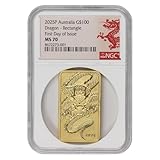
- Certified First Day of Issue
- Produced at The Perth Mint
- FULFILLED IN HOUSE - Australia 2025 1oz Gold Dragon Bar NGC MS70 FDOI Lunar Label
- Graded MS70 by NGC
- 1 ounce of 24 Karat Gold
Do you need a Form 1099-B to report a gold sale?
No. Whether a broker sends you a Form 1099-B and whether you must report a taxable sale on your return are separate questions. Your obligation to report a taxable disposition does not depend on receiving a form.
What the broker reporting exception covers
The 2026 Form 1099-B instructions allow a broker to treat certain precious-metal sales as nonreportable when either of two conditions applies:
- The metal’s form is not one for which the Commodity Futures Trading Commission has approved trading by regulated futures contract.
- The quantity sold is below the minimum needed to satisfy the relevant contract.
For this exception, the instructions require the broker to aggregate a customer’s sales during a 24-hour period. The exception does not apply if the broker knows or has reason to know the customer is arranging sales to avoid reporting. The IRS posted a correction dated January 30, 2026, revising the precious-metals text in the 2025 and 2026 instructions. Check the current instructions and that correction for the tax year you are filing.
An exception from broker reporting is not a tax exemption
When a sale falls under the broker exception, the broker may not send a 1099-B for it, but the gain or loss is still taxable or deductible on your return. Treat the absence of a form as a missing document, not as a tax-free sale.
Rank #4

- Purity: .9999 Fine Gold; 24K
- Metal Content: 0.1 Troy Ounces
- Stock Photo; Image is indicative of quality
- Dimensions: Length: 20 mm; Width: 11mm; Depth: 1 mm
- You will receive one bar per purchase with documentation of authenticity
How to report a metal sale
- Assemble the purchase and sale records for each lot, and determine each lot’s holding period from the purchase date to the sale date.
- Report each sale on Form 8949. Use the Form 8949 category that matches the holding period and whether your broker reported basis to the IRS.
- Carry the Form 8949 totals to Schedule D, where net short-term and net long-term results are combined and the collectibles gain is identified for the rate calculation.
- Where your sales were not reported on a 1099-B, enter the sale information from your own records rather than leaving the transaction off the return.
Gold and silver in retirement accounts
Retirement-account treatment depends on the specific coin or bullion and the custody arrangement. IRS retirement-plan guidance describes exceptions to the collectibles definition for specified gold, silver, or platinum coins, and for qualifying bullion of a required fineness, when a bank or an approved non-bank trustee has physical possession of the metal.
- Metal held in an account with qualifying custody can fall outside the collectibles definition.
- Metal that does not meet the coin or fineness requirements, or that is kept outside qualifying custody, is treated as a collectible.
- In an individually directed account, acquiring a collectible can be treated as distributing the collectible’s cost to the participant in that year.
Holding a coin or bullion in an IRA does not, by itself, make it qualify. Confirm the exact product, its fineness, and the custodian’s arrangement with the plan custodian before you buy.
Funds, trusts, and partnerships
Exchange-traded products that hold metal do not all have the same tax result. Publication 550 includes collectibles and discusses gain attributable to unrealized appreciation of collectibles held through a partnership, an S corporation, or a trust. The legal structure of the product, and how it reports to you, therefore matter. Check the product’s prospectus and its annual tax statement for product-specific treatment. General IRS guidance does not establish the treatment of any named fund.
Comparing your holdings
The same metal can be taxed differently depending on how it is held. The table below compares the main arrangements using the published rules.
Do these 3 things before closing this tab:
1Fix the driver behind crashes, sound loss and screen glitches2Repair Windows errors before they cause bigger problems3Scan for outdated or missing drivers - takes under a minute| Holding arrangement | Classification | Rate framework on long-term gain | Reporting |
|---|---|---|---|
| Bullion or coins held directly in a taxable account | Capital asset and collectible | Maximum 28% on net long-term collectibles gain; ordinary rates if lower | Form 8949 and Schedule D; broker reporting may be excepted |
| Shares or interests in a fund or trust holding metal | Depends on the product’s legal structure | Not stated in general IRS guidance; see the product’s annual tax statement | Per the product’s tax statement |
| Qualifying coin or bullion in a retirement account with bank or approved non-bank trustee custody | Exception from the collectibles definition | Governed by the retirement account’s rules | Reported by the retirement account |
| Coins or bullion in an individually directed account without qualifying custody or fineness | Collectible | Cost can be treated as a distribution to the participant in the year acquired | Per retirement-account rules |
| Metal held by a dealer for sale | Business property, not a capital asset | Not covered by this guide | Not covered by this guide |
Before you apply the comparison to your own holdings, separate your lots by holding period and confirm each lot’s basis. Those two facts decide which row of the table applies to each sale.
Quick Recap
Product prices and availability are accurate as of the date/time indicated and are subject to change. Any price and availability information displayed on Amazon at the time of purchase will apply.




