The Tool Desk
Outbyte PC Repair FREERepair Windows errors before they cause bigger problemsFix Now →Outbyte Driver Updater FREEFix the driver behind crashes, sound loss and screen glitchesFind Drivers →Semiconductor fabs make ultrapure water (UPW) through a connected treatment and distribution system, not with reverse osmosis (RO) alone. Pretreatment protects membranes; RO reduces dissolved constituents; and downstream steps such as electrodeionization (EDI), mixed-bed ion exchange, ultraviolet treatment, degasification and filtration address remaining contaminants. The exact train depends on the sourcewater, process requirements and site design.
What a fab UPW system does
UPW is used to rinse away residues during semiconductor production. The challenge is not simply to remove dissolved salts: a system must also manage organics, dissolved gases, particles and specific ionic contaminants while delivering water through storage and distribution equipment to points of use.
DuPont describes the broad treatment sequence as pretreatment, membrane separation and post-treatment. RO is a major separation step, but its permeate ordinarily needs further polishing in stringent UPW service. A resistivity reading is one measure of water quality, not a complete specification for every fab process.
How the treatment stages fit together
1. Pretreatment protects downstream equipment
Feedwater pretreatment removes suspended matter and organics that could burden membranes or later polishing stages. In one supplier example, Veolia places multimedia and activated-carbon filtration before RO. That diagram illustrates a possible design, not a required recipe for every fab.
#1 Best Overall

- PATENTED DESIGN – The top-mounted fastener allows for easy countertop installation entirely from above, eliminating the hassle of tightening the nut from underneath the sink.
- MINERAL BOOST – The patent-pending natural mineral AK stage delivers spring water with a balanced, healthy pH and multiple essential minerals.
- SEE WHAT’S CAUGHT – The transparent first-stage filter housing makes it easy to monitor contaminant buildup, ensuring timely filter changes.
- NSF 58 CERTIFIED RO SYSTEM – Unlike other brands that lack NSF certification or full system certification, our RCC7AK is certified to NSF/ANSI 58 standards for the entire water filtration system.
- EFFECTIVE FILTRATION – Reduces TDS (93-98%), PFAS (96-99%), Chlorine (95-99%), Asbestos (>99.7%), Barium (>98.4%), Cadmium (>98.8%), Chromium (>99.2%), Copper (>97.8%), Fluoride (>97.4%), Lead (>98.9%), Selenium (>99.0%), and over 1,000 other contaminants.
2. RO reduces dissolved constituents
RO membranes reduce dissolved salts and other constituents before final polishing. DuPont gives typical dissolved-salt rejection of 95–99% or greater, with performance dependent on the membrane, feed composition, temperature and system design. This is a general manufacturer description, not a guaranteed result for a specific plant or a full UPW quality specification.
Semiconductor-grade RO elements are not interchangeable on the basis of a single headline metric. DuPont positions its SG30-400/34i for polishing in traditional, higher-pressure UPW equipment; its product sheet says the 34-mil feed spacer helps reduce fouling and pressure-drop impacts. DuPont positions the SG30LE-440i for newer equipment where lower capital and energy costs may add value. These are manufacturer product claims; the cited material does not establish comparative fab-level lifecycle savings.
Rank #2
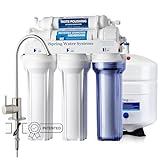
- EFFECTIVELY REDUCES CONTAMINANTS - The iSpring RO system delivers clean, pure, and great-tasting drinking water by removing up to 99% of over 1,000 harmful contaminants, including PFAS, chlorine, fluoride, lead (up to 98%), arsenic, asbestos, calcium, and sodium. It also reduces TDS by 80-90% and reduces hard water minerals that cause scale buildup.
- CERTIFIED TO NSF/ANSI 58 - Produced to strict American quality standards, this iSpring reverse osmosis system is NSF/ANSI 58 certified. For over 15 years, it has provided American families with unlimited, crisp, and refreshing water, superior to bottled water
- LOW MAINTENANCE & LEAK-FREE DESIGN - Engineered with premium components for long-term reliability and minimal upkeep. The transparent first-stage filter housing allows for quick inspections. This compact system fits under most kitchen sinks, requires no power source, and features a check valve to prevent backflow, ensuring safety and leak prevention. The AS-material filter housing offers impact resistance while making filter condition checks effortless.
- HIGH-QUALITY DESIGN & GREAT TASTE - Enjoy clean, safe, and fresh-tasting water with the iSpring under sink RO system. It includes a 100% lead-free designer faucet and food-grade tubing, ensuring crystal-clear ice cubes, fresher tea and coffee, better-tasting food, and healthier baby formula. The system’s advanced filtration reduces contaminants down to 0.0001 microns, while a fine GAC filter provides final polishing for exceptional water quality.
- 100% CUSTOMER SATISFACTION - The RCC7-BN is one of America’s highest-rated under sink reverse osmosis systems. It comes with a 1-year limited manufacturer warranty upon registration, lifetime personalized support from GA, USA, and premium-quality components to deliver bottled-quality drinking water for years to come—helping reduce plastic waste
3. Polishing targets what remains
After RO, ion exchange or EDI can further reduce ionic contaminants. Depending on the design, additional stages address organics, dissolved gases and particles. Veolia’s example includes TOC ultraviolet (UV) treatment, membrane degasification, continuous electrodeionization (CEDI), mixed beds and final filtration. Its polishing loop also shows a UPW tank, heat exchange, additional degasification and a cold deionization ultrafilter.
These stages form a layered barrier strategy: UV treatment is included for total organic carbon (TOC) control, degasification for dissolved gases, ion exchange for ionic polishing, and final filtration or ultrafiltration for particles. The supplier diagram also depicts hot and cold distribution-loop returns and supplies. It demonstrates why a fab system includes production, storage, conditioning, polishing and distribution—not just a membrane skid. It does not show that every fab uses this exact sequence.
Quick wins for a faster PC:
Repair Windows errors before they cause bigger problemsFix Now →Scan for outdated or missing drivers - takes under a minuteDriver Scan →Rank #3

- 𝗘𝗳𝗳𝗶𝗰𝗶𝗲𝗻𝘁 𝗣𝘂𝗿𝗶𝗳𝗶𝗰𝗮𝘁𝗶𝗼𝗻, 𝗣𝗲𝗮𝗰𝗲 𝗼𝗳 𝗠𝗶𝗻𝗱: The DREO 7‑in‑1 RO water filter filters out 99.9% of possible contaminants in water including PFOA, PFOS, chlorine, fluoride and more. It was tested by SGS meeting NSF/ANSI 58 Standards.
EDI and mixed-bed ion exchange compared
EDI uses electrical current to move ions into a reject or concentrate stream while continuously regenerating ion-exchange resin inside the module. DuPont presents EDI as a continuous, chemical-free alternative to conventional mixed-bed ion exchange for polishing RO permeate; electricity is its stated consumable. Conventional mixed beds also appear in supplier UPW diagrams, including as later polishing stages in Veolia’s example.
| Option | How it is used | Input or operating distinction | What the available evidence establishes |
|---|---|---|---|
| EDI | Continuous polishing of RO permeate | Electrical operation; DuPont describes it as avoiding chemical regeneration and associated chemical storage and handling | DuPont lists semiconductor manufacturing for its EDI-310 and claims the module can produce up to 18 megohm-centimeter water. That is a product capability claim, not a plant-wide guarantee. |
| Mixed-bed ion exchange | Conventional ionic polishing; may also appear later in a polishing train | Resin is chemically regenerated in conventional service | Veolia’s supplier diagram includes primary and polishing mixed beds. The cited sources do not give a controlled, fab-specific comparison with EDI. |
The sources do not establish which option has lower fab-specific capital or operating cost, better uptime, more stable quality, or less contaminant breakthrough. Selection and sequencing therefore need to reflect the feedwater, target species, maintenance capability, operating model and quality-monitoring plan. EDI and mixed beds should not be treated as universally interchangeable or as a simple winner-versus-loser choice.
Rank #4

- [Trusted certifications]: Waterdrop G3P600 reverse osmosis system is certified against NSF/ANSI 58 for TDS reduction and NSF/ANSI 372 certified for lead-free material. Also it has been tested and certified against NSF 42 to reduce chlorine, bad taste and odor. The tankless reverse osmosis system is also certified by the Federal Communications Commission. Besides, it meets the EU Standards and UKCA Standards for safety
- [8-stage filtration]: Tested by official third-party laboratory (SGS), the reverse osmosis system can effectively reduce TDS, chromium, PFAS, radium, fluoride, arsenic salt, iron, calcium, particles, chloride, chlorine and radioactive substances in your tap water. And our RO water filter system can reduce chemicals such as vinyl chloride, ethylhexyl acrylate, isobutylene, ethylene glycol, according to the reverse osmosis membrane technical manual
- [Smart display faucet]: The tankless reverse osmosis system is built with a smart display faucet. For instance, the TDS monitor tells you the quality of your filtered water, while the filter life tracker shows how soon you need to replace your filter
- [High capacity, 2:1 low drain ratio]: As an upgraded reverse osmosis system, this reverse osmosis water system produces 600 gallons of filtered water per day. By its low drain ratio, this system can produce only one cup of waste water for every two cups of pure water produced. Furthermore, with a fast and stable water flow rate, this RO system fills a 8 oz cup of water in 8 seconds, which is ideal for drinking and washing vegetables
- [Tankless design]: Waterdrop G3P600 reverse osmosis system has a stylish look. This tankless design saves 70% under sink space. You can change a filter in 3 seconds without moving the system or using any tools. Note: This reverse osmosis system requires under-sink electricity
Why different contaminants need different controls
- Salts and other ions: RO reduces dissolved constituents; EDI or mixed-bed ion exchange provides downstream ionic polishing.
- Organics: The Veolia example includes TOC UV treatment. DuPont describes its AmberTec UP7530 as a semiconductor-grade, boron-selective resin with low TOC leaching and high resistivity as stated benefits.
- Boron and other demanding ionic targets: DuPont describes AmberTec UP7530 as intended for stringent high-purity water and AmberTec UP9600 and UP9700 as resins developed for semiconductor UPW production. These are specialized media choices, not general consumer water-softening products.
- Dissolved gases: Membrane degasification appears in Veolia’s example train.
- Particles: Final filtration and cold DI ultrafiltration appear in that example; their placement is part of the overall system design.
DuPont describes 18.2 megohm-centimeter resistivity as a rigorous resistivity for UPW used to rinse integrated circuits. Resistivity alone does not show whether water meets every relevant limit for organics, gases, particles or a particular fab process.
Independent reader supportYour contribution helps us test, update, and keep practical guides available for everyone.Water reuse belongs in the wider site design
UPW production is only one part of a fab’s water strategy. Reclamation, reuse, resource recovery and wastewater discharge requirements can affect how a site balances water supply with treatment and operations. Supplier materials discuss minimum-liquid-discharge and zero-liquid-discharge directions, but the sources available here do not establish comparable fab-level recovery rates, energy use, costs or savings. Those outcomes should be evaluated for the specific site rather than assumed from a process diagram or vendor description.
Best Value
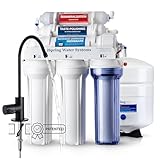
- ALKALINE FILTRATION WITH SLEEK BLACK FAUCET - This advanced 6-stage RO system restores natural alkalinity and essential minerals, delivering better-tasting water compared to standard 5-stage systems. The included black RO faucet enhances your kitchen’s style with a modern, sophisticated touch.
- EFFICIENT IMPURITY REDUCTION - Reduces up to 99% of over 1,000 harmful contaminants, including sediment, vinyl chloride, chlorine, fluoride, lead (98%), arsenic, PFAS, asbestos, calcium, and sodium, ensuring clean, pure drinking water.
- LOW MAINTENANCE - Features a transparent first-stage filter housing for quick visual inspection. Three pre-filters protect the RO membrane, which filters contaminants down to 0.0001 microns, while a fine GAC filter provides a finishing touch. The AK filter restores minerals and alkalinity for fresh, great-tasting water.
- DIY INSTALLATION WITH LEAK PROTECTION - Designed for hassle-free installation with all necessary parts included. Backed by a clear manual, instructional videos, and lifetime technical support. Quick-fitting connectors ensure a leak-free setup without the need for threading pipes. Note: Please check under-sink space before purchasing.
- 100% SATISFACTION GUARANTEED - Register for a 1-year limited manufacturer warranty and enjoy dedicated support from our team in GA, USA. Built with premium components for a long-lasting supply of bottled-quality drinking water, promoting a plastic-free future.
How to assess a proposed UPW train
Because there is no single mandatory sequence in the cited material, evaluate the design as an integrated system rather than choosing a technology by name alone. Ask the design team to connect each stage to the contaminants it is meant to control and to the operating conditions at the fab.
- What are the feedwater characteristics, required quality targets and relevant point-of-use needs?
- How does the proposed sequence control dissolved salts, silica or boron where relevant, TOC, dissolved gases and particles?
- What are the expected fouling, pressure-drop, cleaning, media-replacement or regeneration needs, and how will water quality be monitored?
- How do storage, heat exchange, distribution loops, redundancy and point-of-use polishing fit into the design?
- How will reuse, recovery and discharge constraints interact with UPW production, and what site-specific evidence supports any claimed savings?
DuPont’s RO rejection figures, membrane positioning and EDI capability statements, and Veolia’s process diagram are supplier information. They help explain available technologies, but they are not independent fab-wide performance standards or a substitute for project-specific design and validation.
Quick Recap
Product prices and availability are accurate as of the date/time indicated and are subject to change. Any price and availability information displayed on Amazon at the time of purchase will apply.




