Shared services are evolving from function-specific teams that consolidate routine work into operating models designed to connect entire processes across an organization. The shift can improve visibility, service quality, and coordination, but it is not simply a technology upgrade—and broader Global Business Services (GBS) is not the right destination for every organization.
What shared services transformation means
Shared services traditionally bring similar, high-volume work—such as finance, human resources, or IT—together across business units. Consolidation can standardize work and create scale while keeping service delivery within the organization. Over time, the work can extend beyond routine transactions to include analysis, specialist support, and strategic services.


Transformation changes how that work is organized and delivered. Instead of optimizing each function separately, an organization can redesign processes around the full service journey, clarify who owns each outcome, and connect the people, process, and technology needed to deliver it. The United Nations System Staff College (UNSSC) describes these as the model’s three primary capability levers: “The Shared Services operating model is built on three primary capability levers: People, Process, and Technology.”
The goal has also broadened beyond standardization and scale. Organizations may seek higher productivity and quality, better customer service, innovation, agility, integration across units, and stronger decision support. Cost reduction can matter, but it is not a sufficient vision for transformation on its own.
Do these 3 things before closing this tab:
1Scan for outdated or missing drivers - takes under a minute2Clear out junk files and repair common Windows errors3Fix the driver behind crashes, sound loss and screen glitches#1 Best Overall
Shared services and GBS are not the same thing
A function-specific shared-services center consolidates work within a function, even when it serves multiple business units. A GBS model reaches across functions and can organize services around enterprise-wide processes. CIO’s December 2024 article, drawing on IDC framing, describes GBS as centrally executing processes for different functions and serving units or people across the enterprise.
| Dimension | Function-specific shared services | Broader GBS |
|---|---|---|
| Scope | Usually a function such as finance, HR, or IT across business units | Multiple functions and potentially all business units or employees |
| Process design | Work is commonly organized within functional boundaries | Processes can be coordinated end to end across functions |
| Intended role | Consolidate and deliver a function’s services efficiently | Act as a wider service partner and improve enterprise process execution |
| Visibility | May emphasize performance within the function | Can provide more continuous status visibility across process flows |
| Governance and ownership | Service ownership is primarily functional | Requires coordination of service ownership across functions and the enterprise |
| Change burden and investment | Depends on the scope and design of the existing model | CIO reports that adoption can require significant upfront costs and be difficult to reverse |
Reported reasons organizations consider GBS include improving process execution, reducing cycle time, seeing work status more continuously, optimizing workloads, and matching teams to skills, availability, and service-level agreements. These are intended advantages, not outcomes that follow automatically from changing the organizational label.
What changes in the operating model
A practical transformation starts by mapping how a service actually moves through the organization, including handoffs, decisions, systems, and points where work waits or data is re-entered. The design then connects ownership and measures to the end-to-end outcome rather than treating each team’s task completion as the whole service.
Rank #2
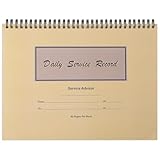
- Record Book: the package includes 1 daily service record book with 80 sheets, offering ample space to meet daily logging needs; It's a practical tool for tracking appointments, managing tasks, and enhancing customer service efficiency
- Ideal Size: measuring 8.5 x 11 inches, this activity log notepad balances portability and capacity; With 80 pages, it's ideal for daily use in the automotive industry, serving as a reliable service record management tool for consistent tracking
- Nice Quality: crafted from quality paper, the activity log book features reliable coil binding for easy page turning and tear-out; Its structured layout provides ample space for detailed entries, supporting effective schedule planning
- Friendly Design: designed for convenience, the daily log book's coil binding allows effortless sheet removal whenever needed; The intuitive layout ensures quick access to logging sections, making daily activity recording simple and efficient
- Versatile Usage: the service log book is a helper for the automotive industry or individuals to record scheduled maintenance, the shop can use it to register the maintenance needs of different customers, individuals can use it to keep track of flat rate hours
- People: Define roles, skills, decision rights, and how teams coordinate across functions and locations.
- Process: Standardize where useful, clarify exceptions, reduce fragmented handoffs, and assign ownership for the complete service flow.
- Technology: Connect workflows and data so teams can see work status, manage service levels, and identify bottlenecks.
- Governance: Set coherent accountability from enterprise or global leadership through country and participating-entity levels.
These elements depend on each other. Automating an unclear process can accelerate the wrong work; a redesigned process without clear ownership can leave handoffs unresolved. Service measures should therefore make outcomes visible, not just count transactions—for example, whether work completes accurately and on time across the full process.
Technology can enable the shift, but does not guarantee its value
CIO identifies artificial intelligence, robotic process automation (RPA), process mining, and process discovery as technologies shaping GBS. Potential generative-AI applications discussed in the article include automating routine tasks, analyzing workflows, personalizing user interactions, standardizing data, and forecasting workloads. These are possible uses, not proof of realized savings or better service in a particular organization.
A Delphi study by Cicero Ferreira and Marijn Janssen, published online in 2022 and in the Journal of the Knowledge Economy in 2023, asked more than 30 experts, executives, and researchers about technologies that could affect shared-services centers by 2030. Its data collection took place in the first half of 2020. The panel identified six technology groups: AI and machine learning; internet- and package-based automation; business process management systems (BPMS) and RPA; business analytics; blockchain; and cloud computing. This is an exploratory expert forecast, not a guarantee that all six will be adopted or deliver a particular result.
Rank #3
Organizations should choose technology based on the process problem they need to solve, the quality and accessibility of their data, and the ability to govern changes to service delivery. Tools can make workflows and performance more visible; they cannot substitute for leadership, process ownership, or a credible service model.
Conditions for a successful transformation
The UNSSC’s 2017 case study emphasizes a robust transformation framework, a clear vision beyond cost reduction, senior leadership backing, and change management. It also points to two dimensions of coherence: vertically, from global to country levels; and horizontally, across the entities participating in the shared model.
Quick wins for a faster PC:
Repair Windows errors before they cause bigger problemsFix Now →Scan for outdated or missing drivers - takes under a minuteDriver Scan →- Define the value sought: Specify whether the priority is service quality, productivity, integration, agility, decision support, or a combination—not just a target to reduce cost.
- Secure leadership sponsorship: Cross-functional changes need leaders who can resolve competing priorities and support decisions that affect multiple units.
- Establish service ownership: Make clear who is accountable for each end-to-end process, its service levels, and exceptions.
- Plan for organizational change: Prepare affected teams for new roles, workflows, governance, and escalation paths.
- Align across levels and entities: Ensure local delivery arrangements fit the enterprise model without leaving country or participating-unit responsibilities ambiguous.
Cost claims need careful interpretation. The UNSSC report relays a Deloitte global Shared Services survey figure of approximately 8% average annual savings. That is a reported survey average, not a forecast for a specific organization or a guaranteed recurring return from transformation.
Rank #4

- Record Book: the package includes 2 daily service record book with 80 sheets, offering ample space to meet daily logging needs; It's a practical tool for tracking appointments, managing tasks, and enhancing customer service efficiency
- Ideal Size: measuring 8.5 x 11 inches, this activity log notepad balances portability and capacity; With 80 pages, it's ideal for daily use in the automotive industry, serving as a reliable service record management tool for consistent tracking
- Nice Quality: crafted from quality paper, the activity log book features reliable coil binding for easy page turning and tear-out; Its structured layout provides ample space for detailed entries, supporting effective schedule planning
- Friendly Design: designed for convenience, the daily log book's coil binding allows effortless sheet removal whenever needed; The intuitive layout ensures quick access to logging sections, making daily activity recording simple and efficient
- Versatile Usage: the service log book is a helper for the automotive industry or individuals to record scheduled maintenance, the shop can use it to register the maintenance needs of different customers, individuals can use it to keep track of flat rate hours
When a move to GBS may—and may not—fit
A broader model may be worth considering when important services cross functional boundaries, fragmented handoffs obscure accountability, or the organization needs a more integrated view of workload and service performance. A function-specific center may remain appropriate when consolidating one function addresses the main need and the complexity of enterprise-wide governance would outweigh the benefits.
There is no neutral cost comparison in the cited material that determines which model is cheaper for every organization. CIO cautions that moving to GBS can involve substantial upfront costs and may be difficult to reverse. Those are reported considerations, not a universal financial rule; the transition’s investment and reversibility depend on an organization’s existing systems, contracts, governance, and design choices.
BHP: an example of a cross-functional approach
PwC’s case study, published September 30, 2024, says BHP began rethinking its model in 2021. The company wanted Group Business Services to act as a digital transformation partner while maintaining safe, reliable outcomes for its workforce. PwC describes a move from separate function-led teams toward an end-to-end, process-led model connecting finance, HR, supply chain, procurement, marketing, sales, and maritime operations.
Outdated Drivers Are Slowing You Down
One free scan finds every outdated or missing driver and matches the right update for your exact hardware.Free scan · exact hardware matchWindows Errors? Fix Them Before They Spread
Repair common Windows errors and clear accumulated junk for a smoother, more stable PC - no reinstall needed.Free scan · no reinstallAccording to PwC, the program used process baselining and intelligence, automation, analytics, and agile delivery squads. Its described scope later expanded into risk and controls, service management, SAP-related testing, change management, and mergers and acquisitions. PwC quotes BHP Group Officer for GBS Sundeep Singh: “For BHP the clear goal was to connect and digitalise its processes.”
This is a provider-authored account of one company’s program, not evidence that the same approach or results will transfer to other organizations. SAP’s 2024 award page separately describes BHP’s transition to a GBS operating model and names SAP Signavio Process Collaboration Hub, Journey Modeler, Process Manager, Process Intelligence, and Process Governance among the capabilities featured in its account.
Quick Recap
How to assess the next step
- Map the service as delivered today. Identify the customer, handoffs, systems, exceptions, delays, and the teams accountable for each stage.
- Choose the right scope. Decide whether the need is to consolidate a function or coordinate processes across several functions; do not treat GBS as the default endpoint.
- Define measurable service outcomes. Set priorities that reflect quality, timeliness, visibility, productivity, or other business needs, alongside any cost objectives.
- Design governance and change together. Establish process owners, decision rights, service levels, escalation paths, and a plan for supporting affected teams.
- Make technology choices against the design. Use workflow, analytics, automation, or AI capabilities to address identified process needs, with appropriate data and governance in place.
- Evaluate investment and transition risk. Consider upfront costs, organizational capacity, dependencies, and how the model could be adjusted if enterprise-wide integration does not deliver the intended value.
Product prices and availability are accurate as of the date/time indicated and are subject to change. Any price and availability information displayed on Amazon at the time of purchase will apply.




