Remote medical scribing can improve physician productivity, but the published evidence does not establish a standard return on investment for remote human scribes. A practice should treat ROI as a local calculation: count only additional revenue it can actually collect, then subtract the scribe’s fully loaded cost and any added operating expenses.
What does the evidence say about scribe productivity and revenue?
Studies of medical scribes generally suggest that clinicians may see more patients or spend less time documenting. That is evidence of a possible route to financial benefit—not proof that a remote scribe will produce the same result in every practice.
Emergency departments: more patients and RVUs per hour
A 2022 systematic review and meta-analysis covering 39 studies and more than 562,682 emergency-department encounters found that scribes were associated with 0.30 more patients treated per hour (95% confidence interval 0.10–0.51), 0.14 more relative value units (RVUs) per encounter (95% CI 0.03–0.24), and 0.55 more RVUs per hour (95% CI 0.30–0.80). The review found no overall difference in emergency-department length of stay and called for more cost-benefit research. These results are from emergency departments and do not isolate remote human scribing. Read the 2022 systematic review.
Cardiology: a large revenue estimate with important limits
A single cardiology-clinic study published in 2015 reported 9.6% more patients per hour with scribes. Its authors attributed an estimated $1,372,694 in additional annual cardiovascular revenue to increased patient volume and higher-coded notes, against a reported scribe cost of $98,588. Much of the revenue estimate included downstream cardiovascular services, so it is not equivalent to cash margin for the clinic or a portable ROI estimate for a remote service. One author disclosed consulting fees from scribe providers Scribe-X and Essia Health; that disclosure is relevant context, but it does not by itself invalidate the findings or establish an endorsement. Read the cardiology study.
#1 Best Overall
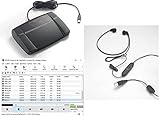
- heavy duty Infinity IN-USB-3 USB transcription foot Pedal
- Express Scribe Professional Transcription Software
- Transcription Headset
Dermatology: higher revenue in supported sessions
An American Medical Association summary of a 2018 dermatology study reported 7.7% higher revenue in sessions supported by scribes. Average physician documentation time was 6.1 minutes across 690 audited encounters before the program and 3.0 minutes across 695 post-scribe visits. The comparison covered two three-month periods; it was not a randomized trial of remote-scribe ROI. Read the AMA summary.
Outpatient studies: promising productivity, mixed economics
A 2026 scoping review of 20 outpatient studies, based on searches through September 2024, found increased productivity measures in 19. Only six studies included comprehensive costs. The review concluded that economic results depend on specialty, starting productivity, and how thoroughly costs are counted. Read the outpatient economic review.
Rank #2
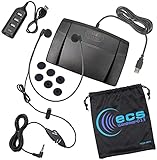
- ONE STEP AWAY: With this complete kit, you'll only need a transcription software and you can start your audio transcription tasks right away!
- LIGHTWEIGHT AND COMFORTABLE HEADSET: WordHear-O 3.5 mm Under-chin Headset is phenomenal for audio transcription. The design makes it lightweight, comfortable, and fits the contour of most ears. The 10 foot cord has a adjustable volume control along with a Mono/Stereo and 3.5 mm plug. It comes with a carry pouch for storage. Excellent for use into audio transcription software programs.
- LESS FOOT FATIGUE: Infinity 3 USB Audio Transcription Foot Pedal is designed for both ease of use and the ability to handle a heavy dictation / audio transcription workout with little to no foot fatigue.
- STAY CONNECTED: Don't have enough USB ports on your computer for your USB Foot Pedal or USB Headset. Here is the solution! All you have to do is plug this into one of the USB ports on your computer and it will then allow up to 4 different USB devices to be plugged in at the same time.
- WE GOT YOU COVERED: We also include three (3) pairs of replacement ear cushions for your lightweight and comfortable WordHear-O 3.5mm audio transcription headset.
Why those results do not establish remote-scribe ROI
The studies above cover different settings, specialties, and scribe arrangements. A result from an emergency department, cardiology clinic, or dermatology program cannot be assumed to represent a remote human service in another practice. The 2021 AHRQ-associated evidence review reported no virtual-scribe data among the evidence it assessed and noted limited information on documentation quality, hiring-model comparisons, training, supervision, and program scaling. Newer outpatient studies do not automatically resolve that gap when they cover different arrangements or study designs. Read the AHRQ-associated evidence review.
A separate 2019 multicentre randomized trial examined emergency-medicine workflow, not outpatient remote human scribing. Its cost-benefit analysis assumed per-patient revenue remained unchanged with a scribe, illustrating how estimates depend on setting and assumptions. It should not be treated as a current remote outpatient price quote. Read the BMJ trial.
Rank #3
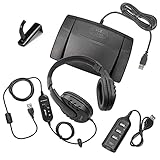
- COMPLETE TRANSCRIPTION KIT: With this complete kit, you'll only need a transcription software and you can start your audio transcription tasks right away
- PREMIUM USB HEADSET: Includes the WordMaster Deluxe Overhead Around-The-Ear USB Transcription Headset for computer audio transcription with a premium in-line built-in sound card that bypasses computer sound cards and matches the frequency response of the spoken word
- ERGONOMIC FOOT PEDAL DESIGN: Infinity 3 USB Audio Transcription Foot Pedal is designed for both ease of use and the ability to handle a heavy dictation and audio transcription workout with little to no foot fatigue
- 4-PORT USB HUB INCLUDED: Expand your connectivity options by plugging this hub into one of the USB ports on your computer to allow up to 4 different USB devices to be plugged in at the same time
- SPACE-SAVING HEADPHONE HOLDER: Includes a Headphone Hook Holder Hanger to hang the WordMaster USB Headset on any smooth surface, keeping it away from desk debris and saving valuable workspace
How to calculate ROI for your practice
Use collected revenue, not billed charges, and set a defined measurement period. A useful framework is:
Incremental net benefit = collected revenue attributable to added capacity and documentation effects − fully loaded scribe cost − added operating costs.
Rank #4
- High quality Grundig headset included
- Infinity USB Foot Pedal
- Express Scribe Pro License, No Subscription Needed
Then calculate ROI against the program cost. State the denominator clearly—for example, recurring program cost during the same period—so the result can be compared consistently with other investments. Do not count downstream revenue unless your practice actually receives it.
Count benefits the practice can realize
- Additional visits: Estimate only visits the practice can schedule, staff, complete, and collect payment for. Time released from documentation has no visit-volume value if there is no appointment capacity or patient demand.
- Documentation-related effects: If you measure changes in coding, charge capture, or collections, compare actual results and attribute them carefully. A higher billed amount is not necessarily a higher collected amount.
- Downstream services: Include them only when the practice receives the resulting revenue. A health system’s revenue should not be counted as the clinic’s benefit if the clinic does not capture it.
Include the full cost of the program
- Wages or contract fees, including any costs that vary with hours or coverage.
- Training, onboarding, and the time staff spend supervising or correcting work.
- Licensing, technology, and any integration or setup expenses.
- Scheduling and coordination, turnover, and other added operating costs.
Check whether added capacity is plausible
A 2020 Journal of Medical Economics model estimated that a practice needed an average of 1.34 additional new-patient visits per day (295 per year) to recover annual scribe costs. The modeled threshold ranged from 0.89 visits per day in cardiology to 1.80 in orthopedic surgery. The study used 2015 U.S. CMS and National Ambulatory Medical Care Survey data; results were sensitive to hourly scribe cost and whether CPT revenue was included, and the model excluded indirect costs and downstream revenue. These are modeled thresholds, not current price guidance or a guarantee for a remote program. The authors concluded: “For all specialties, modest increases in productivity due to scribes may allow physicians to see more patients and offset scribe costs, making scribe programs revenue-neutral.” Read the 2020 model.
Best Value

- Supports audio and video playback (DSS, DS2, DSS Pro, MP3, WAV, WMA, AIFF, MP2, VOX, and more)
- Infinity 3 Function USB Foot Pedal/Switch is the premier transcription foot pedal today
- Headset comes with built in boomless microphone, 5-hour battery life, extended Bluetooth range, and USB adapter
- Works with Microsoft Word and all major word-processors
- Pedal and headset are designed with an emphasis on comfort, performance, and durability
Compare options using the same business case
Remote human scribes, in-person scribes, and ambient AI scribes are different operating models. Compare them against the same baseline and measurement period rather than applying a productivity percentage from a study to every option.
| Decision factor | What to establish |
|---|---|
| Scribe model | Whether the option is remote human, in-person human, or ambient AI; do not treat evidence for one as evidence for another. |
| Specialty and visit mix | Which clinicians and appointment types are in scope, and whether study populations resemble your own. |
| Baseline documentation burden | How much clinician time documentation currently takes and where delays occur. |
| Available appointment capacity | Whether the practice can fill additional visits and support the resulting workload. |
| EHR fit and training | How the workflow fits the EHR and what training, supervision, and correction time it requires. |
| Full costs | Recurring and implementation costs, including technology, coordination, and turnover. |
| Revenue ownership | Which collections accrue to the practice and which, if any, belong elsewhere in the health system. |
| Quality and experience | How the practice will monitor documentation quality, workflow, and patient experience alongside financial results. |
Keep ambient AI results separate
A 2025 UCSF report on a study of ambient AI scribes described a 5.8% increase in weekly RVUs. The report concerned voluntary early adopters in a single health system. It is evidence about ambient AI in that setting—not about remote human scribing—and should not be used as a remote-scribe revenue forecast. Read the UCSF report.
Quick Recap
Product prices and availability are accurate as of the date/time indicated and are subject to change. Any price and availability information displayed on Amazon at the time of purchase will apply.




