Supermicro’s four-socket X14 servers make a substantial hardware play for enterprises that need high CPU density, large memory pools, or GPU capacity in one system. But the July 2025 launch does not show that customers’ trust has returned. Supermicro’s FY2026 Form 10-K, filed in 2026, says one material weakness in IT general controls remained unremediated as of June 30, 2026. Product ambition and corporate-control progress are relevant to enterprise buyers—and neither establishes what customers think.
What Supermicro announced for four-socket X14
On July 16, 2025, Supermicro said it was shipping four-socket X14 servers based on Intel Xeon 6 processors with P-cores. The company positioned the systems for large-scale database and enterprise applications, high-performance computing, mission-critical workloads, in-memory databases, and applications that need a very large memory footprint.
The headline specifications are vendor-stated maximums across the announced systems, not promises that every chassis or orderable configuration has every capability. Supermicro’s multi-processor product area and product materials describe a family; buyers need to verify the exact model, CPU configuration, and chassis.
| Capability | Supermicro’s published figure | What to verify |
|---|---|---|
| Processor capacity | Up to 344 cores per system, according to Supermicro’s 2025 announcement. | The selected system’s supported CPUs and resulting core count. |
| Memory | Up to 16 TB, according to Supermicro’s 2025 announcement. | Supported DIMM type, capacity, population rules, and memory bandwidth for the intended configuration. |
| PCIe expansion | Up to 20 PCIe 5.0 slots across the announced systems, according to Supermicro’s 2025 announcement. | The selected chassis’s actual slot count and which slots remain available after other components are installed. |
| GPU capacity | Up to six double-width GPUs in the 4U system, according to Supermicro’s 2025 announcement. | GPU model support, slot layout, power and cooling requirements, and whether the intended configuration is orderable. |
Supermicro’s CEO Charles Liang described the systems as offering “the simplicity and serviceability of a single system” with up to 16 TB of memory and up to six double-width GPUs. That is the company’s launch-day positioning. Intel executive Karin Eibschitz also praised the portfolio in the announcement; a partner endorsement is not independent customer evidence.
Free tools Windows power users keep installed
One-click scans. No signup required.
#1 Best Overall
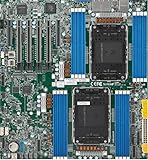
- Intel Xeon 6500/6700-series processors with E-cores and P-cores, Dual Socket LGA-4710 (Socket E2) supported, CPU TDP supports Up to 350W TDP
- Total up to 4TB ECC RDIMM DDR5-6400MT/s in 16 DIMM slots
- 3 PCIe 5.0 x8 via MCIO connectors
- M.2 Interface: 2 PCIe 5.0 x4M.2 Form Factor: 2280, 22110
- Dual LAN with 1GBase-T with Broadcom BCM5720
Which enterprise workloads might fit the platform?
Large-memory and in-memory workloads
A system with a very large memory pool may suit workloads that benefit from keeping more data in memory or scaling up within a single node. Supermicro says that scaling up this way can avoid the latency of distributing work across a network. That is a vendor claim, not a published result for a named customer workload. Whether it helps depends on the application, data set, memory access pattern, software, and comparison system.
Database and mission-critical deployments
Supermicro says the servers are certified for SAP HANA and Oracle Linux. Certification should be checked against the specific model and configuration, as well as the current software and support requirements, before purchase. The announcement does not establish that every configuration is certified or suitable for every database deployment.
Rank #2

- Product Name: Server Motherboard
- Chipset Model: C741
- Processor Socket: Socket LGA-4677
- Processor Generation Supported: 4th Gen
- Processor Supported: Xeon
GPU, HPC, and I/O-intensive systems
The stated support for multiple double-width GPUs and PCIe 5.0 expansion may matter for workloads that need accelerators or substantial I/O. Actual fit depends on the selected chassis, supported devices, storage arrangement, rack power and cooling, and serviceability needs. The official X14 overview also describes DDR5, CXL 2.0, EDSFF E1.S/E3.S storage options, remote management, and hardware and silicon Root of Trust with component attestation as platform features. Those are manufacturer descriptions; they do not independently verify security outcomes in deployments.
What the X14 launch does—and does not—say about enterprise trust
Supermicro’s FY2026 Form 10-K says BDO audited the company’s financial statements and internal control over financial reporting for the fiscal year ended June 30, 2026. The filing reports that the company remediated three material weaknesses identified for FY2025, while one IT general-controls weakness remained unremediated at June 30, 2026. That is a concrete control-status disclosure, but it is not a measure of customer sentiment.
Rank #3

- 3rd Gen Intel Xeon Scalable processors, Single Socket LGA-4189 (Socket P+) supported, CPU TDP supports Up to 270W TDP
- Intel C621A
- Up to 2TB 3DS ECC RDIMM, DDR4-3200MHz; Up to 2TB 3DS ECC LRDIMM, DDR4-3200MHz Up to 2TB Intel Optane Persistent Memory, in 8 DIMM slots
- 2 PCIe 4.0 x8, 1 PCIe 4.0 x16, 1 PCIe 4.0 x8 (in x16 slot) 3 PCIe 3.0 x8
- Intel C621A controller for 10 SATA3 (6 Gbps) ports; RAID 0,1,5,10
For earlier context, Supermicro announced on December 2, 2024, that a board special committee had completed its review. The company said the committee found that EY’s stated concerns and resignation conclusions were not supported by facts examined in its review, and that it made control and governance recommendations. This is Supermicro’s account of the committee’s conclusions, not a neutral adjudication of every allegation. Separately, the FY2025 Form 10-K records the former auditor’s concerns and resulting filing delays.
The available product and filing information does not establish that customers returned, that trust rose or fell, or that the X14 launch caused a change in customer confidence. It supports a narrower conclusion: Supermicro is competing for demanding enterprise workloads with a high-capacity platform while continuing to report a remaining internal-control weakness.
Rank #4
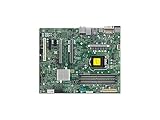
- Supermicro X12SAE Motherboard
What buyers should check before evaluating an X14 system
Published family-level maxima and certifications are not enough to compare configurations or judge whether a system meets a deployment’s requirements. Before selecting a system, confirm:
- The exact orderable model, supported Xeon 6 CPUs, and core count.
- Memory capacity, type, population rules, and bandwidth for the planned workload.
- Available PCIe slots, supported GPUs, storage options, and their compatibility in the same chassis.
- Current SAP HANA or Oracle Linux certification for the precise system and configuration, where relevant.
- Rack power and cooling requirements, serviceability, and support arrangements.
- Whether the organization’s governance and supplier-risk requirements are met independently of the server’s technical specifications.
Supermicro’s 2025 announcement included an “up to 50%” performance comparison with the previous generation of Intel processors. The reviewed announcement does not provide an independent result for a named customer workload, so that figure should be treated as a vendor comparison rather than a general performance guarantee. The available material also does not establish a like-for-like price/performance or total-cost comparison for a defined configuration.
Windows Errors? Fix Them Before They Spread
Repair common Windows errors and clear accumulated junk for a smoother, more stable PC - no reinstall needed.Free scan · no reinstallCrashes, No Sound, or Screen Glitches?
Random freezes, missing sound and display glitches usually trace back to one bad driver. Find and replace yours safely.Free scan · under a minuteQuick Recap
Best Value

- Supermicro X12SPI-TF Motherboard
- 3rd Gen Intel Xeon Scalable processors, Single Socket LGA-4189 (Socket P+) supported, CPU TDP supports Up to 270W TDP
- Intel C621A
- Up to 2TB RDIMM, DDR4-3200MHz; Up to 2TB LRDIMM, DDR4-3200MHz
Product prices and availability are accurate as of the date/time indicated and are subject to change. Any price and availability information displayed on Amazon at the time of purchase will apply.




