Crashes, No Sound, or Screen Glitches?
Random freezes, missing sound and display glitches usually trace back to one bad driver. Find and replace yours safely.Free scan · under a minutePC Slower Than It Used to Be?
A free scan shows the junk files, broken settings and background clutter dragging Windows down - then fixes them in one click.Free scan · Windows 10 & 11Single-entry bookkeeping summarizes income and expenses; double-entry records each transaction in at least two ledger accounts, as equal debits and credits. The second system also tracks assets, liabilities, and net worth, so it can show a fuller financial picture. Its balancing check is useful, but it does not prove that the books are accurate or complete.
How single-entry and double-entry bookkeeping work
Single-entry: a simpler record of income and expenses
Single-entry bookkeeping generally focuses on money received and paid. The Internal Revenue Service describes a system that summarizes daily cash receipts and records monthly totals for receipts and disbursements. It can be a practical way for a straightforward small business to keep track of cash flow.

Because this approach centers on income and expenses, it does not provide the same built-in account structure for showing what a business owns, owes, or has invested in it.
Double-entry: two-sided transaction records
In double-entry bookkeeping, a transaction is entered in a journal and then posted to ledger accounts. Each transaction affects at least two accounts: one or more debits are matched by one or more credits, and total debits must equal total credits. The accounts can track income and expenses as well as assets, liabilities, and net worth.
What’s actually slowing this PC down?
Pick the symptom - the matching free tool is one click away.
For example, if a business buys equipment with cash, the records can show both the increase in equipment and the decrease in cash. The transaction is not just an expense summary; it reflects how the business’s financial position changed.
Key differences at a glance
| Feature | Single-entry | Double-entry |
|---|---|---|
| Typical structure | Summaries of receipts and disbursements | Journal entries posted to ledger accounts |
| Accounts emphasized | Income and expenses | Income, expenses, assets, liabilities, and net worth |
| Maintenance | Simpler to maintain for uncomplicated records | Requires a chart of accounts, journals, and ledger posting |
| Built-in arithmetic check | No matching debit-credit total | Total debits must equal total credits; this flags an imbalance but does not verify accuracy |
| Useful when | The main need is a straightforward record of income and payments | The business needs a fuller view of financial position or more detailed account balances |
The definitions and system characteristics in this comparison follow the IRS’s Publication 583, Starting a Business and Keeping Records.
Rank #2

- EASY TO MANAGE - Use this accounting ledger book to track your payments, deposits, and balances, and develop good bookkeeping habits to meet your financial goals.
- UNDATED ACCOUNT TRACK - Use a ledger book to record every expense you make no matter what day it starts. The accounting book is plenty of space to record each transaction you make, and state its number, date, description, account, payment or deposit amount, and total balance.
- HIGH QUALITY - The A5 expense tracker notebook is used to high quality 100gsm pure white paper, brown elastic band and a back pocket for extra space. A total of 64 sheets(128 pages), it comes with 3480 entry lines (29 lines per page, 60sheets/120pages), 1 page Year Overview, 7 lined notes pages.
- MANAGE YOUR FINANCES & SUCCEED - Use this business expense tracker notebook, You will be able to easily analyze your financial activities and quickly prepare accurate financial statements. Use your records to regularly assess your spending and income and find any unnecessary expenses you can cut to improve your financial performance.
- THE PERFECT GIFT - Use account ledger book for your personal or business finances, give it to your friends, colleagues as a gift for Birthday| Easter|Children's Day|Halloween|Thanksgiving|Christmas|Back to school and New Year's Day.
Does double-entry mean accrual accounting?
No. Double-entry describes how transactions are recorded across accounts. Cash and accrual accounting describe when income and expenses are generally recognized for accounting purposes. Under the cash method, income is generally reported when received and expenses when paid; under the accrual method, income is generally reported when earned and expenses when incurred. These are separate choices, though tax rules and a business’s circumstances can affect which methods it may use.
The IRS discusses both bookkeeping systems and accounting methods in Publication 583. Do not infer a business’s tax method just from whether it keeps single-entry or double-entry books.
Recommended Free Tools
Rank #3
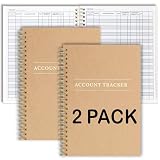
- PERFECT FOR RECORD KEEPING: The 2 Pack account ledger books are versatile and can be used to track finances, budgets, expenses, and other business or personal records. They are perfect for individuals, entrepreneurs, or small business owners who need a reliable and efficient way to keep track of their finances. With 100 pages, customers can record transactions over an extended period, making it a handy tool for financial planning and organization.
- COMPACT AND LIGHTWEIGHT: The account ledger books are compact and lightweight with each book weighing 7 ounces and measuring 8.5 x 6.25 inch, making them easy to carry around. You can take them with them in a bag or briefcase, making them ideal for on-the-go use. This feature ensures that you can access your records at any time, whether you are at work or on the move.
- DURABLE KRAFT COVER: The kraft cover is a distinguishing feature of these account ledger books. It provides a durable layer of protection that can withstand daily wear and tear, making it suitable for long-term use. Additionally, the classic, rustic appearance of the cover gives it a timeless and professional look that can fit in any setting.
- PREMIUM QUALITY: Elegant style with the words ''Account Tracker'' embossed in fancy Gold Foils. The gold coil ring binding is a practical design feature that enhances the functionality of the account ledger books. It allows pages to turn smoothly and easily, making it effortless to flip through the book while keeping pages in place. The ring binding also ensures that pages won't fall out, preventing the loss of vital information.
What the debit-credit balance can—and cannot—tell you
When total debits and credits do not match, the ledger has an arithmetic imbalance that needs investigation. That makes double-entry a useful structural check. But matching totals do not establish that every transaction was recorded, classified correctly, or entered for the right amount. An omitted transaction, a wrong account classification, or two compensating errors can leave a ledger balanced while the records are still wrong.
HMRC’s Business Income Manual cautions that double-entry does not necessarily guarantee accuracy and emphasizes the integrity of the recorded figures. Source documents and regular reconciliation remain important whichever system you use.
Rank #4

- Adams Columnar Analysis Pads are adaptable ledgers perfect for accounting or other numeric data; 4-column ledger has fill-in headers, numbered columns & rows & 50 double-sided 3-hole punched sheets
- Columnar sheets are printed on green tinted non-glare paper to help prevent eye strain; heavy-duty 75 gsm bond is acid free and archival safe for recordkeeping
- Shaded double columns keep your data straight and your decimals aligned; 4-column record books are ideal for recording expenses and other transactions for your home, business or side gig
- Each ledger sheet has numbered rows and columns to eliminate the need for hand numbering; increases your accuracy and saves time
- Quality columnars at a stock-up price; Adams columnar pads are sturdy and have a 3 hole punch to fit a standard binder; securely stores your accounting books for tax season
Which system should a small business choose?
Single-entry may fit a simple operation
If your business is uncomplicated and your immediate need is a clear record of cash receipts and payments, single-entry may be a workable starting point—provided it meets the recordkeeping rules that apply where you operate. The IRS puts it plainly: “The single-entry system of bookkeeping is the simplest to maintain, but it may not be suitable for everyone.” That statement appears in IRS Publication 583, section “Bookkeeping System” (12/2024).
Double-entry helps when you need a fuller financial picture
Consider double-entry when you need to monitor assets, debts, receivables, payables, or equity; handle credit transactions; prepare fuller financial statements; or build a chart of accounts that can grow with the business. A balance sheet requires information about assets, liabilities, and equity, which a simple income-and-expense summary does not show in the same structured way.
Free tools Windows power users keep installed
One-click scans. No signup required.
Best Value

- Easy To Track Your Finances: HAUTOCO accounting ledger book keeps you on top of your expenses and income! Help you keep your money organized, spend well, and set and achieve financial goals
- Premium Material: The A5 accounting ledger book has a total of 120 pages and 2040 lines of entries. It is made of 100gsm thick paper to reduce ink leakage; it is equipped with a waterproof and sturdy PP cover to protect the inner pages
- Practical Design: Compact 8.3 x 6.2'' expense tracker notebook is easy to carry and features information pages, 2025 calendar, yearly financial goals page, and PVC pocket for storing important tickets and loose items
- Manage Your Finances Effectively: Undated accounting books with number, date, description, account, payment or deposit amount, and total balance. You will be able to easily analyze your financial activities and quickly prepare accurate financial statements
- Ideal For Small Business or Personal Use: An accounting log journal can track your business or personal financial status. With a clear record of transactions, you can find unnecessary expenses or fraudulent charges
Inventory, unpaid invoices, or complex long-term contracts may also affect the accounting method a business should consider. UK government guidance discusses those circumstances in relation to traditional accounting, but they are not a universal rule that requires double-entry bookkeeping: GOV.UK guidance on keeping business records.
Keep either system reliable
- Keep receipts, invoices, and other documents that support recorded transactions.
- Reconcile your books with bank statements regularly. The IRS recommends checking that the bank statement, checkbook, and books agree.
- Review how transactions are classified and make sure all relevant activity is recorded; a balanced debit-credit total alone cannot do that work.
- Check current local tax and recordkeeping requirements. IRS guidance is U.S.-specific, while UK requirements differ; inventory and other business circumstances can affect tax accounting choices.
For U.S. context, see IRS Publication 583. For UK context, see GOV.UK’s recordkeeping guidance. Neither system, by itself, determines the tax method a business is permitted or required to use.
Quick Recap
Product prices and availability are accurate as of the date/time indicated and are subject to change. Any price and availability information displayed on Amazon at the time of purchase will apply.




