Remote and hybrid work remain established features of U.S. employment, but there is no single “remote-work rate.” In the latest measures summarized here, 13.8% of U.S. workers usually worked from home in 2023, while 34% of wage and salary workers sometimes did so in the 2024–25 period. Those figures describe different things, not a contradiction. Recent data support a post-pandemic level above 2019, but they do not establish a precise forecast for the next decade.
How many people work from home?
The answer depends on whether a survey asks where someone usually works, whether their job allows home working, whether they worked at home at all during a sampled day, or whether they did so in the previous week. The statistics below are U.S.-based and use each source’s own population and reference period.
Usually working from home: Census ACS
The U.S. Census Bureau’s American Community Survey (ACS) measures workers who usually worked from home. Its reported share rose sharply during the pandemic, then eased while remaining above its pre-pandemic level:
| Year | Workers who usually worked from home |
|---|---|
| 2019 | 5.7% |
| 2021 | 17.9% |
| 2022 | 15.2% |
| 2023 | 13.8% |
These are the ACS figures highlighted by Census Bureau survey statisticians in their 2025 explanation of 2023 work-from-home patterns. The measure is about a worker’s usual arrangement; it does not count everyone who occasionally does a task at home.
Do these 3 things before closing this tab:
1Clear out junk files and repair common Windows errors2Scan for outdated or missing drivers - takes under a minute3Repair Windows errors before they cause bigger problems#1 Best Overall

- 【Power up Easily with Built-in Charging Station】Stay fully charged with 4 AC outlets, 1 USB port, and 1 Type-C port—perfect for your laptop, phone, speakers, gaming console, or desk lamp. The reversible design of the l shape desk lets you place the power strip on either side of the wide desk, so your cables stay neat and your devices stay powered no matter how you set up your space
- 【More Storage, Less Mess】3 fabric drawers of the computer desk with drawers give you hidden space for notebooks, controllers, pens, and office or gaming accessories—keeping your desktop clean and focused. The 3-tier metal mesh shelf underneath is strong enough for a CPU tower, printer, books, files, or gaming gear. Everything has a place
- 【Deeper & Roomier L-Shaped Desktop】With a 19.7" extra-deep desktop, you get more working room for dual monitors, drawing tablets, speakers, or gaming equipment. The fully reversible layout lets you choose left- or right-hand orientation to fit your room perfectly—no more struggling to match the home office desk to your space
- 【Built for Bedroom, Study, or Gaming Room】Whether you're building a cozy study desk corner, a productive home office, or an immersive gaming station, this large desk fits right in. The sturdy metal frame and high-quality particleboard deliver great durability with scratch-resistant & waterproof performance. Adjustable feet keep the desk steady even on slightly uneven floors
- 【Easy to Assemble】We include clearly labeled parts, step-by-step instructions, and all the tools you need. You can finish installation of the l shaped desk with storage faster than exception
Having access to home work versus using it
The Bureau of Labor Statistics (BLS) Job Flexibilities and Work Schedules module found that, across data collected in 2024 and 2025, 37% of wage and salary workers could work at home and 34% sometimes did so. The module covers a worker’s sole or main job, excludes self-employed people, and is not the same as the ACS usual-workplace measure. BLS reported that 28% of wage and salary workers had days when they worked only at home. These estimates are from a two-year module average, not a daily count or a fully remote-work share. See the BLS release and tables.
Work at home on a sampled day
In the 2025 American Time Use Survey (ATUS), 35% of employed people did some or all of their work at home on days they worked. In the detailed table, 34.5% of employed people working on an average day worked at home; the figure was 34.9% for full-time workers. ATUS counts any amount of work at home on the sampled day, even when home is not the person’s usual workplace. The same release reports that 70% did some or all of their work at their workplace; those shares can overlap because a person may work in more than one location. BLS also found that women were more likely than men to work at home on days worked (38% versus 31%). These are 2025 annual-average diary estimates published in 2026; see the BLS ATUS release and tables.
Rank #2

- Electric Height Adjustment – Sit or Stand Any Time: Quiet motor (under 52 dB) with memory presets. Easily switch between sitting and standing from 28.3" to 46.5" to help reduce sedentary time
- Sturdy & Stable – Stays Solid at Full Height: Strong steel frame remains stable even when fully extended. Performance may vary slightly by floor type and load weight, but reliable for daily work, gaming, or study
- Spacious 55" Desktop with Cable Management: Large 55-inch surface fits multiple monitors and gear. Built-in cable management keeps cords tidy for a clean, organized workspace
- Quiet & Smooth Height Adjustment: Powerful motor enables seamless height changes and stable transitions, helping create a peaceful workspace that sparks creativity
- Easy Assembly & Great Value: Clear instructions and straightforward setup in 10–30 minutes. Offers electric height adjustment, memory presets, and solid build quality(The desktop is composed of two boards)
Working from home in the previous week
The Federal Reserve’s 2026 report on household economic well-being asked about the week before its 2025 survey. In that reference week, 39% of workers worked from home at least some of the time: 17% entirely from home and 23% some of the time. The rounded subgroups do not add exactly to the rounded overall figure. The report also found that 23% of workers with at least a bachelor’s degree worked entirely from home, compared with 10% of workers with a high school degree or less; 30% of self-employed workers worked entirely from home. These are worker reports for that survey’s reference week, not estimates of usual workplace across the year. Details are in the Federal Reserve’s employment and job quality chapter.
What the figures say about access and work arrangements
Some workers can work at home but do not do so routinely
In the BLS 2024–25 module, 56 million wage and salary workers (37%) could work at home, while 51 million (34%) sometimes did. The gap is consistent with access and actual use being different measures; it does not by itself explain why an individual worker did not work from home. Among workers who sometimes did, 33% said their job required it, 31% cited personal preference, and 12% cited coordinating work with personal or family needs. Of those who sometimes worked at home, 89% were paid for that work, 6% were unpaid, and 5% did both paid and unpaid work at home. The percentages refer to different questions and, in the pay breakdown, to the subgroup that sometimes worked from home.
The Tool Desk
Outbyte Driver Updater FREEFix the driver behind crashes, sound loss and screen glitchesFind Drivers →Outbyte PC Repair FREEClear out junk files and repair common Windows errorsFree Scan →Rank #3

- 【Simple Desk】Enjoy a simple yet spacious work space with this sleek rustic-brown desk. Measuring 54''x19.7''x29.5'', it is the perfect solution for your study, kid's room, or home office. With a wide desktop, it accommodates your computer, calendar, lamp, and other essentials, leaving enough room to enjoy a cup of coffee
- 【Versatile Desk】Whether you need a large office desk, a bedroom desk, a gaming setup, or a desk for your child's room, this versatile desk fits seamlessly into any space, serving multiple purposes with ease
- 【Reinforced Structure】Crafted from durable particleboard and thick steel tubes, this work from home desk offers a stable and sturdy structure. Reinforcement struts beneath the tabletop provide additional stability, ensuring its longevity for working or gaming
- 【Variety of Styles and Colors】Featuring a selection of 5 on-trend hues - sleek grey, black, warm rustic brown, a unique blend of rustic brown and black for a distinctive look, and white - along with multiple sizes, this home desk is designed to effortlessly match any home decor theme and enhance a wide range of design aesthetics
- 【Easy Assembly】Say goodbye to complicated setups. This PC desk has a simple structure, visually demonstrative instruction and provided tools, and it will be finished in less than 40 minutes
Home-based workers differ from the workforce overall
Census Bureau’s 2023 ACS analysis reported a median age of about 43.5 among home-based workers, versus 41.7 for the total workforce. About 3.6% of home-based workers were below the poverty level, compared with 9.3% of workers commuting by public transportation. Roughly two-thirds of home-based workers were White, compared with about one-half of workers who carpooled. These are descriptive comparisons among groups, not evidence that working at home caused differences in age, poverty, or race.
What businesses report about remote work
A June 2025 Census Center for Economic Studies working paper analyzed more than 150,000 firm-level responses to the Business Trends and Outlook Survey. Its abstract reports that nearly a third of businesses had employees working from home, with substantial variation by sector: the share was nearly ten times greater in Information than in Accommodation and Food Services. The paper also says employees worked from home about one day per week on average. These are business-survey findings, not a count of all U.S. employees or a measure of how many work entirely remotely.
Rank #4
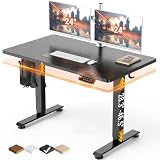
- Electric Height Adjustment – Sit or Stand Any Time: Quiet motor (under 52 dB) with memory presets. Easily switch between sitting and standing from 28.3" to 46.5" to help reduce sedentary time
- Sturdy & Stable – Stays Solid at Full Height: Strong steel frame remains stable even when fully extended. Performance may vary slightly by floor type and load weight, but reliable for daily work, gaming, or study
- Spacious Desktop with Cable Management: Large surface fits multiple monitors and gear. Built-in cable management keeps cords tidy for a clean, organized workspace
- Quiet & Smooth Height Adjustment: Powerful motor enables seamless height changes and stable transitions, helping create a peaceful workspace that sparks creativity
- Easy Assembly & Great Value: Clear instructions and straightforward setup in 10–30 minutes. Offers electric height adjustment, memory presets, and solid build quality(The desktop is composed of two boards)
Employer expectations are a five-year signal, not a decade forecast
The paper’s authors report that businesses expected work-from-home levels to be similar five years ahead. That is an employer expectation recorded in survey evidence, not an observed future outcome, and it does not establish where remote work will stand ten years later. The paper’s abstract also reports that 7% of businesses considered onsite work more productive and 2% considered work from home more productive; 70% said they did not track employee office days and 75% did not monitor employees while they worked from home. These responses describe what surveyed businesses said, not the measured productivity of each arrangement. Read the Census working-paper abstract.
Independent reader supportYour contribution helps us test, update, and keep practical guides available for everyone.What remote-work statistics can—and cannot—say about productivity
BLS summarizes research finding a positive relationship between increases in remote work and total factor productivity growth across industries, alongside statistical associations with changes in unit costs. An industry-level association is not proof that remote work caused the change, and it cannot be translated into a universal claim that an individual remote worker is a particular percentage more productive. BLS notes that research using updated 2023 productivity data was presented at a 2025 conference and that a paper was forthcoming when the page was accessed. See the BLS productivity research summary.
Best Value

- One-Touch Height Adjustment: Easily adjust the FEZIBO electric standing desk from 28.3" to 46.5". With 3 customizable memory presets, switch seamlessly between sitting and standing. Ideal for home offices, gaming setups, study areas, and productive workspaces
- Outstanding Stability: Built with a reinforced steel frame, this 47.2" x 23.6" standing desk supports up to 176 lbs, providing a sturdy and wobble-free workspace at any height
- Powerful Motor: Uprated lifting performance with reliable long-term operation, tested for up to 50,000 lift cycles, with lower noise levels under 45dB during running
- Multiple Sizes & Colors: Crafted from FSC-certified wood for a sustainable choice, the splice desktop comes in a range of sizes to fit small spaces or larger setups. Multiple color options make it easy to match your home office, bedroom, or workspace style
- Effortless Assembly: Most components come pre-assembled for quick, hassle-free setup. With a detailed manual and video guide, you can setup in just about 30 minutes and start working comfortably
How to compare remote-work statistics fairly
Before comparing two percentages, check whether they refer to the same thing. A “usually works from home” share should not be treated as interchangeable with access to home work or any home work on one sampled day.
- Population: Does the estimate cover all employed people, wage and salary workers, self-employed people, or businesses?
- Definition: Is it about usual workplace, permission or ability, occasional use, a fully remote arrangement, or a hybrid schedule?
- Reference period: Is the question about a sampled diary day, the previous week, a calendar year, or a two-year module average?
- Unit: Is the result a share of workers, a share of businesses, or an average number of work-from-home days?
- Evidence type: Is it an observed survey estimate, a descriptive group comparison, an association, or an employer expectation?
Use each figure to answer the question it actually measures. For example, the ACS trend is useful for tracking the share of workers who usually work at home, while the BLS flexibility module describes access and occasional use among wage and salary workers in their main job. Neither alone captures every hybrid arrangement.
What the data suggest for the next decade
The clearest supported conclusion is that U.S. work from home remained more common in 2023 than in 2019 on the ACS usual-workplace measure, even after falling from its 2021 peak. BLS’s later measures show that home work also remains part of many workers’ schedules, though they use different definitions and populations. The Census business survey offers a limited near-term clue: surveyed firms expected similar WFH levels five years out. The available evidence does not establish a precise U.S. rate for 2036, and it does not provide a global estimate. Any longer-range projection should be treated as uncertain rather than presented as a statistic.
Quick Recap
Product prices and availability are accurate as of the date/time indicated and are subject to change. Any price and availability information displayed on Amazon at the time of purchase will apply.




