What’s actually slowing this PC down?
Pick the symptom - the matching free tool is one click away.
Dacora Motors is a real New York startup, but it is not yet an established automaker or a production-car company. Operated by Delaware corporation DC Motors Corp., the company is developing the Dacora 001, a planned $500,000-plus electric ultra-luxury vehicle with 1930s Streamline Moderne styling, a wood hood, and a highly configurable cabin.
Dacora says first deliveries could arrive in 2028. As of August 10, 2026, however, publicly available information does not establish completed federal certification, independently verified performance, regular production, or customer deliveries. The most accurate description is a pre-production startup selling an ambitious automotive concept—not a modern Duesenberg in the historical sense.
What is Dacora Motors?
Dacora Motors was founded by MIT-trained engineers Kristie D’Ambrosio-Correll and Eric D’Ambrosio-Correll. Kristie is the company’s CEO and Eric is its CTO, according to Dacora’s company information and its launch announcement.
Kristie D’Ambrosio-Correll previously served as CTO of MIRROR, the connected-fitness company acquired by lululemon for approximately $500 million. Dacora uses that experience as part of its investor-facing credibility narrative. LinkedIn lists Dacora as a privately held motor-vehicle-manufacturing company with a stated size of 2–10 employees, although that category is not an audited headcount.
Free tools Windows power users keep installed
One-click scans. No signup required.
#1 Best Overall

- AUTHENTIC REPLICA: Die-cast metal 1:43 scale model of the 1953 Cadillac Series 62, featuring detailed exterior finish and classic vintage styling
- FUNCTIONAL FEATURES : Working doors that open and close, plus pull-back action mechanism for interactive play
- QUALITY CONSTRUCTION : Built with die-cast metal body, rubber tires, and precise plastic components for durability and authentic look
- PERFECT SIZE : Measures 5 inches in length, making it ideal for display or play while maintaining impressive detail
- REALISTIC DETAILS: Features authentic chrome trim accents, detailed interior, and period-correct wheel designs true to the original 1953 Cadillac
The company’s legal operating entity is DC Motors Corp., a Delaware corporation, as identified in Dacora’s privacy policy and reservation agreement. Its proposed manufacturing and design base is in New York’s Hudson Valley.
Dacora describes itself with ambitious labels, including America’s first modern ultra-luxury vehicle brand and the first female-founded and led automotive brand in history. Those are company or investor claims, not independently established historical conclusions. They depend on how terms such as automotive brand, ultra-luxury, and American-made are defined.
The company has also been associated with Female Founders Fund, while Halogen Ventures has publicly described Dacora as part of its portfolio. That indicates outside investor support, but it does not establish that Dacora has enough capital to engineer, certify, manufacture, and service the vehicle.
The Dacora 001 is the vehicle behind the Duesenberg comparison
Dacora’s reservation contract calls the vehicle the Dacora 001. Media coverage has variously called it the Dacora, Dacora EV, Dacora sedan, luxury car, or hatchback. Because the company’s own material generally calls it a vehicle or car, Dacora 001 or ultra-luxury EV is more precise than assigning it a definitive body style.
The Tool Desk
Outbyte PC Repair FREEClear out junk files and repair common Windows errorsFree Scan →Outbyte Driver Updater FREEFix the driver behind crashes, sound loss and screen glitchesFind Drivers →The design draws heavily on 1930s Streamline Moderne. It has a long hood, pronounced sculptural fenders, a fastback-like rear treatment, and an intentionally theatrical silhouette. Dacora says it worked with the Pininfarina Group on the design. That establishes a design collaboration; it does not establish that Pininfarina engineered the entire car, will manufacture it, or that Automobili Pininfarina is a partner.
The most distinctive exterior feature is a hand-crafted wood hood. Dacora presents it as a modern reference to American “woodie” vehicles. The concept is visually memorable, but it also raises practical engineering questions involving weather resistance, repairability, pedestrian-safety requirements, durability, and the effect of a large, ornate body on aerodynamic efficiency.
Why Duesenberg?
The comparison is meaningful when it refers to a particular American luxury-car business model: advanced engineering, individualized coachwork, low production volume, extreme pricing, and a claim to rival the best European marques.
The Duesenberg Model J debuted in 1928. Its 420-cubic-inch straight-eight used dual overhead camshafts and four valves per cylinder, producing 265 horsepower—an extraordinary output for its time. Duesenberg sold the chassis, which could then be completed by independent coachbuilders with custom bodies and interiors. The result was not merely a standardized luxury sedan but a highly individualized automobile.
The price structure reflected that approach. A Library of Congress historic survey records a Model J chassis price of $8,300, with custom coachwork potentially adding as much as $20,000. The Revs Institute, the Indianapolis Automotive Museum, and the Library of Congress survey document the car’s engineering, coachbuilt construction, pricing, and prestige.
That makes the analogy with Dacora understandable:
| Duesenberg Model J | Dacora 001 |
|---|---|
| Race-derived and unusually advanced engineering | Electric propulsion and more than 800 horsepower claimed by the company |
| Chassis completed through custom coachbuilding | Modular and highly configurable cabin |
| Very low-volume luxury production | Limited production planned by Dacora |
| American alternative to European prestige marques | Intended competitor to brands such as Rolls-Royce and Bentley |
| Expensive, individualized ownership | A $500,000-plus bespoke ownership model |
The difference is just as important. Duesenberg had a demonstrated engineering and competition record before and during its luxury-car era. Dacora has public design work, a displayed vehicle or prototype, reservations, and projections, but no public production record. Dacora is not reviving the Duesenberg company, licensing its name, or using a Duesenberg platform. “Modern Duesenberg” is an editorial analogy and aspiration, not an established heritage relationship.
What Dacora says the 001 will offer
The car’s proposition goes beyond retro styling. Dacora wants owners to be able to reconfigure the vehicle after delivery, making the car more like a long-term commissioning platform than a fixed color-and-trim purchase.
Rank #2

- 1:18 Special Edition. Detailed die-cast precision model. Large - approx 9.5" replica.
- Die-cast metal body. Opening doors and engine compartment.
- Full functioning steering. Four-wheel suspension.
- Detailed chassis with separate exhaust system.
- Mounted on plastic stand.
- A wood dashboard with physical dials and switches.
- A digital display that can disappear behind or into the woodwork.
- Hardwood, woven wool, leather, and other natural or bio-based cabin materials.
- Modular seating configurations and an adjustable floor system intended to change the driving position.
- Replaceable upholstery collections that Dacora says could be released twice a year.
- Interchangeable center-console modules, with concepts including a food-and-beverage station, desk, wardrobe, bonsai garden, humidor, or record player.
- The option for an owner to supply personal wood for use in the interior.
Dacora’s descriptions also use “no plastic” language. That needs to be narrowed: the public descriptions primarily concern the interior, not a vehicle that contains no plastic anywhere. A modern EV normally uses polymers, adhesives, insulation, wiring, seals, coatings, electronics, and battery-related materials. The supportable formulation is that Dacora says it is eliminating plastic from much of the cabin.
Car Design News reported that seating and upholstery could be changed after delivery, and that owners could select different console configurations. This is an unusual customer proposition, but it creates its own obligations: Dacora would need to preserve the availability of replacement materials, maintain hidden displays and software, and ensure that interior changes do not compromise restraints, wiring, crash performance, or warranty coverage.
Dacora 001: claimed figures versus established evidence
The following numbers come from Dacora’s public materials or reporting about its plans. They should not be read as independent test results.
| Item | What has been stated | How to interpret it |
|---|---|---|
| Starting price | $500,000 | Company-stated starting target; a bespoke vehicle could cost more |
| Power | More than 800 horsepower | Company-provided projected specification |
| Range | Estimated 400 miles | Company estimate, not a confirmed EPA result |
| Curb weight | 6,500 pounds | Company-published figure; no independent test cited |
| Rear legroom | 45 inches | Company-provided figure |
| Cargo volume | 25 cubic feet | Company-provided figure |
| Ground clearance | 7.5 inches | Company-published figure |
| Acceleration | Sub-four-second 0–60 mph target has been discussed | Reported target, not a verified result |
| Hybrid version | May be available on request | Launch material gives no engine, battery, emissions, or performance details |
| First deliveries | Targeted for 2028 | Production plan, not a delivery record |
| First-year production | 50 vehicles, with deliveries targeted for late 2028 | Plan reported by MotorTrend |
| Reservations | More than 80 | Dacora investor-material claim |
| Presale revenue commitments | More than $40 million | Company claim; not audited revenue or necessarily collected deposits |
| Certification and deliveries | No public confirmation found | Must be treated as unverified as of August 10, 2026 |
No public source reviewed for this article confirms the battery capacity, charging voltage, charging time, battery chemistry, motor supplier, drivetrain layout, EPA range, top speed, towing capacity, crash-test results, or production-intent homologation status. MotorTrend mentioned possible use of a hybrid powertrain and speculated about a GM Ultium connection, but Dacora has not publicly confirmed Ultium, a GM motor, or another specific supplier.
Where and how Dacora says it will build the car
Dacora says each vehicle will be handcrafted with American-sourced components at a Hudson Valley design atelier and garage. It has also promoted a planned 100-acre Hudson Valley Garage combining production, design, accommodations, and customer experiences. The company’s public material presents that facility as planned or developing; there is no dated public evidence reviewed here that it had opened as an operating production plant by August 10, 2026.
The proposed buying process is similarly boutique. Dacora says vehicles will be sold by concierge appointment, with a personal advisor helping each customer through customization. That could appeal to buyers who want a commissioning experience rather than a conventional dealership. It does not, however, answer the operational questions that determine whether a luxury-car startup can survive: parts availability, warranty repairs, software support, technician training, battery replacement, roadside service, and recall administration.
MotorTrend reported a production ramp of 50 cars in the first year, 100 in 2029, and an eventual goal of 5,000 cars annually by the middle of the 2030s. A 50-car first year is consistent with a hand-built, low-volume launch. Reaching 5,000 vehicles a year would require a substantially different manufacturing and supply-chain system, with far more capital, tooling, quality control, service capacity, and working inventory.
The money mechanics: reservation, presale, and investment are different
A $50,000 reservation is not a car purchase
Dacora’s reservation agreement covers the Dacora 001 and calls for a $50,000 deposit. The document says the deposit is refundable subject to the agreement’s conditions and explicitly states that the reservation is not a vehicle purchase agreement. It may be credited toward costs associated with building the vehicle under a later purchase agreement.
The agreement also contains mandatory individual arbitration and a class-action waiver. Those are material terms for anyone considering a large deposit. A reservation holder should read the refund provisions, timing, cancellation rights, governing law, and circumstances under which a later purchase agreement would replace the reservation terms.
The waitlist letter is a separate, non-binding step
Dacora’s current waitlist form uses a non-binding letter of intent. It says a prospective customer indicates an intention to provide a 10% deposit to secure a production position before the end of 2026, while stating that payment timing, payment method, and refundability will be addressed in a future purchase contract.
Readers should not automatically treat the waitlist letter and the $50,000 reservation agreement as interchangeable. One is a non-binding expression of intent; the other is a reservation contract with stated deposit terms. Neither, based on the public documents reviewed, is the same as a signed purchase agreement for a completed, certified vehicle.
Rank #3

- Brand new box
- Real rubber tires.
- Detailed interior, exterior,
- Made of diecast metal with some plastic parts.
- Officially licensed product
Presale commitments are not recognized revenue
Dacora’s investor-facing Founding Owner Deal Room claims more than 80 presale reservations, more than $40 million in presale revenue commitments, reservations equal to 150% of first-year production, and $2 million in projected 2025 revenue. It also cites multiple patent filings and leadership experience involving Lamborghini, Audi, and Chanel.
These are Dacora’s own investor-material claims. The page does not publicly provide a customer list, signed purchase contracts, a deposit ledger, audited revenue, patent numbers, or a definition of “presale revenue commitment.” A commitment may represent expressed buying intent rather than collected, non-refundable cash. It should not be presented as delivered revenue or as proof that 80 customers will ultimately purchase cars.
Recommended Free Tools
The fundraising page is not proof that a larger round closed
The deal room currently solicits a $5 million pre-Series A financing. It states that $4 million remains available, sets a $1 million minimum investment, and describes a SAFE that converts at a 10% discount with no valuation cap. This appears to be an active fundraising solicitation, not evidence that the full round has closed.
In practical terms, a SAFE is a contract for a future equity interest rather than ordinary stock issued immediately. A 10% discount generally means the investment converts at a discounted price in a later financing, while the absence of a valuation cap means the disclosed terms do not set a maximum conversion valuation. The exact rights depend on the complete documents, including any provisions not summarized on the web page. A $1 million minimum and the possibility of an illiquid private-company investment make this a transaction for sophisticated investors who can evaluate the offering documents and tolerate a total loss.
Axios previously reported that Dacora was seeking $10 million to $30 million in Series A financing. No public source reviewed here confirms that this larger round closed. The difference between seeking capital, receiving a commitment, closing a financing, and having usable cash on the balance sheet matters greatly in vehicle manufacturing.
Can the engineering and production plan work?
There is no basis to declare the plan impossible, but the public engineering record is incomplete. More than 800 horsepower, an estimated 400-mile range, and a claimed 6,500-pound curb weight describe an ambitious vehicle. Evaluating that combination would require the battery capacity, aerodynamic data, tire specification, thermal-management design, charging performance, motor details, and testing methodology. Dacora has not publicly disclosed those items.
Quick wins for a faster PC:
Scan for outdated or missing drivers - takes under a minuteDriver Scan →Repair Windows errors before they cause bigger problemsFix Now →The company has some evidence in its favor: engineering-trained founders, a stated design relationship with Pininfarina, previous consumer-product experience, and a clear product identity. But the critical evidence is missing:
- A disclosed battery and motor supplier or platform architecture.
- Independent dynamometer, range, charging, or acceleration testing.
- Public crash-test or homologation results.
- A demonstrated production-intent prototype.
- A documented final-assembly site and manufacturing partner.
- A service, warranty, parts, and recall plan.
It is also important to distinguish the stages of vehicle development. A rendering is not a show car; a show car is not necessarily an engineering prototype; an engineering prototype is not a production-intent vehicle; and a production-intent vehicle is not a federally certified, customer-deliverable automobile. Publicly available material confirms design work and a displayed vehicle, but does not establish that the car has completed the later stages.
Regulatory hurdles are not waived by low volume
Dacora’s proposed production scale does not automatically exempt it from U.S. safety rules. NHTSA’s low-volume framework defines a low-volume manufacturer as one producing no more than 5,000 motor vehicles worldwide annually, but the special replica-vehicle provisions are separate and apply to vehicles replicating designs at least 25 years old.
A new Dacora design inspired by 1930s automobiles should not casually be described as qualifying for the replica exemption. Its styling references an earlier era, but that is not the same as reproducing a specific historic vehicle under the federal replica rules.
Before a normal customer could confidently register and operate the vehicle, the company would need to address the applicable requirements for vehicle identification numbers, manufacturer registration, Federal Motor Vehicle Safety Standards, electrical and battery systems, labeling, defect reporting, recalls, and state registration. A hybrid version would also bring emissions-certification issues, including requirements relevant to California and other states that follow California rules.
Rank #4

- 1956 Thunderbird - 77312D Showcasts Model Vehicle
- 1/24 Scale Collectible Model Luxury Car
- This is a 7.5"L x 2.75"W x 2.25"H Diecast Metal model with some plastic parts
- Freewheeling And Workable Steering, Openable Hood, Doors, And Trunk
- 1 Car , No box
NHTSA’s manufacturer portal and its Product Information Catalog and Vehicle Listing provide places to look for manufacturer, VIN, and vehicle information. NHTSA also requires manufacturers to report certain safety defects and conduct recalls when applicable. Low volume can reduce scale; it does not eliminate safety, certification, defect, recall, or consumer-protection obligations.
Independent reader supportYour contribution helps us test, update, and keep practical guides available for everyone.Five ways to judge Dacora’s credibility
1. Product distinctiveness
Dacora has a coherent identity. It is not another anonymous electric crossover, and its modular interior is more unusual than ordinary paint, upholstery, and wheel choices. The coachbuilt-American-luxury analogy is strongest here.
The risks are practical. A large retro body and wood exterior may complicate aerodynamics, pedestrian protection, weather sealing, repair, and long-term durability. A cabin with many removable modules and hidden electronic displays may also create rattles, electrical failures, expensive replacement parts, and complicated warranty claims.
Windows Errors? Fix Them Before They Spread
Repair common Windows errors and clear accumulated junk for a smoother, more stable PC - no reinstall needed.Free scan · no reinstallCrashes, No Sound, or Screen Glitches?
Random freezes, missing sound and display glitches usually trace back to one bad driver. Find and replace yours safely.Free scan · under a minute2. Engineering credibility
The founders’ backgrounds and Pininfarina design collaboration are positive signals. They are not substitutes for validated powertrain, battery, crash, thermal, software, and durability engineering. Until Dacora publishes or demonstrates those milestones, the performance figures remain company targets.
3. Manufacturing credibility
A low-volume launch is plausible in principle. Hand-building 50 cars is a very different challenge from manufacturing 5,000 annually. Neither handcrafted labor nor a reservation list solves supply-chain qualification, repeatable quality, certification, service, warranty, and recall obligations.
4. Financial durability
Automotive companies spend heavily before meaningful vehicle revenue arrives. They must pay for engineering, prototypes, crash testing, tooling, certification, battery and powertrain inventory, software, factory setup, warranty reserves, and service infrastructure. Whether Dacora’s proposed $5 million pre-Series A is sufficient cannot be determined from public material, but the amount is clearly only one part of the capital story.
Presale commitments can help demonstrate demand. They are not the same as cash collected, and neither is the same as a profitable delivery. A $500,000 starting price also does not reveal the company’s gross margin after bespoke materials, low-volume labor, warranty costs, supplier minimums, shipping, taxes, and customer support.
Do these 3 things before closing this tab:
1Clear out junk files and repair common Windows errors2Fix the driver behind crashes, sound loss and screen glitches3Repair Windows errors before they cause bigger problems5. Customer proposition
Dacora’s strongest commercial argument is that it may offer something between a Rolls-Royce-style commission and an aftermarket custom shop: a highly personal car intended to evolve throughout ownership. That proposition only works if the company can support each unusual configuration for years.
Potential owners should ask how long upholstery collections will remain available, who will service hidden displays, how software updates will be delivered, where trained technicians will be found outside New York, how battery replacement will work, and whether modifications affect crash certification or resale value.
What a prospective buyer should verify before sending money
A $50,000 reservation is a substantial personal-finance decision, even for a wealthy buyer. Before paying, a prospective owner should obtain and review:
- The actual contract. Confirm whether the document is a reservation, a non-binding letter, or a purchase agreement.
- Refund conditions. Identify the deadline, permitted cancellation reasons, payment method, and how long a refund may take. Do not assume “refundable” means unconditional.
- Total delivered price. The $500,000 figure is a starting price, not necessarily the final price after customization, transportation, taxes, registration, and options.
- Production position. Ask what a position means if the 2028 target slips or the production plan changes.
- Certification evidence. Request the company’s intended manufacturer, VIN, safety-certification, and state-registration pathway.
- Warranty and service. Ask who will repair the battery, motors, electronics, displays, body, woodwork, and bespoke interior modules.
- Company identity and payment destination. Verify that payment is being made to the legal entity named in the contract, not an unrelated intermediary.
- Dispute terms. Read the arbitration clause and class-action waiver before signing.
Anyone considering the private investment should separately review the SAFE, capitalization information, ownership dilution, use of proceeds, financial statements, liquidation terms, investor eligibility, and the possibility that the company never produces a vehicle. A reservation is a consumer transaction; a SAFE is a high-risk private investment. They should not be evaluated as though they were the same opportunity.
Best Value
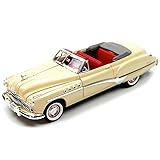
- Brand new 1/18 scale diecast car model of 1949 Buick Roadmaster Cream with Red Interior die cast model car by Motormax. Brand new box. Real rubber tires.
So, is Dacora a modern Duesenberg?
Not yet. Dacora has a more coherent luxury proposition than many early-stage EV ventures: a recognizable American design language, a bespoke customer experience, modular interiors, and an explicit low-volume strategy. The founders and outside design involvement provide credible starting points.
But the Duesenberg comparison currently describes ambition rather than achievement. Duesenberg earned its reputation through demonstrated engineering, racing pedigree, coachbuilt production, and a completed history of delivering exceptional cars. Dacora must still show that it can turn a concept or prototype into a certified, independently tested, serviceable automobile; produce it in real numbers; and support it after delivery.
The decisive milestones are not another rendering or another reservation announcement. They are a production-intent prototype, disclosed powertrain and battery engineering, regulatory certification, a functioning factory or contract-manufacturing arrangement, completed customer cars, and a durable service network.
Frequently Asked Questions
Is Dacora Motors a real company?
Yes. Dacora Motors is operated by DC Motors Corp., a Delaware corporation, and has publicly identified founders, a website, investor materials, and a vehicle program. That does not mean it is already a certified automaker or that it has delivered cars.
Is the Dacora 001 currently available for normal purchase?
No publicly available information reviewed as of August 10, 2026 establishes regular production or customer deliveries. Dacora is accepting waitlist indications and reservations for a planned vehicle targeted for 2028.
Does a $50,000 Dacora reservation buy a car?
No. Dacora’s reservation agreement says the $50,000 deposit is subject to refund conditions and that the reservation is not a vehicle purchase agreement. It may be credited under a later purchase contract.
Is Dacora connected to the original Duesenberg company?
No such licensing, ownership, or technical relationship has been established in the public material reviewed. The Duesenberg reference is an editorial comparison based on American prestige, advanced engineering, coachbuilt customization, low production, and high pricing.
Has Dacora raised its Series A financing?
The public record reviewed does not confirm that the larger Series A reported by Axios closed. Dacora’s current investor page instead solicits a $5 million pre-Series A round and describes a SAFE with a 10% discount and no valuation cap.
Free tools Windows power users keep installed
One-click scans. No signup required.
The Bottom Line
Dacora Motors is best understood as a promising but unproven pre-production automotive startup. Its planned Dacora 001 has a distinctive design and a credible luxury-market thesis, but its horsepower, range, production timing, reservation totals, and revenue commitments remain company claims or projections rather than independently verified results.
For buyers, the key issue is that a reservation is not a purchase and a $500,000 starting price does not guarantee a delivered, certified, supportable vehicle. For investors, the key issue is that a private SAFE and presale commitments do not remove the substantial engineering, regulatory, manufacturing, service, and financing risks. Dacora can aspire to be the Duesenberg of the electric era; it will earn that comparison only by delivering the cars.
Quick Recap
Product prices and availability are accurate as of the date/time indicated and are subject to change. Any price and availability information displayed on Amazon at the time of purchase will apply.




