Pete Carroll’s clearest leadership lesson is to make a few durable principles visible in everyday work. In Seattle, his “Always Compete” philosophy showed up in the pace and structure of practice, the energy coaches were expected to bring, and challenges designed to help players improve—not simply defeat one another. The case is useful beyond football, but it is not proof that one philosophy caused the team’s results or a formula every leader should copy.
Choose principles that can guide ordinary decisions
A personal philosophy is useful when it does more than sound inspiring. It should help a team decide how to prepare, respond to setbacks, and treat one another when no speech is being made. Carroll described competition as a continuing operating principle, not a temporary theme. In a 2023 interview roundup, he said the team sought to “maintain a consistency” by competing in all the things it did, rather than leaning on a seasonal underdog identity that might not last. The Seahawks’ 2023 account of the interview presents his remarks.



For a leader, the practical takeaway is to choose a small number of principles that still make sense in routine situations. A principle should help answer real questions—what “good preparation” means, what effort looks like, or how teammates challenge one another—not just decorate a team meeting. This is an interpretation of Carroll’s approach, not a tested prescription for every workplace.
Make the philosophy observable in routines
Carroll’s practice philosophy was not confined to a slogan. A 2017 Seattle Seahawks practice feature describes high-tempo work, competition in drills, attention to technical details, and players tapping an “I’m In” sign before taking the field. The team kept score, Carroll said, but scoring was not the whole point. He described the team as “competing to throw a great practice” and to work and hustle every day.
The lesson for a non-sports team is to translate the function, not borrow the football ritual. A team might make a quality standard explicit in a review checklist, use timed practice runs for a presentation, or build a regular peer challenge into training. The routine should give people a concrete way to enact the principle and see whether the work meets the standard.
Model the standard before asking others to meet it
Carroll put responsibility for practice energy on the coaches. “So it starts with me, and I kind of pass it along,” he said in the Seahawks’ 2017 feature. The account describes coaches preparing before players arrive, reinforcing the idea that the leader’s behavior is part of the environment being set.
In any team, a stated expectation is more credible when the leader’s own conduct supports it. If a manager asks for preparation, they should arrive prepared; if they ask colleagues to respond constructively to mistakes, they should demonstrate that response themselves. This does not mean a leader must perform constant enthusiasm. It means the standards demanded of others should be visible in the leader’s decisions and habits.
Use competition to improve the work and the people doing it
Carroll framed competition as striving toward a goal, not diminishing another person. In the 2017 account, he said, “The competition is about striving for what you want, not about beating somebody down,” and described the opponent across from a player as someone who could help that player become what they could be.
What’s actually slowing this PC down?
Pick the symptom - the matching free tool is one click away.
That distinction matters outside sport. A useful challenge can sharpen a proposal, reveal a skill gap, or encourage a colleague to raise their standard. A destructive contest instead rewards withholding information, humiliating peers, or winning at the expense of the shared task. Leaders can shape which kind of competition takes hold by defining what is being measured and recognizing both strong individual work and contributions that help the group improve.
Keep shared standards without requiring identical personalities
Common principles do not require people to act alike. In the Seahawks’ 2023 interview roundup, Carroll said he did not want to make players into something they were not and looked for the attributes that distinguished them. He put it plainly: “So the last thing I want to do with our players is try to make them like something that they are not.”
For leaders, the balance is to make expectations clear while leaving room for different strengths, styles, and personalities. A shared standard might be that people prepare thoroughly or give candid feedback; it need not dictate that everyone communicates or leads in exactly the same way.
Make high standards sustainable
Competition was not the whole culture described by Seattle. A 2023 Seahawks training-camp feature portrays a mix of rules, purpose, competitive practice, enjoyment, and close bonds. That account offers a more rounded picture than relentless pressure: relationships and fun were part of the environment alongside demanding work.
The Tool Desk
Outbyte Driver Updater FREEScan for outdated or missing drivers - takes under a minuteDriver Scan →Outbyte PC Repair FREEClear out junk files and repair common Windows errorsFree Scan →Leaders can take this as a reminder to consider how a philosophy feels to live with over time. High expectations do not require making every interaction a test. Teams also need trust, room to recover, and reasons to enjoy working together. The Seattle account describes those elements; it does not establish that they guarantee performance.
Rank #4
What Carroll’s Seattle record can—and cannot—show
Carroll coached Seattle for 14 seasons. The Associated Press reported in January 2024 that the Seahawks reached two NFC championships and won the franchise’s only Super Bowl during that tenure. The same report described a later plateau: Seattle had a losing record in 2021, then consecutive 9–8 seasons, and had not advanced beyond the divisional round since the 2014 playoffs as of January 2024. It also reported Carroll’s acknowledgment that the team had lost an edge.
Those outcomes provide context, not a causal test. They do not show that “Always Compete” alone produced the championships, nor do later results establish that every part of the philosophy failed. The sources cited here do not isolate the effect of Carroll’s leadership approach from the many other factors involved in team performance.
Further reading
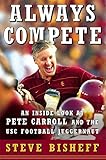
Readers who want historical context can look at Steve Bisheff’s Always Compete: An Inside Look at Pete Carroll and the USC Football Juggernaut. Macmillan lists the 272-page book as published by St. Martin’s Press and on sale September 1, 2009; it covers Carroll and the 2008 USC Trojans. It is not a book authored by Carroll or presented here as a step-by-step leadership manual.
Quick Recap
Product prices and availability are accurate as of the date/time indicated and are subject to change. Any price and availability information displayed on Amazon at the time of purchase will apply.




