Recommended Free Tools
A financial plan turns your goals into decisions about what to do with your money, and when. Start by listing what matters to you and when you will need the money. Then take stock of your income, spending, assets and debts; use that picture to set a workable budget, address high-interest debt, build accessible savings and invest for longer-term goals when appropriate. This guide is for U.S. readers and provides general education, not individualized financial, tax or legal advice.
How do I start a financial plan?
Begin with the outcomes you want, not with a particular account or investment. The SEC’s Investor.gov recommends listing your most important goals and estimating how many years remain until each one. Common goals include retirement, education, buying a home, and preparing for emergencies. Its Saving and Investing publication also offers a worksheet for identifying what you want to save or invest for and by when.


For each goal, record four things:
- Goal: What do you want the money to accomplish?
- Target date: When do you expect to need it?
- Current resources: What savings or other resources are already set aside?
- Next step: What contribution or other action can you take now?
Rank goals when you cannot fund everything at once. A short-term goal and a retirement goal call for different approaches because the time available to save—and the time available to recover from a market decline—differs. Revisit dates and amounts when your circumstances change.
What should I include in a financial snapshot?
Write down what you own, what you owe, what comes in and what goes out. The snapshot gives you a starting point for decisions; it is not a judgment about how well you are doing.
#1 Best Overall

- Used Book in Good Condition
Calculate net worth
List assets such as bank balances and investments, then list liabilities such as credit-card balances and loans. Net worth is assets minus liabilities. Investor.gov recommends updating this statement annually. A single figure is less useful than seeing how it changes over time and understanding what is driving the change.
Track monthly cash flow
Record take-home income and spending, including debt payments, savings and investing. Include bills that do not arrive monthly by estimating their monthly share. Investor.gov suggests automatic transfers as one way to pay yourself first, provided the transfer amount and timing work with your cash needs.
The CFPB’s budgeting article, dated June 5, 2019, recommends getting a full view of income and spending before making a budget. Its budgeting guidance links to a worksheet that brings together income sources, expenses and bill due dates.
How do I make a monthly budget?
A budget is a working plan for where income will go. Use actual numbers from your snapshot, then adjust the plan when income, bills or priorities change. A simple monthly process is:
- Write down reliable take-home income and the timing of each payment.
- List essential bills and their due dates, along with variable necessities such as groceries and transportation.
- Add minimum debt payments, irregular expenses, and any savings or investing contributions.
- Compare planned outflows with income. If spending exceeds income, identify changes or assistance that may close the gap; if there is room, assign it to a priority goal rather than leaving it unplanned.
- Review the budget after a month and revise estimates that did not match reality.
The 50/30/20 rule—allocating 50% of income to needs, 30% to wants and 20% to savings and debt repayment—is one framework used in CFPB educational materials, not a requirement. Actual housing costs, income, family responsibilities and debt can make those percentages unrealistic. Treat the categories as a prompt for discussion, not a test you must pass.
Should I pay off debt or save first?
There is no single sequence that fits every household. Interest on high-cost debt can steadily increase what you pay, while having no accessible cash can leave you vulnerable to an unexpected bill. Investor.gov cautions: “No investment will give you guaranteed returns to outweigh the high interest rate you pay with a credit card or other high interest debt.” Investment returns are uncertain, so do not assume investing will beat an expensive debt rate.
Rank #3
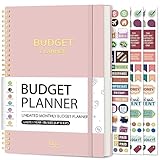
- Effective Budget Planning - Take control of your finances with the budget account book. This comprehensive planner allows you to plan and track your income, expenses, savings, and financial goals in one convenient place. With its intuitive layout and easy-to-use sections, you can stay organized and make informed decisions to achieve financial success.
- User-Friendly Layout - The budget planner features a user-friendly layout designed for easy navigation and organization. Each month, you'll find dedicated budget pages where you can set financial goals, track your income, and plan your expenses. Additional sections include debt trackers, savings goals, bill payment trackers, and more, making it simple to stay on top of your finances.
- Undated Monthly Calendar & Bonus Stickers - Featuring undated calendar each month, you'll have ample space to mark paydays, bills due, appointments, and important dates. Say goodbye to difficult writing spaces. Plus, we've included 3 cute sticker sheets that allow you to personalize your financial organizer and make budgeting more fun. Dates are not pre-printed and are completed by the user.
- Reliable and Convenient Design - Our monthly budget planner is designed for your convenience and built to last. The elastic band keeps everything securely in place, and the dual-sided pocket provides extra storage. Experience a budget planner that combines practicality and durability.
- Master Budgeting with Ease - Our financial planner includes a complete guidebook that provides valuable insights and instructions for optimal usage. From setting financial goals to tracking expenses, this guidebook offers step-by-step guidance and practical tips. Whether you're new to budgeting or an experienced user, this resource will help you make the most of your budget planner, empowering you to achieve financial success.
Consider the trade-offs together: keep essential bills current, understand the interest rates and minimum payments on debts, and decide how much accessible savings you need while directing additional money toward costly balances or other urgent goals. The right balance depends on your expenses, income stability, available support and debt terms. Investor.gov offers general guidance to control high-interest debt, establish emergency savings and contribute regularly toward longer-term goals; it does not prescribe one personalized payoff order for everyone.
How much emergency savings should I build?
Emergency savings are money you can access for an unexpected expense or income interruption without relying immediately on borrowing or selling a long-term investment. Investor.gov points to a savings account at a bank or credit union as one option. In the United States, deposits may be insured by the FDIC or NCUA depending on the institution, account and eligibility; confirm coverage for your specific account with the institution or insurer.
What’s actually slowing this PC down?
Pick the symptom - the matching free tool is one click away.
Investor.gov gives “up to six months of income” as an example of an emergency-fund target some people use. It is not a universal rule or a required starting balance. You can build savings in stages: first choose a manageable initial target based on likely near-term needs, then reassess the amount as you learn more about your expenses and income risks.
Independent reader supportYour contribution helps us test, update, and keep practical guides available for everyone.When should I save, and when should I invest?
For near-term goals and emergency reserves, access and stability are often more important than growth potential. Investor.gov distinguishes accessible savings for short-term needs from investing for longer-term goals. Investments can lose value, including when you are close to needing the money, so match the approach to the goal’s time horizon and your capacity and willingness to tolerate losses.
Mutual funds and exchange-traded funds (ETFs) are among the common investment choices described by Investor.gov. A diversified fund spreads money across multiple securities, which can reduce some risk; diversification cannot prevent losses or guarantee a gain. The SEC’s Introduction to Investing materials include hypothetical contribution illustrations using an assumed 7% average annual return. Such examples depend on their assumptions and are not forecasts or promises of what an investor will earn.
Retirement and education savings plans are account structures that may have tax features or other rules. In the U.S., examples discussed by Investor.gov include workplace 401(k) plans, individual retirement accounts (IRAs) and education savings plans; some workplace plans may include employer matching. Eligibility, contribution limits, tax treatment and plan terms depend on current rules and personal circumstances. Check current IRS, plan-provider or other official guidance before acting rather than assuming one account or contribution rate suits everyone.
Best Value

- EFFECTIVELY MANAGE YOUR MONEY - Our budget planner helps you take control of your finances by providing sections for financial goals, savings, debts, daily expenses, monthly budget, monthly budget review. This finance planner is a good finance book and will help you manage your money effectively.
- PREMIUM QUALITY - Our budget planner is made with high-quality 100gsm paper that reduces ink leakage, fraying, and shade issues. The sturdy and flexible cover,, helps protect the pages. The metal lay-flat twin-wire binding ensures durability and longevity.
- ORGANIZED MONTHLY GOALS & BUDGETS - Our 12-month budget planner helps you set monthly goals, budgets, reviews, and develop good monetary habits, strategies, and action plans. Write down monthly financial goals, put reminders of bills and payments on the calendar, plan your monthly budget in each category, track daily expenses, and review the monthly budget at the end of the month.
- FLEXIBLE USAGE - Our undated finance planner allows you to start at any time and place, making it convenient to use. It has a perfect size of 8.6x5.9 inches and fits in every bag, so it's always at hand.
- CREATE FINANCIAL FREEDOM - Our budget planner is your chance to develop monthly habits, monetary strategies, and action plans to start your journey to long-term financial freedom. It allows you to track monetary flow and review each area for improvements. With this 1-Years budget book, you can take the first step towards financial freedom.
How do I know whether I need a financial planner?
You may be able to organize straightforward goals and a budget on your own. Professional help can be useful when you want advice tailored to several connected decisions—for example, retirement, investments, insurance, taxes or estate planning—or when you are unsure what kind of service you need. Planner services vary: some address a broad set of topics, while others offer narrower recommendations. A planner is not automatically independent of product incentives, so understand the service and its limits before engaging.
Before hiring someone, ask:
- What specific work will you do, and what is outside the scope?
- What will the advice, ongoing service or products cost?
- How are you compensated: hourly or fixed fees, commissions, or a combination?
- What conflicts of interest may apply, and how are they addressed?
- What credentials and relevant experience do you have for my needs?
Investor.gov advises consumers to check an investment professional’s registration, understand risks and fees, and research investments. In the United States, use the appropriate official registration lookup for the type of professional and service involved; registration is not a guarantee of performance. Compare more than a headline fee: scope, limitations, compensation and the kind of advice you will actually receive all matter.
Quick Recap
Product prices and availability are accurate as of the date/time indicated and are subject to change. Any price and availability information displayed on Amazon at the time of purchase will apply.




