Short answer: T-Mobile has used several different price-protection promises, and they do not all mean that your recurring monthly rate could never increase. Some versions described a frozen rate; others allowed T-Mobile to raise the price but offered to cover a customer’s final month if the customer left within 60 days. That difference is the core of the dispute behind Oddo et al. v. T-Mobile USA Inc., a proposed class action alleging that T-Mobile’s advertising promised customers a lasting or “lifetime” price lock.
T-Mobile has not been shown to have been ordered to compensate all affected customers. The case remains litigation, not a final judgment or certified class settlement. Whether you have a claim depends heavily on your enrollment date, plan, historical terms, advertising, account changes and the source of the bill increase.
As an Amazon Associate I earn from qualifying purchases.
The phrase “price lock” did not always describe the same protection
T-Mobile’s current explanation divides historical accounts into four groups. These dates are T-Mobile’s present classification; individual eligibility can still depend on the precise plan, account history, promotions and whether the customer changed plans.
The Tool Desk
Outbyte Driver Updater FREEScan for outdated or missing drivers - takes under a minuteDriver Scan →Outbyte PC Repair FREERepair Windows errors before they cause bigger problemsFix Now →| Account or plan timing | T-Mobile’s current description | Central dispute |
|---|---|---|
| Before April 28, 2022 | Un-contract Promise. T-Mobile says only the customer can change the monthly rate, while also describing a final-month payment if T-Mobile raises prices and the customer leaves within 60 days. | Whether T-Mobile could raise the rate and substitute an exit payment for a genuine price freeze. |
| April 28, 2022–January 17, 2024 | Original Price Lock. T-Mobile says qualifying customers could keep the regular monthly rate. | Whether the promise prohibited a recurring plan-rate increase while the customer stayed on the qualifying plan. |
| January 18, 2024–April 22, 2025 | Last Month Price Lock. T-Mobile says the regular rate stays the same, but a customer may leave and receive coverage for the final month after a price change if the customer gives notice within 60 days. | Whether calling this “price lock” reasonably communicates a frozen price or merely an exit remedy. |
| April 23, 2025 onward | Five-Year Price Guarantee for qualifying Experience plans, subject to exclusions. | The protection is for five years, not necessarily for the customer’s lifetime or the life of the account. |
See T-Mobile’s current Price Lock FAQ for the company’s eligibility categories and exclusions.
#1 Best Overall

- True Unlimited High-Speed Data at 4G/LTE speed on T-Mobile Network in USA.
- Unlimited calls within the USA, International texting and personal hotspot at 3G speed.
- Calls, texting, and data can also be used in the USA, Canada and Mexico.
- The activation takes up to 2 Hours.
What did T-Mobile actually promise?
The wording matters. These statements have materially different practical and legal effects:
- “We will never change the price you pay” sounds like a continuing promise not to increase the recurring rate.
- “Only you can change what you pay” suggests that T-Mobile cannot unilaterally raise the price while the customer remains enrolled.
- “We will pay your final month if we raise prices and you leave” permits a price increase but offers a limited remedy if the customer cancels promptly.
- “The regular monthly rate stays the same” may protect the base plan rate without freezing taxes, fees, discounts, equipment charges or add-ons.
- “Price guaranteed for five years” defines a time-limited guarantee and is not the same as a lifetime promise.
In January 2017, T-Mobile promoted its Un-contract for T-Mobile ONE customers using language that the company would not change what customers paid. A separate explanation described reimbursement of the final month if T-Mobile raised prices and the customer left. Customers and plaintiffs argue that the qualification did not match the plain meaning of the headline promise. T-Mobile has argued in responses to some complaints that the Un-contract never meant prices could not be raised.
The legal question is not simply whether a bill went up. It is whether the specific advertising and contract terms created an enforceable promise not to raise the recurring charge, or instead created the narrower right to leave and receive a final-month payment.
Quick wins for a faster PC:
Clear out junk files and repair common Windows errorsFree Scan →Fix the driver behind crashes, sound loss and screen glitchesFind Drivers →The lawsuit: Oddo et al. v. T-Mobile USA Inc.
Oddo et al. v. T-Mobile USA Inc. was filed in the U.S. District Court for the District of New Jersey. Four plaintiffs allege that T-Mobile marketed plans as guaranteed for life or for as long as customers remained with the carrier, induced customers to enroll, and later raised prices.
The complaint reportedly asserts breach-of-contract, consumer-protection and related claims. The plaintiffs also said they had opted out of T-Mobile’s mandatory arbitration provision and class-action waiver. That issue could be important because T-Mobile’s service terms may require many disputes to be arbitrated individually rather than pursued in court or as a class action.
Rank #2

- Unimited Talk and Text in USA. Unlimited High speed 4G LTE Data in USA. Unlimited Hotspot/Tethering at 3G using your mobile phone. Under Fair Usage Policy, T-Mobile may slow slow down data speed after 50GB of usage.
- This SIM card is not yet activated. Activation may take up to 24 hours. To save time, we suggest you schedule your activation in advance. Please send the activation request as per instruction provided with the SIM Card.
- This SIM Card WILL NOT WORK IN MODEM/WIFI DEVICES. The SIM Card only works in unlocked GSM Phones. The mobile number cannot be ported out (cannot be transferred to another carrier).This SIM Card is for use in the USA only. Cannot be used outside the USA.
- Must be activated within 90 days of purchase. If there is no activation request, we will activate on the 90th day.
The plaintiffs seek remedies described in the complaint, potentially including damages, restitution, injunctive relief or enforcement of the alleged price promise. That does not mean T-Mobile has been ordered to pay, that every customer will receive a refund, or that the court has certified a class. Readers should treat the case as a filed complaint and proposed class claims unless a later court order establishes otherwise.
Read the publicly available Oddo complaint and T-Mobile’s legal terms for the underlying allegations and contractual provisions.
What does “lifetime” mean?
“Lifetime” is not self-defining. Depending on the advertisement and incorporated terms, it might refer to:
- the customer’s lifetime;
- the life of a particular plan;
- the period the customer remains in good standing;
- the duration of the service relationship;
- a marketing shorthand for a cancellation or reimbursement right; or
- a promise limited by arbitration, exclusions or other terms.
The decisive evidence may include the exact advertisement the customer saw, the enrollment date, the plan terms then in effect, account notices, later plan changes and whether a new agreement replaced the old one. A current FAQ can explain how T-Mobile now categorizes accounts, but it does not automatically determine what a 2017 or 2019 advertisement and contract meant when a customer enrolled.
Why a higher bill does not automatically prove a violation
T-Mobile’s price-protection programs generally distinguish the recurring base plan rate from other charges. The company identifies exclusions or possible changes involving:
Rank #3
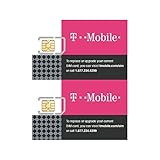
- "Triple-cut" SIM Card can be punched out for the desired size. Universal, 3-in-1 SIM.
- GSM Technology. Compatible with 3G, 4G and 4G LTE devices.
- Compatible with postpaid cellular service.
- No annual contract.
- SIM card only.
- taxes and regulatory fees;
- per-use charges;
- third-party services;
- add-ons and some non-data features;
- equipment prices and equipment promotions;
- one-time bill credits;
- discounts, including certain AutoPay-related amounts;
- network-management practices; and
- some home-internet equipment upgrades or future technology changes.
Before concluding that T-Mobile raised a locked rate, compare the old and new bills line by line. The increase may result from a lost discount, an expired promotional credit, a newly added service, device financing, taxes or fees rather than a change to the protected recurring plan charge.
Customer complaints show the practical conflict
Reporting in 2024 described customers who said they had been promised a permanent rate, were told that their plan was retired, or were moved toward newer plans. Some said they had to call repeatedly to obtain a credit. Others said they could not easily leave because device-installment balances would become due or because they would lose promotional bill credits.
Some customers also reported being denied a final-month payment because T-Mobile said cancellation occurred outside the required 60-day window. These are individual customer accounts, not findings that every subscriber received the same treatment. T-Mobile’s publicly compiled responses to FCC complaints emphasized the company’s interpretation of the final-month reimbursement condition. The materials are available through this complaint compilation.
Advertising regulators raised a related concern about home internet
On June 17, 2024, BBB National Programs’ National Advertising Division recommended that T-Mobile discontinue or modify its “Price Lock” claim for 5G home internet so the policy’s unusual structure was clearer. The decision focused on the risk that ordinary consumers could understand “Price Lock” as a conventional frozen-price guarantee when the policy operated differently.
T-Mobile said it would comply while maintaining that its advertising was appropriate. The NAD decision is not a court ruling and does not establish liability in the customer lawsuit, but it provides independent context for why the wording can be confusing. Read the NAD decision.
PC Slower Than It Used to Be?
A free scan shows the junk files, broken settings and background clutter dragging Windows down - then fixes them in one click.Free scan · Windows 10 & 11Outdated Drivers Are Slowing You Down
One free scan finds every outdated or missing driver and matches the right update for your exact hardware.Free scan · exact hardware matchRank #4

- Unlimited 5G Data - Enjoy data connection with speeds up to 5G
- Unlimited 3G Mobile Hotspot/Tethering - Give your friends & family a hotspot when they need it. Connect your laptop, tablet, and other devices!
- US Phone Number / Unlimited Calls & Texts - Comes with a US phone number as well as unlimited calls and texts
- English Instruction Manual Included - Comes with QR code to our activation sites & our support chat
- Secure 24/7 Customer Support - We will help you solve any problem you may have
How to find out which protection applies to you
- Identify the enrollment or switch date. Find the date the relevant line or plan was activated or changed.
- Record the exact plan name. Note whether it was T-Mobile ONE, Magenta, a 55+ or military plan, a First Responder plan, Go5G, home internet, prepaid or a business account.
- Find the original representation. Save the advertisement, email, text, store material or webpage that described the protection.
- Compare bills. Mark the first month with a higher charge and separate base service, taxes, fees, discounts, equipment, device payments and add-ons.
- Check account changes. Adding lines, switching plans, accepting a new promotion or changing account type may affect eligibility. T-Mobile says a later-added line may not extend or restart a guarantee, and a plan change generally can cause the old promotion to be lost.
- Check the notice period. If the applicable program offers final-month reimbursement, confirm when T-Mobile notified you and whether you left within the stated 60-day period.
- Review arbitration status. Determine whether you opted out, when you opted out and whether that opt-out was effective under the applicable terms.
Important edge cases
- Added lines: The protected amount may be the published rate on the line’s activation date, rather than the original advertised account price.
- Discounts: AutoPay discounts, free-line credits and temporary promotions may change without a direct increase to the guaranteed base rate.
- Home internet: The NAD decision concerned advertising clarity, not a universal ruling that every home-internet bill increase violated a contract.
- Device financing: Leaving can accelerate device payments or end promotional credits, depending on the installment agreement.
- Business accounts: Business eligibility and terms may differ from consumer accounts.
- Prepaid: T-Mobile’s current FAQ says qualifying prepaid plans activated or switched beginning June 24, 2025 receive the five-year guarantee; older prepaid accounts should not assume they receive the same protection.
Should you leave T-Mobile?
Do not make the decision from the advertised service rate alone. Calculate the total cost through the end of your device-financing period, including:
- the remaining device balance;
- bill credits you would lose by leaving;
- activation, equipment or transfer charges;
- tax and fee differences;
- the value of included streaming, roaming or other benefits; and
- coverage at your home, workplace and usual travel destinations.
Verizon, AT&T and prepaid or MVNO providers such as Visible, Metro by T-Mobile, Cricket and US Mobile may be alternatives, but a lower advertised rate is not proof of a better deal or a stronger price guarantee. Compare current offers, taxes, device terms, network access, roaming and promotional lock-ins before switching. Prices and promotions change, so verify them directly with each provider.
What to do if your bill increased
1. Ask T-Mobile for a written determination
Request a written answer identifying:
- the price-lock category T-Mobile believes applies;
- the date the account qualified;
- the recurring charge it says may be changed;
- whether the increase is a plan-rate change, fee, discount change or add-on;
- whether you qualify for a final-month payment; and
- the deadline and procedure for requesting it.
Keep the chat transcript, case number and names or identifiers for customer-service representatives. A written response is more useful than relying on a verbal explanation that cannot later be documented.
2. Preserve your evidence
Save the original advertisement, enrollment date, historical terms, bills before and after the increase, price-change notice, support transcripts, call-reference numbers, any credit denial, cancellation date and proof of when T-Mobile was notified. Also preserve device-installment documents and evidence of plan changes, added lines and accepted promotions.
3. Consider a regulator complaint
You can consider filing with the Federal Communications Commission and your state attorney general or consumer-protection agency. A complaint can create a record and prompt a carrier response, but it does not automatically establish liability or guarantee compensation.
4. Consider legal advice carefully
Arbitration clauses and class-action waivers can materially affect your options. An effective opt-out may matter, but the result depends on the applicable terms, timing and facts. A licensed attorney can assess whether an individual arbitration claim, court claim or participation in the proposed litigation is appropriate. Do not assume that filing a complaint or leaving service preserves every legal remedy.
Quick Recap
Product prices and availability are accurate as of the date/time indicated and are subject to change. Any price and availability information displayed on Amazon at the time of purchase will apply.




