Tyco Electronics entered the relay market in 1999 and, by 2000, had roughly $450 million in relay sales. A market estimate cited by EE Times put it third behind Omron and Matsushita. Tyco’s push was built less around one breakthrough product than around acquisitions, established brands, factory consolidation, broad distribution and engineering support. These are historical figures and plans reported in 2001, not a description of today’s relay market or Tyco’s current corporate structure.
Spencer Chin’s EE Times report, published August 16, 2001, is the basis for this account. It attributes the estimated $4.7 billion 2000 market size and Tyco’s ranking to Venture Development Corp.; the article does not define the market estimate in detail.
Tyco bought a fast route into the relay business
Rather than build a relay business solely from the ground up, Tyco assembled one through acquisitions. In September 1999, it acquired Siemens’ Electromechanical Components group for $1.1 billion. The purchase brought the Potter & Brumfield, OEG and Schrack relay brands, as well as Siemens’ own brand. Tyco rebranded the Siemens name under Tyco while retaining the other acquired relay names.
In July 2000, Tyco’s acquisition of Thomas & Betts added the Agastat relay brand. The company also acquired Axicom, a Swiss supplier of telecommunications relays, around October 2000, based on the timing in the August 2001 report.
What’s actually slowing this PC down?
Pick the symptom - the matching free tool is one click away.
#1 Best Overall
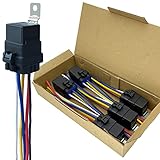
- Never go beyond its capabilities. Try to stay 10 to 15% below what the rate is for
- 12-volt 5-prong (SPDT) relay. Excellent water-repellent and dustproof ability, but do not use it in water
- Be careful when inserting the relay into the socket. If you force it, you will bend the female connectors
- Primary leads use 12 a.w.g tinned copper wire. Coil leads use 16 a.w.g
- Nominal Coil Voltage: 12 V DC; Coil Power: 1.8 W; Coil Resistance: 80 Ω; Must Operate Voltage: 6~8 V DC; Must Release Voltage: 0.6~3.6 V DC; Maximum Applied Voltage: 15.6 V DC
Together, the purchases gave Tyco more than manufacturing assets: they brought recognized product lines, customer relationships and expertise across relay categories. They also offered a much quicker way to broaden market coverage than developing every product family and customer connection internally. The report does not separate how much of Tyco’s sales or market position came from acquisitions versus organic growth.
Legacy brands helped make the portfolio visible
Potter & Brumfield was described as the best-known of the four relay brands acquired from Siemens. Industry analyst John Gordon told EE Times that Tyco had high visibility in the market, particularly through its marketing of Potter & Brumfield. That recognition could matter to engineers choosing components and buyers managing established supplier relationships: a familiar name can make a newly consolidated business easier to evaluate.
Keeping OEG, Schrack, Agastat and Potter & Brumfield preserved identities customers already knew, while the Siemens relay line took the Tyco name. A multi-brand approach can preserve segment-specific recognition, but it also creates a portfolio-management challenge: customers must be able to understand which brand and product family fits their needs. The 2001 account describes the retained names but does not explain how Tyco managed overlap among them.
Rank #2
![2PCS Electromagnetic Power Relay, 8-Pin 10A 110/120 AC Relay Coil with Socket Base, LED Indicator, DPDT 2NO 2NC - MY2NJ 2PCS [Applicable for DIN Rail System]](https://m.media-amazon.com/images/I/41WZmx0Ed2L._SL160_.jpg)
- Electromagnetic relays are widely used: household air conditioner compressor motors, fan motors, cooling pump motors, starter relays for car starters, spur relays, motors, generator circuit breakers, industrial relays, etc
- Product Name: Electromagnetic Power Relay; Model: YJ2N-LY Type: DPDT; number of terminals: 8
- Coil voltage: 110V/120V AC; Contact capacity: 10A 240VAC with din rail and self-tapping screws.
- Red mechanical indicatoe:It can intuitively judge whether the relay is attracted
- LED signal lamp : It can judge the AC or DC coil, and judge whether the coil is energized
Acquisitions widened the product range
Tyco began marketing OEG relays in North America and introduced a miniature printed-circuit-board relay under the Schrack brand. The OEG line included PCB relays, general-purpose panel relays and plug-in relays. Those additions helped Tyco address more applications and gave its sales operation more categories to present against established competitors such as Omron and Matsushita.
Do these 3 things before closing this tab:
1Fix the driver behind crashes, sound loss and screen glitches2Clear out junk files and repair common Windows errors3Scan for outdated or missing drivers - takes under a minuteThe report’s evidence concerns product categories and market reach, not comparative performance. It provides no product-by-product data on switching capacity, service life, reliability, price or delivery time, so it cannot establish that Tyco’s relays outperformed competitors.
Factory consolidation paired scale with concentration
Tyco was reportedly producing hundreds of millions of relays annually while consolidating multiple relay operations into three locations: Austria, China and Mexico. The OEG line was built at a 16,500-square-foot plant in Shenzhen, China.
Rank #3

- Integrated Diode: Each relay includes a built-in diode that suppresses induced voltage during switching, safeguarding your electrical components from potential damage.
- Small size/Low power consumption/High contact voltage/ High sensitivity.
- Contact Material: Ag Alloy / Contact Resistance: ≤ 100MΩ.
- Minimum operating voltage 8V, corresponding minimum operating current is 100mA; Standard operating voltage 12V, corresponding standard operating current is 150mA.
- Life Expectancy Electrical: 100,000 Operation, Life Expectancy Mechanical: 10,000,000 Operation.
Fewer, larger or more focused sites can reduce duplicated operations, concentrate expertise and make capacity easier to coordinate. Those are plausible reasons for consolidation, not measured results in the report: it gives no quantified cost savings, productivity gains, utilization rates or employment effects. Concentrating production can also increase dependence on a smaller number of facilities, making site disruptions more consequential. The “hundreds of millions” figure describes relays produced annually, not necessarily units sold.
An existing sales network gave Tyco a route to customers
Tyco chose to sell relays through its existing global sales force instead of creating a separate relay sales organization. Representatives could offer relays alongside switches, connectors and terminal blocks to customers who might buy several kinds of electromechanical components. This approach could make cross-selling easier and avoid the cost of building a standalone commercial network.
Thirty global and regional distributors complemented direct sales, according to the report. Using both channels broadened customer access, although the article does not describe account rules or how Tyco managed potential conflicts between direct representatives and distributors.
Rank #4

- 12V Relay Module: Working Voltage: DC 12V; Maximum Load: AC 250V/10A, DC 30V/10A; Trigger Current of Opto-Isolator: 5mA
- Fault-Tolerant Design: Fault Tolerant Design, Even if the Control Line is Broken, the Relay will not Operate;All Interfaces of Relay can be Wired Out Through the Terminals Directly,Normally Open and Normally Closed
- Optocoupler Isolation:1 Channel Relay Board use Optocoupler Isolation that has Strong Driving Ability and Stable Performance ,The Isolation Circuit Prevent Damages to I / O Port by Relay Switch Current
- Jumper Design: The Relay Module has a Jumper That You Can Set Rather the Unit State Changes with High or Low Signal. Has Screw Terminals for Relay (NC,C,NO) and for Input; Coil +, Coil - and Trigger.
- Wide Application: DC 12V Relay Module Works Well with ARM /PIC /AVR /MCU/Raspberry/CNC Machine/ PS4 etc.
Application support added more than product availability
Tyco had a UL-certified test laboratory in Winston-Salem, North Carolina, and six relay application specialists across the United States, according to a Tyco executive quoted in the report. A lab and application staff can help customers assess components and work through selection or design questions, making technical assistance part of the supplier relationship rather than leaving the sale to a catalogue listing.
The article does not identify particular test protocols or say what certifications the laboratory performed. Its account supports the narrower point that Tyco presented testing resources and application expertise as part of its relay offering.
What the 2001 account can—and cannot—show
The combination of acquired brands, wider product coverage, consolidated manufacturing, existing sales channels and application support formed a coherent attempt to challenge larger relay competitors. Yet a larger portfolio and reported production scale do not by themselves prove market-share gains or profitable integration.
- Integration: The report does not quantify savings, facility changes or the performance of the acquired businesses.
- Customer adoption: It offers no customer interviews, design-win examples or retention data.
- Competitive outcome: Omron and Matsushita are named as leaders, but the report does not analyze their response or show that Tyco later overtook them.
- Product comparison: There is no evidence here to rank the companies’ relays on price, performance or reliability.
- Current relevance: The article documents a strategy and corporate arrangement around 1999–2001; it does not establish current ownership, product availability or market position.
Read as a historical strategy snapshot, the story is about assembling an ecosystem around a component: brands to reduce unfamiliarity, factories to support volume, distribution to reach buyers and technical staff to help secure applications. It records Tyco’s effort to move up the relay field, not proof of where the company or its products stand today.
Quick Recap
Product prices and availability are accurate as of the date/time indicated and are subject to change. Any price and availability information displayed on Amazon at the time of purchase will apply.




