Free tools Windows power users keep installed
One-click scans. No signup required.
Put the referral in the subject line or opening sentence, name the person accurately, then explain briefly why you are contacting the recipient and make one clear, modest request. For example: “Jordan Lee suggested I reach out to you about [specific topic].” Ask the referrer before naming them if you are unsure they are comfortable being mentioned, and never imply a stronger endorsement than they gave.
What to include in a referral email
- The connection: Name the person who referred you and, when it helps, describe your relationship in a few words.
- Your reason for writing: Identify the role, question, or professional topic that brings you to the recipient.
- One specific next step: Ask for something reasonable, such as application guidance, a short conversation, or the right contact.
- A courteous close: Thank the recipient for their time and keep the message concise.
The referral explains why you are contacting this person; it does not obligate them to help or guarantee a job, interview, or response.
As an Amazon Associate I earn from qualifying purchases.
Choose wording that matches the connection
Direct referral
Use a simple opening when the person explicitly suggested that you contact the recipient: “Jordan Lee suggested I reach out to you about [role, project, or topic].” Boston University’s career-center template uses a similar construction: “Susan Wilson suggested that I get in touch with you.” Boston University’s alumni networking guidance
Referral with relationship context
If the recipient may not know why the referrer connected you, add a short, accurate clause: “Jordan Lee, who I worked with at [company/on project], recommended I contact you about [specific topic].” Keep the context factual; there is no need to recount your history. Northwestern’s template likewise identifies the shared contact and explains the reason for reaching out. Northwestern’s informational interview guidance
#1 Best Overall

- Promote Your Business: Showcase your business card on everyday household reference cards with these peel and stick business card magnets. This unique and effective marketing tool will help you stand out from the competition.
- Versatile and Convenient: Use these household magnets to stuff in door knob bags, Open House handouts, or giveaway items. They also fit in a #10 envelope and mail for the 1oz rate. Their magnetic backing allows for easy placement on refrigerators, filing cabinets, or any other magnetic surface, ensuring your information is always within reach.
- High-Quality Reference Cards: Each box contains 100 cards with a peel and stick business card magnet, providing you with ample supply to make a lasting impression on your target audience. These reference cards are made from durable materials, ensuring they withstand long term use.
- Increase Visibility and Accessibility: By placing your business card on a household magnet, you enhance its visibility and accessibility. Your clients and potential customers will have a constant reminder of your services whenever they use or reference the magnet, increasing the likelihood of future business opportunities.
- Stand Out and Stay Top of Mind: Effectively promote your business and leave a lasting impression on your clients. Your business card will be prominently displayed in households, ensuring you stay top of mind when it comes to real estate needs. These magnets are a must-have marketing tool for any professional.
Mutual contact, but no direct referral
If the person only shared the recipient’s name or you learned of the recipient through a mutual contact, do not describe that as a recommendation. Try: “[Name] mentioned your work in [field], and I’m reaching out because [specific reason].” This distinguishes a mutual connection from an explicit endorsement.
Subject lines that make the connection clear
- Referred by [Name] — [role or topic]
- [Name] suggested I reach out
- Informational interview request — referred by [Name]
Northwestern’s official template uses “Informational Interview Request Referred by (Referral Name),” while The Balance gives “Referred by Chris Rogers” as an example. The Balance’s referral email examples
Rank #2

- PERSONALIZED BUSINESS CARDS – Customize your business cards with your company logo and text. Perfect for business professionals, salespeople, small businesses, and more.
- EASILY CREATE YOUR OWN – Upload your logo, add custom text, and select a background color. Include important details such as your name, company name, title, address, phone number, or website.
- MULTIPLE QUANTITIES – Available in quantities ranging from 50 to 10,000 business cards. Choose the perfect amount to suit your needs.
- STANDARD SIZE – Each business card measures the standard 2" x 3.5".
- 16PT CARDSTOCK – Crafted from premium 16PT cardstock for a sturdy, professional finish that makes a lasting impact.
Adapt the email to your purpose
Asking about a job opening
“Jordan Lee suggested I contact you about the [job title] opening. I’m a [current role] with experience in [relevant skill], and I’m interested in [specific reason]. Would you be the right person to ask about the application process?”
This gives the recipient the connection, a relevant detail about you, and an easy-to-answer question. It asks for guidance rather than treating the referral as a request to secure the job.
Rank #3
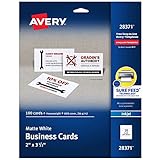
- Quality Cardstock: Crafted from white cardstock paper for printer, these custom business cards offer professional quality, making your business cards easily customizable and personal
- Sure Feed Technology: Get a reliable output for your blank business cards, Sure Feed Technology technology that reduces tmisalignments and jams so every detail is correctly printed on your custom cards
- Smooth, Clean Edges: With multiple precise cuts, these white cardstock business cards provide clean, smooth edges for easy separation, so your custom business cards maintain a professional appearance
- Customization: Use Avery business cards templates to design and print business cards that can be customized at home using card paper with an inkjet printer
- Crisp, Smudge-Free Printing: Compatible with inkjet printers, the white cardstock paper delivers crisp, smudge-free prints for business cards, allowing you to customize your designs on both sides
Requesting a networking conversation
“[Name] suggested I reach out because of your work in [field]. I’m exploring [specific topic] and would appreciate 15 minutes to hear your perspective, if your schedule allows.”
A time-limited request makes the ask concrete while leaving the recipient room to decline. You can also ask for a pointer to another contact if a meeting is not appropriate.
Rank #4

- Value Pack: This set includes 100 self-adhesive business card magnets, suitable for large-scale promotions, events, or corporate giveaways. Ideal for increasing brand visibility
- Brand Marketing: Designed to help your brand stand out, these kitchen reference business magnets provide a practical way to distribute your business card. Each magnet combines marketing with functionality, making it an effective publicity tool
- Versatile Use: These peel-and-stick business magnets can be used in giveaways, and fit in a 10 envelope and mail for the 1oz rate. They come with a self-adhesive backing, allowing them to easily stick to doors, refrigerators, and other metal surfaces, keeping your brand message within easy reach
- Kitchen Reference: Each business card magnet includes a kitchen measurement conversion chart covering gallons, quarts, pints, cups, tablespoons, teaspoons, and more. This makes cooking easier for customers while also giving them a chance to see your brand
- Guide & Notes: The brand promotion business magnets back of the card features instructions for the Heimlich maneuver, providing quick and accurate guidance in the event of a choking incident; The blank space allows you to jot down passwords or daily to-do lists, making it extremely practical
Contacting someone about a business or project topic
“[Name] suggested I contact you about [project or topic]. I’m working on [brief context], and I’d like to ask about [specific question]. Would you be the right person to speak with?”
State the purpose plainly and avoid implying that the referrer promised an introduction or outcome unless they actually did.
Best Value

- No app or device requirement: Share your dot.Profile with anyone, as others don't need an app or a dot.device to receive your information.
- Hassle-free sharing: Easily share your dot.Profile with unlimited free shares of your digital business card.
- Simple sharing process: Tap your dot.device to a compatible phone or scan the dot.Profile QR code to share your profile. Compatible with a wide range of phones.
- Update information on the go: Keep your dot.Profile up to date by easily modifying and updating your information as it changes, ensuring you always have the most accurate details.
- Privacy and security: Protect your information with dot, as no passwords are ever needed to link your social accounts. Dot uses only usernames and links to create your digital business card.
A complete email you can adapt
Subject: Referred by Jordan Lee — [role or topic]
Hello [Recipient Name],
Jordan Lee suggested I reach out to you about [specific role, project, or topic]. Jordan and I [brief, accurate description of your connection]. I’m currently [one-line relevant background], and I’m interested in [specific reason for contacting this recipient].
Would you be available for [a short call / a brief conversation / a pointer to the right person]? If someone else is the better contact, I’d appreciate your direction. I understand if your schedule does not allow.
Recommended Free Tools
Thank you for your time,
[Name]
[Contact details, if appropriate]
Before you send it
- Confirm permission and wording. If it is not clear that the referrer is comfortable being named, ask first. Use only the endorsement they gave: “you can mention me” is not the same as “I highly recommend you.”
- Check the connection is described accurately. Say whether the person referred you, suggested you reach out, or simply gave you the recipient’s name.
- Keep the message focused. Include only the background that helps explain your purpose, then make one manageable request.
- Proofread the names and details. Check the recipient’s name, the referrer’s name, the role or topic, and the subject line.
- Thank the referrer separately. Send them a brief thank-you after making the contact, and update them if the outreach leads somewhere.
University career-center examples and career guidance support this practical pattern: identify the connection, explain your reason for writing, make a specific request, and thank the recipient. The wording is useful etiquette, not evidence that mentioning a referral guarantees a reply or interview.
Quick Recap
Product prices and availability are accurate as of the date/time indicated and are subject to change. Any price and availability information displayed on Amazon at the time of purchase will apply.




