What’s actually slowing this PC down?
Pick the symptom - the matching free tool is one click away.
Hosting a dedicated server means more than renting a physical machine: your business must plan who administers it, how it is secured, and how services and data will be restored after a failure. Use this checklist to decide whether dedicated hosting fits, choose a provider and configuration, and verify readiness before production.
Decide whether a dedicated server fits
A bare-metal dedicated server is a physical machine reserved for one customer. That can provide predictable resources and physical isolation, but it does not automatically provide high availability, backups, DDoS protection, compliance, application security, or managed operating-system administration. A single dedicated server can still be a single point of failure.
Vendors also use related terms differently. A cloud dedicated host reserves physical hardware on which you run cloud virtual machines; an AWS Dedicated Host, for example, offers host placement visibility. A dedicated instance runs on hardware dedicated to a customer account but does not provide the same placement controls. A VPS or cloud VM generally shares physical infrastructure. Colocation means you supply and maintain the hardware in a provider’s facility. Ask what the contract means by “dedicated” and which party owns each operational task.
| Option | When it may fit | Main trade-off |
|---|---|---|
| Unmanaged bare metal | Sustained, predictable workloads and a capable internal team or administrator. | The business handles most system administration, security, backups, and recovery. |
| Managed dedicated server | A business that wants dedicated hardware but needs operational help. | “Managed” varies; responsibilities and exclusions must be confirmed in writing. |
| Cloud dedicated host | Cloud-integrated workloads, host placement needs, or eligible license models. | Cloud architecture and billing can be more complex than a flat server rental. |
| VPS or cloud VM | Smaller, variable, or rapidly scaling workloads. | Usually lacks physical isolation and may have different resource guarantees. |
| Colocation | A business that owns specialized hardware and needs a data-center facility. | You remain responsible for hardware procurement, spares, and much of the maintenance. |
| SaaS or managed platform | A standard business need that does not require control of the underlying server. | Less control over the underlying infrastructure and configuration. |
Dedicated hosting is more likely to make sense when predictable capacity, specialized hardware, large local storage, physical isolation, or full operating-system control is important. Consider an alternative if the workload is small or highly variable, you lack an administrator and cannot fund managed support, or a single-server outage would be unacceptable. For AWS-specific host and instance distinctions, see AWS Dedicated Hosts overview and Dedicated Instances. For conventional bare metal, OVHcloud says customers are responsible for administration in its dedicated-server arrangements; check the exact service terms at OVHcloud’s getting-started guide.
#1 Best Overall
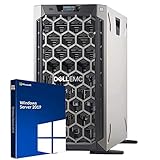
- 3.5 Inch Hot Plug Hard Drive PowerEdge T340 Tower Server Chassis
- Microsoft Windows Server 2019 Standard Operating System
- Processors: Intel Xeon E-2124 Quad-Core 3.3GHz 8MB CPU, Up To 4.3GHz Turbo
- Memory: 32GB (2 x 16GB) DDR4 PC4-21300 2666MHz Unbuffered Memory
- Hard Drive: 8TB (4 x 2TB) 7.2K RPM 6Gb/s SATA 3.5 Inch HDDs in RAID
Define the workload and recovery requirements
Write down the requirements before choosing hardware. Estimates do not need to be perfect, but they should make assumptions visible and give you a baseline for capacity and recovery decisions.
- Application type, user count, peak concurrent connections, current traffic, and expected growth over the next 12–36 months.
- CPU needs, memory use, database size and growth, and storage characteristics: capacity, random I/O, throughput, or latency.
- Required uptime and maintenance windows.
- Recovery time objective (RTO): how long the service can be unavailable.
- Recovery point objective (RPO): how much recent data the business can afford to lose.
- User geography, latency needs, data-residency requirements, compliance obligations, and applicable software licenses.
- Who will administer the server, respond to alerts, approve changes, and handle emergencies.
Translate the RTO and RPO into a recovery plan. A server rental alone does not guarantee either target: backups, replacement capacity, configuration records, staff availability, and recovery testing all affect the result.
Choose hardware, location, and operating system
CPU and memory
Check the processor model, physical-core count, sustained performance, virtualization support, and any relevant instruction-set or encryption acceleration. A high core count does not guarantee good performance for an application that depends on fast single-core execution. Ask whether burst performance is limited. Size memory for the OS, application, database cache, virtualization overhead, and planned growth; databases and virtual machines can suffer sharply when they run short of RAM. Consider ECC memory for workloads where correcting memory errors matters and the provider offers it.
Storage and redundancy
Match the storage to the workload. NVMe SSDs generally suit latency-sensitive applications better than spinning disks, while capacity-heavy workloads may have different priorities. Confirm drive count and type, usable capacity after RAID and filesystem overhead, reserve space, replacement procedures, and whether RAID is hardware-managed, software-managed, or unavailable. RAID can help a service continue after some drive failures; it is not a backup and will not protect against deletion, ransomware, corruption, or loss of the server.
Recommended Free Tools
Network and location
Ask about port speed, committed or shared bandwidth, transfer allowances, metering and fair-use terms, IPv4 and IPv6, routed subnets, reverse DNS, DDoS options, and any additional fees. A stated port speed does not by itself mean that throughput is guaranteed or unlimited. Choose a data center near users unless legal, resilience, or interconnection needs point elsewhere; record its country and region and check data-residency implications.
Linux or Windows Server
Choose an OS that the application supports and the team can operate reliably. Compare vendor support, automation, identity integration, licensing, and total operational cost—not just the server price. For Windows, confirm the edition and whether the provider supplies the license or expects customer-provided licensing; check applicable CAL and application licensing obligations. AWS Dedicated Hosts can support eligible customer-owned licenses, including certain Windows Server and SQL Server models, subject to the vendors’ terms; see AWS Dedicated Hosts and AWS’s BYOL guidance.
Vet the provider and the total cost
Get the service scope and costs in writing. Unmanaged hosting can leave the customer responsible for OS updates, accounts, firewall rules, application security, backups, monitoring, recovery, licensing, and incident response. If a provider calls a service “managed,” request a responsibility matrix rather than assuming the term includes every task.
- Data-center location, hardware specifications, upgrade options, and failed-drive or failed-server replacement process.
- Network port, traffic terms, IP availability, DDoS scope and limits, and provider-level firewall behavior.
- Remote console, rescue mode, virtual media, or other out-of-band access when the OS or network is unavailable.
- Supported OS images and versions, license arrangements, and costs for operating systems, databases, control panels, extra IPs, bandwidth, storage, backups, and support.
- Backup retention and restore process; monitoring capability; support hours, response targets, escalation, reboots, and maintenance procedures.
- Acceptable-use and abuse policies, cancellation terms, data deletion, and how to export data or migrate away.
- If managed, exactly who patches, reboots, configures firewalls, administers applications and databases, monitors alerts, restores backups, and handles incidents.
Budget for more than the monthly server charge: include backup storage, monitoring, licenses, security services, managed support, engineering time, migration, and recovery work. Prices and included features vary by location and configuration. Hetzner documents a customer-configurable firewall model for dedicated servers and distinguishes it from managed-server monitoring and security arrangements; see its technical and organizational measures. Treat each provider’s actual product and contract as authoritative.
The Tool Desk
Outbyte Driver Updater FREEFix the driver behind crashes, sound loss and screen glitchesFind Drivers →Outbyte PC Repair FREEClear out junk files and repair common Windows errorsFree Scan →Rank #2

- This Certified Refurbished Product is tested and certified to look and work like new. The refurbishing process includes functionality testing, basic cleaning, inspection, and repackaging. The product ships with all relevant accessories, a minimum 90-day warranty, and may arrive in a generic box. Only select sellers who maintain a high-performance bar may offer Certified Refurbished products on Amazon.com.
- Dell OptiPlex 7040 Small Form Factor High Performance Business Desktop Computer.
- Intel Quad Core i5-6500 up to 3.6GHz.
- 16GB RAM, 256GB SSD, WiFi.
Prepare business access and recovery before provisioning
Use a company-controlled provider account, not an employee’s personal email. Enable multifactor authentication (MFA), authorize at least two administrators, store recovery codes in a business password manager, and record who can reach the provider console, billing, DNS, backups, and support. Give administrators separate identities, keep credentials out of shared documents, and define offboarding and emergency access procedures.
Before changing firewall or login settings, make sure you can reach the provider’s console, rescue environment, or other recovery path. Record the server’s hostname, IP addresses, OS release, kernel, disk layout, DNS requirements, timezone, and initial configuration. Test a second administrative login before closing the installation session.
Provision and secure an Ubuntu Server example
The following is a baseline for a newly installed Ubuntu Server system, not a complete production configuration for every release or application. Confirm commands and policies against the selected OS version and your environment. Ubuntu’s guidance recommends updates, least privilege, a firewall, and secure remote administration: Ubuntu Server security suggestions.
1. Update the system and record its version
sudo apt update
sudo apt upgrade
sudo reboot
After reconnecting, record the system details:
uname -a
lsb_release -a
2. Create an administrator and install an SSH key
sudo adduser deployadmin
sudo usermod -aG sudo deployadmin
ssh-keygen -t ed25519
ssh-copy-id deployadmin@SERVER_IP
Ubuntu documents Ed25519 key generation and key-based login through authorized_keys in its OpenSSH server guide. In a separate terminal, test the key before changing existing access:
PC Slower Than It Used to Be?
A free scan shows the junk files, broken settings and background clutter dragging Windows down - then fixes them in one click.Free scan · Windows 10 & 11Outdated Drivers Are Slowing You Down
One free scan finds every outdated or missing driver and matches the right update for your exact hardware.Free scan · exact hardware matchssh deployadmin@SERVER_IP3. Allow required traffic before enabling the firewall
For a public web server that needs SSH, HTTP, and HTTPS, a basic UFW example is:
sudo ufw default deny incoming
sudo ufw default allow outgoing
sudo ufw allow OpenSSH
sudo ufw allow 80/tcp
sudo ufw allow 443/tcp
sudo ufw enable
sudo ufw status verbose
If SSH should be reachable only from an administration network, replace the broad SSH rule with a source-restricted one. Use your actual trusted address or CIDR range:
sudo ufw delete allow OpenSSH
sudo ufw allow from ADMIN_IP_OR_CIDR to any port 22 proto tcp
Keep an existing session open and verify a second connection before ending it. Avoid exposing database ports publicly; prefer a private network, VPN, bastion, or tightly restricted source rules. Ubuntu’s firewall guide covers UFW configuration and logging. Enable logging if appropriate for your operations:
sudo ufw logging on4. Harden SSH without locking yourself out
Create a drop-in configuration file:
sudo nano /etc/ssh/sshd_config.d/99-business-hardening.confExample settings for a key-authenticated deployment:
Do these 3 things before closing this tab:
1Fix the driver behind crashes, sound loss and screen glitches2Clear out junk files and repair common Windows errors3Scan for outdated or missing drivers - takes under a minuteRank #3

- Powerful 8th Generation Processor - The Dell OptiPlex 7060 desktop computer is powered by an Intel 6-core 8th Generation i7-8700 processor, which can reach up to 4.60 Ghz, enabling efficient multitasking.
- Microsoft Windows 11 Pro – This Dell small form factor desktop computer comes pre-installed with the Windows 11 Professional operating system. Microsoft has reimagined how the PC should work for you and alongside you, and this Windows 11-powered desktop is redefining productivity.
- Smooth Multitasking – The Dell OptiPlex is equipped with a blazing-fast new 512GB M.2 NVMe solid-state drive (SSD), which stores important files and applications while supporting faster boot speeds and higher data transfer rates.
- High-Performance Office Desktop – This business desktop computer serves as a reliable workstation, suitable for both home and business computing. The spacious desktop tower case allows for future expansion, making it an excellent fit for use as an office PC.
- Rich Ports – This Dell OptiPlex computer is equipped with 5 USB 3.0 ports, 2 USB 2.0 ports, and 2 DisplayPort ports, supporting dual-monitor connections. Additionally, a wireless keyboard and mouse are included.
PermitRootLogin no
PasswordAuthentication no
PubkeyAuthentication yes
Do not disable password authentication until key access succeeds in a separate session and emergency console access is available. Validate the configuration before reloading SSH:
sudo sshd -t
sudo systemctl reload ssh
Changing the SSH port is not a substitute for strong authentication, least privilege, patching, or firewall restrictions.
5. Verify updates, time, and running services
Ubuntu uses unattended-upgrades for automatic updates. Verify the service and timer, and review logs rather than assuming every package is covered:
systemctl status unattended-upgrades
systemctl status apt-daily-upgrade.timer
sudo ls -lah /var/log/unattended-upgrades/
If it is not installed:
sudo apt install unattended-upgradesUpdate behavior depends on configured package sources and policy; third-party repositories and application software may require separate controls. Test updates where possible, monitor failures, define reboot behavior, and use exclusions only with a documented reason. See Ubuntu’s automatic updates guide and security updates documentation.
Check time synchronization and identify exposed services:
timedatectl status
sudo ss -tulpn
systemctl list-unit-files --type=service --state=enabled
Correct time supports reliable logs, certificates, authentication, and backup schedules. Disable unnecessary services and avoid untrusted package sources.
6. Configure TLS and application services
For public web applications, configure HTTPS, suitable HTTP-to-HTTPS redirection, renewal monitoring, and protection for private keys. Ubuntu notes that public production services generally need a CA-signed certificate rather than a self-signed one; see its certificate documentation.
Install only the services required for the workload—such as a web server, database, container runtime, virtualization stack, or file service—and give each a supported version, access model, firewall policy, update plan, backup method, log location, restore procedure, and monitoring check. Avoid self-hosting email unless the team can operate deliverability, abuse controls, DNS records, reputation monitoring, and redundancy.
Rank #4

- MODEL P74439-005: Compact and affordable HPE ProLiant MicroServer Gen11 powered by Intel Pentium Gold G7400 3.7GHz processor, ideal for file sharing, NAS, and basic business workloads
- READY OUT OF THE BOX: Includes 16GB DDR5 UDIMM memory (expandable to 128GB), one 1TB SATA 6G Business Critical HDD, embedded Intel VROC SATA, dedicated iLO-M.2 port kit, 180w external power adapter and 1/1/1 warranty for dependable plug-and-play server operation
- WHISPER-QUIET & SPACE-SAVING: Ultra-compact mini tower design fits easily in small office spaces; supports wall, flat, or vertical placement for deployment flexibility
- INTEGRATED REMOTE MANAGEMENT: Comes with HPE iLO 6 and embedded TPM 2.0 for secure, license-free remote server administration through shared port access
- EXPANDABLE DESIGN: Two PCIe slots (including PCIe 5.0) and four LFF-NHP drive bays provide robust options for storage and component scalability. Features new MR408i-p controller support for enhanced storage performance
Apply the equivalent controls on Windows Server
Linux commands do not apply to Windows. For Windows Server, confirm licensing and configure the host under the organization’s identity and security standards before production:
- Use a separate administrative account, MFA where the identity architecture supports it, and a documented break-glass method.
- Restrict RDP to a VPN, bastion, private network, or approved source addresses; do not expose it broadly to the internet without a strong security design.
- Use Windows Firewall with least-privilege rules, enable Windows Update according to policy, and verify Defender or the approved endpoint protection.
- Install only required roles and features. Join Active Directory or Entra-based identity only after the network and trust design is ready.
- Forward event logs, configure application-consistent backups such as tested VSS-aware protection where appropriate, and document recovery keys and local administrator access.
- Set and test reboot behavior after updates; retain license records and verify all applicable Windows, CAL, database, and application obligations.
Configure DNS and network exposure
Decide whether services need public or private addresses, which IPv4 and IPv6 paths are required, which DNS provider owns records, and whether reverse DNS is needed. Plan provider-level and OS-level firewalls together, along with VPN or bastion access, segmentation, load balancing, rate limits, DDoS mitigation, egress controls, and monitoring endpoints.
Common examples include SSH on 22/tcp, HTTP on 80/tcp, and HTTPS on 443/tcp. RDP commonly uses 3389/tcp and should be restricted. Database and application ports should normally stay private or be limited to trusted source networks. These are examples, not a universal allowlist: open only what the deployed service requires, and remove temporary rules when no longer needed.
Design backups and disaster recovery separately
A backup plan defines what is protected, how often, where copies are stored, how long they are retained, and how restoration works. Ubuntu’s backup guidance also emphasizes off-site storage and redundant methods.
Quick wins for a faster PC:
Clear out junk files and repair common Windows errorsFree Scan →Scan for outdated or missing drivers - takes under a minuteDriver Scan →Repair Windows errors before they cause bigger problemsFix Now →- Protect application data and use an application-consistent method for databases.
- Include configuration, deployment scripts or infrastructure-as-code, DNS details, and secrets or certificates through an appropriately protected process.
- Keep encrypted copies off the production server, with access controls that prevent one compromised administrator account from deleting every copy.
- Set retention periods and define who can initiate, approve, and verify restores.
- Document how to rebuild the OS, deploy the application, restore data, redirect DNS, and return users to service.
A provider snapshot may be useful, but it is not automatically independent, immutable, off-site, application-consistent, or restorable after account compromise. RAID only helps with some disk-failure scenarios; it does not replace independent backups.
Test the recovery path
Restore a representative system or dataset and measure the result against the business’s RTO and RPO. Verify that replacement capacity can be obtained, the application can be rebuilt from documentation or automation, the database can be restored, DNS can be redirected, and users can authenticate. A backup that has never been restored is an unverified assumption.
Independent reader supportYour contribution helps us test, update, and keep practical guides available for everyone.Set up monitoring and maintenance
Monitor the provider and hardware, operating system, application, backups, and security—not just CPU usage. A host can be unavailable because of a full filesystem, disk latency, network loss, deadlocked service, expired certificate, failed backup, or database contention even when CPU use is low.
- Provider and hardware: reachability, power, disk and RAID health, network errors, bandwidth, maintenance, and DDoS events.
- Operating system: CPU and load, memory pressure, swap, disk capacity and latency, filesystem errors, failed services, reboots, authentication attempts, and patch status.
- Application: health checks, response time, error rate, queue depth, database connections, job failures, certificate expiry, and business transactions.
- Backup and security: job completion and age, restore results, malware alerts, firewall events, privileged-account changes, new listening ports, and configuration drift.
Every alert needs an owner, severity, delivery method, runbook, escalation path, and maintenance-window behavior. Schedule patching and reboots, review capacity, retain searchable logs, and periodically review administrator access.
Best Value

- 2026 RYZEN EMBEDDED R2514 PROCESSOR - The G11 Ryzen mini pc is powered by an 8-thread Quad-Core Zen+ architecture, this R2514 processor delivers up to 30% greater aggregate performance than the Intel N150 and the 4300U. The R2514 is built on the powerful Zen+ architecture specifically designed and validated for continuous operation (24/7 Workload) in business, industrial and professional settings, where consistency is paramount. Ideal for routine tasks, server, NAS, office work and home entertainment,which is more convenient than traditional desktop pc.
- AMD RADEON GRAPHICS 1.2GHz - this powerful mini computer with 480% Faster Integrated Graphics: The built-in AMD Radeon Graphics GPU delivers a staggering 480% higher 3DMark Time Spy performance than the Intel N150's UHD graphics. Powered by dedicated shader cores clocked at 1.2GHz, it dramatically outperforms the N150 for intensive visual tasks and surpasses the 4300U's iGPU by 21% in raw computational throughput. With support for triple independent 4K displays, H.265/HEVC encoding, and modern APIs like DirectX 12 and Vulkan, this GPU turns the R2514 into a true multimedia powerhouse for professional edge computing, industrial HMI, or high-end digital signage station.
- DUAL CHANNEL 16GB RAM MEMORY - The R2514 platform supports dual-channel DDR4 memory (2×8GB; Total 16GB), effectively doubling the data pathway between RAM and the processor compared to a single 16GB stick used in N150 or 4300U systems. With dual-channel, the GPU experiences zero memory bottlenecks, resulting in significantly higher frame rates (up to 30% improvement in gaming scenarios), smoother 4K video playback, and faster application responsiveness—especially in professional workloads like CAD viewing, real-time data visualization, and multitasking across multiple displays.
- DUAL NIC 2.5GBE ETHERNET - The G12 mini PC with dual 2.5GbE ports, you can transform it into a high-speed, all-in-one networking hub. This setup enables it to function as a professional-grade firewall and router (using software like pfSense/OPNsense) for unbeatable network security and ad-blocking, a blazing-fast Network Attached Storage (NAS) server, and a compact server for a home lab running virtual machines and containers (with Proxmox). It can also be used to create a dedicated, isolated network for IoT devices and security cameras or as a compact VPN server for secure remote access.
- UNLEASH RAW PERFORMANCE MODE 35W - Dominate demanding tasks with the AMD Ryzen Embedded R2514 processor. When switched to Performance Mode in the BIOS (press "Esc" key repeatedly during boot, save then exit), this mini PC delivers superior multi-core processing power, significantly outperforming Intel N-series chips in CPU-intensive applications, multitasking, and creative workloads.
Run a production-readiness check
Use this checklist as a go-live gate. Record the owner and evidence for each item in the deployment log.
- Approved administrator login and emergency console or recovery access both work.
- Required traffic passes and unneeded traffic is blocked at the relevant firewall layers.
- DNS resolves correctly; reverse DNS is configured if needed; HTTPS works and renewal monitoring is in place.
- Application health checks and database connections succeed.
- Monitoring collects the expected signals, and alerts reach the right people.
- Backups complete, and a restore test has been performed.
- Logs are retained and searchable; OS, kernel, application versions, and license records are documented.
- Provider support and incident escalation procedures are known.
- Maintenance window, rollback or migration plan, capacity baseline, and security approval are recorded.
- The business owner has accepted the remaining operational risks.
Recognize common failure modes
Firewall or SSH changes lock out administrators
This often happens when a firewall is enabled before the current SSH or RDP path is allowed, or password login is disabled before a key is tested. Add the approved access rule first, keep a working session open, test a second session, and confirm console access. If locked out, use the provider console, rescue mode, or out-of-band management to correct the configuration. For SSH keys, check file permissions such as chmod 700 ~/.ssh and chmod 600 ~/.ssh/authorized_keys, as well as the username and key.
A database or admin interface is exposed publicly
Check whether the service is bound to all network interfaces or whether a provider firewall rule opened its port. Bind it to localhost or a private address where possible, restrict allowed sources, and use a VPN or private network. Monitor authentication failures and use TLS where supported.
Updates cause an application problem
Use staging and a maintenance window where practical, monitor update logs, and keep a tested rollback or recovery path. Automatic update scope depends on configuration; do not disable security updates globally without documented risk acceptance.
Disk space disappears or one server fails
Logs without rotation, database growth, temporary files, local backups, old container images, core dumps, and mail queues can consume storage. Set disk alerts, rotate logs, review retention, keep backups elsewhere, and review capacity regularly. For a physical-server outage, the response depends on replacement capacity, tested backups, deployment automation, DNS planning, and—if the uptime target requires it—a secondary or failover architecture.
Make the operating model part of the decision
Before committing, name who patches, manages access, watches alerts, tests recovery, approves exposure, and responds out of hours. If the business cannot staff those responsibilities, compare a managed service, managed cloud platform, or SaaS option with the cost of hiring an administrator or contracting a clearly scoped service provider. For an external administrator, assess named engineers, response times, privileged-access controls, confidentiality, incident notification, documentation ownership, restore obligations, and exit assistance.
A dedicated server is a hosting choice, not a complete operations or resilience plan. The right decision is the option whose capacity, isolation, cost, and responsibilities match the workload and the team’s ability to operate it.
Quick Recap
Product prices and availability are accurate as of the date/time indicated and are subject to change. Any price and availability information displayed on Amazon at the time of purchase will apply.
Free tools Windows power users keep installed
One-click scans. No signup required.




