Estimate the electricity cost by multiplying the system’s average wall power in kilowatts by its operating hours, then multiplying the resulting kilowatt-hours (kWh) by your electricity rate. For example, a setup averaging 100 watts and running 24/7 uses 72 kWh in a 30-day month; at 17.30¢ per kWh, that is about $12.46 for energy. Your actual cost depends on measured power use, operating schedule, and utility rate.
How to calculate electricity cost
Watts measure power at a moment; kilowatt-hours measure energy over time. One kilowatt is 1,000 watts. The U.S. Energy Information Administration (EIA) explains how electricity is measured.
- Set the boundary. Decide whether you are estimating the computer alone or the full setup, including monitor, networking equipment, external storage, and other attached devices.
- Find average wall power. Use a representative reading at the outlet across the system’s normal idle and active use. A power supply’s rated capacity or a component’s peak specification is not the same as average consumption.
- Convert watts to kilowatts. Divide the average watts by 1,000.
- Multiply by operating hours. The result is energy use in kWh. For varying workloads, measure or estimate an average for the period, or calculate idle and active periods separately and add them.
- Multiply by your electricity rate. Use the applicable price per kWh from your utility plan, including time-of-use pricing if relevant.
Formulas: kWh = average watts ÷ 1,000 × hours. Energy cost = kWh × price per kWh. For a steady load running all day in a 30-day month: monthly kWh = watts ÷ 1,000 × 24 × 30.
Worked example: a computer running 24/7
Suppose the complete setup averages 100 W at the wall and runs continuously. It uses 0.1 kW × 24 hours × 30 days = 72 kWh in a 30-day month. At 17.30¢/kWh, the EIA’s preliminary 2025 U.S. annual residential average, the energy cost is 72 × $0.173 = $12.456, or about $12.46 for that month.
#1 Best Overall
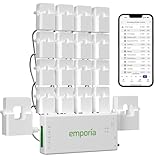
- SAFETY YOU CAN TRUST WITH UL CERTIFICATION: With Emporia Energy, your home energy monitoring is safe, reliable, and certified. The Emporia Vue is UL Listed, meaning it has met rigorous safety standards for electrical products in the U.S. and Canada. This certification ensures that every component has been thoroughly tested to prevent hazards, such as overheating, short-circuiting, or fire, offering you peace of mind as you manage your home’s energy consumption.
- INSTALLS IN CIRCUIT PANEL of most homes with clamp-on sensors. Supports Single phase, Single-split phase, and 2-wire systems. 3-wire systems; 3-phase, 4-wire Wye systems with earthed (TN or TT) neutral (no-Delta) are supported with an additional 200A sensor (sold separately).
- 24/7 ENERGY MANAGEMENT AND MONITORING: Automate, manage and control your home's real power anywhere, anytime to prevent costly repairs, conserve energy, and save costs. Monitor solar / net metering. PROTECTED BY A 1-YEAR WARRANTY.
- LOWER YOUR ELECTRIC BILL: Configure settings in the Emporia Energy App to automate energy management for time of use, peak demand, excess solar, and rewards programs. You can even see live reporting and invaluable savings opportunities instantly. Gauge real-time spending and get actionable notifications and automated energy management to help you reduce costs.
- REAL-TIME ENERGY DATA: REQUIRES 2.4 GHz WIFI WITH AN INTERNET CONNECTION to monitor energy use with iPhone / Android / Web app. Vue sensors collect energy data and are accurate from ±2%. The Vue is UL and CE Listed for your safety. 1 second data is only available in the app (when actively open) and retained 3 hours. Minute and hour data are retained in the cloud. 1 minute data is retained 7 days, 1 hour data is retained indefinitely. Export cloud data whenever you want in the app.
Over 365 days, the same assumed load uses 876 kWh and costs about $151.55 at that illustrative rate. These are arithmetic examples, not a prediction for a particular machine or electricity bill. EIA says its 17.30¢ figure is based on February 2026 Electric Power Monthly data and is preliminary; it is a national reference, not necessarily your utility’s rate. See EIA’s explanation of electricity prices and factors affecting them.
How to get a useful power reading
A wall-side measurement reflects what the equipment draws from the outlet, including power-supply losses. Measure the whole setup if that is what you want to budget for. The U.S. Department of Energy’s worksheet lists a wattmeter as optional: “Watt Does It Cost To Use It?”
Rank #2

- ⚡ EASY INSTALLATION: Installs in circuit panel of most homes with clamp-on sensors. Supports single-phase up to 240VAC line-neutral; single, split-phase 120/240VAC; and three-phase up to 415Y/240VAC (no Delta). The branch lines can automatically match different phases and have no restrictions in terms of quantity and voltage.Panels with access only to busbars will need flexible sensors available from SEM-Meter.
- ⚡ ENERGY MONITORING ANYTIME, ANYWHERE: Monitor your home's real power anywhere, anytime to prevent costly repairs, conserve energy, and save costs. Monitor solar / net metering. Light commercial 3 phase option available as a separate bundle. Protected by a 1-year warranty.
- ⚡ VARIOUS ELECTRICAL APPLIANCE MONITORING: Comes with 16 50A sensors to accurately monitor your air conditioner, furnace, water heater, washer, dryer, range, etc.
- ⚡ LOWER YOUR ELECTRIC BILL: SEM-Meter measures real-time spending and gets actionable notifications to understand where savings can be made, both to lower your electric bill and to conserve energy and protect the planet’s resources. Be an environmentalist.
- ⚡ REAL-TIME ENERGY DATA: Connect SEM-Meter device via 2.4GHz WiFi to monitor energy usage, with an accuracy range of 1%. View usage in real time through Android/Apple software. Statistics of power usage in now/day/week/month/year format: the validity period of hourly exported data is 90 days, and the exported data of day/month/year data is permanent, available at any time Export from application.
Record readings that match how you actually use the system: idle, ordinary work, and sustained compute. If it spends different amounts of time in each state, weight those readings by the hours spent there. For instance, calculate idle watts × idle hours and active watts × active hours, convert each to kWh, then add them before applying the rate. This is more informative than treating a peak reading as a typical continuous load.
Use your rate, not a generic electricity price
Electricity prices vary by locality, and some utilities offer time-of-day pricing. Check the current plan or tariff that applies to your household and when the equipment runs; EIA’s national average may not match the marginal rate you pay. Also, this calculation estimates the energy charge. The total bill can differ because of fixed charges, taxes, tiered rates, credits, or other tariff components.
Rank #3

- Multi-function power monitor: Our electric usage monitor can monitor the power (W), electricity(kWh), voltage(V), frequency(Hz), current(A), power factor(PF), unit price($/kWh), total cost($) of your appliances. By switching 8 display modes, you can easily know the various parameters while the appliance is working. The “electricity” mode can calculate and display how much power your appliance uses. And the “total cost” mode will show how much electricity bill it cost in cumulative time
- Overload protection: When the loading power of the appliance is over the default overload threshold 1800W, the whole display with backlight and the word “OVERLOAD” will keep flashing to warn the users. Please turn off the appliance for safety concern
- Premium Material: The whole body of our energy meter is made of high-quality ABS material. It makes our home electricity usage monitor more long lasting, fireproof and anti-drop. The standard US socket and plug is suitable for all US standard appliances
- Backlight Display: With white backlight and black words, the LCD display of our home power monitor can display the data clearer and help you to read the data easier no matter day or night. The backlight will only lights up when the device is connected to AC power. If no button is pressed, the backlight turns off automatically after 10 minutes. You can also press the "UP" button to turn off the backlight manually, and press any button to turn on backlight again
- Easy to reset: No reset tool needed, our appliance power usage meter is easy to reset. You can press the “M” button for 5 seconds directly to reset the device. After reset, all cumulative data (electricity quantity, cost) will be cleared, and all settings will be restored to factory settings
For context, EIA reports that residential electric-utility customers in the United States used an average of 10,791 kWh each in 2022, with usage varying between states. That household statistic is not a server or workstation benchmark. The cited official sources do not establish one representative power draw for home servers or AI workstations, whose configurations and workloads vary.
Independent reader supportYour contribution helps us test, update, and keep practical guides available for everyone.Compare systems on an equal basis
To compare two configurations, keep the measurement boundary, workload, measurement duration, operating schedule, and electricity rate consistent. Include the same peripherals in both—or exclude them from both—and compare average watts during idle, ordinary work, and sustained compute. State the assumptions alongside the cost so the estimate can be checked or updated when usage or rates change.
Quick Recap
Best Value

- EM16P MODEL & LOCAL CONTROL & DATA PRIVACY: Access your home energy monitor data locally via Built-in Web UI, Open API, and MQTT without relying on cloud services. Unlike cloud-dependent monitors, Refoss ensures your data stays within your home network. Direct local access protects your privacy while giving you 100% full control of your home energy system.
- NATIVE HOME ASSISTANT & OPENCLAW AI: Experience seamless Native Home Assistant integration right out of the box—no firmware flashing or complex coding required. Featuring ✨NEW✨ OpenClaw Support, it enables AI-driven automation for smarter, real-time energy management and seamless smart home control.
- MAXIMIZE SOLAR & ZERO FEED-IN AUTOMATION: Designed for solar homes, the power monitor works with the Refoss app and Home Assistant to automatically use surplus solar power. Appliances like EV chargers, washing machines, and water heaters are powered during midday peaks, maximizing solar self-consumption and reducing low-value electricity feed-in to the grid. Optimizes usage and reduces bills.
- REAL-TIME MONITORING & ±1% ACCURACY: Monitor voltage, current, active power, and power factor of major appliances. Provides ±1% accuracy (200A: 2–200A; 60A: 1–60A) and ±2% at low current. Daily data stored up to 5 years and exportable. With no subscriptions or hidden fees, you get deep historical insights to help you identify every energy-saving opportunity and save 10–20% on monthly bills.
- SMART ALERTS & CIRCUIT-LEVEL CONTROL: Set usage targets for each individual circuit and receive instant alerts when appliances exceed normal consumption. Refoss app supports automation and peak management to optimize schedules, reduce peaks, and improve efficiency. Real-time electricity usage monitor for circuit-level insights.
Rank #4

- Various Monitoring Parameters: The power energy meter can monitor the power (W), energy (kWh), volts, amps, hertz, power factor, cost, minimum and maximum power (W), cumulative days and time of your appliances. By switching 7 display modes, you can easily know the various parameters while the appliance is working. The home energy monitor can also calculate and display how much power your appliance uses and how much electricity bill it cost in cumulative time
- Upgraded LCD Display: With large screen size 2.36 inch x 1.85 inch, clearer monitor backlit, our electrical usage monitor can display the data clearer and more visible no matter day or night. 180°full wide viewing angles is great for reading and recording the data in any angles. No need to stand on the front of the display and bend over to read the numbers
- Adjustable Backlight Time: Our upgraded watt meter has 5 options of backlight time. The default backlight time duration is 10 minutes(bL-0). If you want to change the backlight time, you can press and hold "UP" and "DOWN" button at the same time to enter backlight time setting, then press "UP" and "DOWN" to select the backlight time (bL-0 =10 minutes, bL-1=1 hour, bL-2=4 hours, bL-3=8 hours, bL-4=always on), finally press the "COST" to save the backlight time settings
- Overload Protection: When the power of the appliance exceeds the overload power, the LCD will display “OVERLOAD” to warn the user. All the buttons will quit working and can only be workable when you lower or remove the load power. The default overload power is 3680W and is adjustable from 0 to 3680W. In general, you need to set the overload power to 1800W before using. Just press the "function" button for more than 3 seconds to enter the setting
- Data Memory Function: The wattage meter will record your power consumption data when you remove it from socket, or remove appliances from the electricity monitor. You can directly see the last data when you use it next time. This function can also automatically save the data when there is a sudden power failure
Product prices and availability are accurate as of the date/time indicated and are subject to change. Any price and availability information displayed on Amazon at the time of purchase will apply.




