Quick wins for a faster PC:
Repair Windows errors before they cause bigger problemsFix Now →Scan for outdated or missing drivers - takes under a minuteDriver Scan →Clear out junk files and repair common Windows errorsFree Scan →Estimate an AI rack from the equipment it contains and the workload it will run—not from a generic rack-density rule. First calculate rack IT input power, then use it to estimate heat removal; treat facility electricity and cooling-system capacity as separate questions with their own assumptions.
Choose what you need to estimate
“Power and cooling” can refer to several different quantities. Define the boundary before doing the arithmetic, and label each result as expected, peak, or nameplate:
- Rack IT input power: electricity consumed by the servers, accelerators, switches, storage, and other IT equipment in the rack.
- Rack IT heat load: the heat that must be removed from those devices, whether through air, a liquid loop, or both.
- Facility electrical demand: IT power plus electricity used by cooling, power conversion and distribution, and other building systems.
- Cooling-system capacity: the capacity needed to remove heat under the site’s conditions and design assumptions.
These quantities are related, but they are not interchangeable. ASHRAE identifies rack kW as a common way to characterize maximum load and recommends workload-based estimates for a more accurate picture of actual modern data-center power use. ASHRAE, 2023 Handbook, Chapter 20
Build an equipment-level power estimate
Calculate the nameplate bound
List every installed IT device, its quantity, and its manufacturer input-power rating. For a conservative nameplate sum, multiply each device’s rated input watts by its quantity, add the device totals, then divide by 1,000 to get kilowatts:
#1 Best Overall

- Ventilation Fan: Designed to quietly ASUS GT/RT- AC5300 , cool Xboxs, CPU/ GPU, Playtations, Rokus, TVs, receivers, mondems, routers, DVRs, window fans ,network appliances, DIY aquarium cooling and other audio video electronics
- Variable Speed Control: 110V - 220V Fan power supply with speed control function, turn the knob to adjust the speed, 4V - 12V adjustable fan speed,and can turn off the fan . | Input: 100V - 240V 50/60Hz | Output: DC 3-12V 200-2000ma
- DIY Vertical Window Fan: Can both vertical and horizontal, provide efficient cooling and ventilation. Mining rigs rely on the cooling power of fans for optimal operation.Double Metal Protective, the fan is equipped with double metal protective net
- Easy to Install: Draw out air in refrigerators, provide ventilation in greenhouses, prevent amplifier overheating, and vent hot air from living room consoles like PS4. Y cable connects 2 fans, two fans can be 42cm/16.5 in far away from each other
- Dual Ball Bearing: 240mm x 240mm x 25mm / 9.45in(L) x 4.72in(W) x 1in(H) in in total. | Rated Voltage :12V | Rated Current: 0.93A at full speed | Airflow: (82CFM)x4 at 12V | Speed: 2500 RPMx4
Nameplate rack IT power (kW) = sum of [device quantity × rated input watts] ÷ 1,000
This is an upper-bound planning figure based on the ratings you include, not a prediction of ordinary operation. Keep the equipment ratings and their source dates in your worksheet so the estimate can be checked when hardware changes.
Rank #2
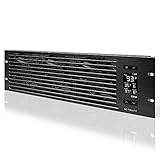
- An intelligent fan system designed for cooling audio video, DJ, server, network, and IT equipment racks.
- Protects rack-mount equipment from overheating, performance issues, and shortened lifespans.
- Programmable thermostat controller with automated speed control, alarm warnings, and backup memory.
- Premium anodized aluminum construction with CNC-machined detailing for a professional appearance.
- Size: 3U Rack Space | Design: Intake | Airflow: 60 to 300 CFM | Noise: 12 to 38 dBA | Bearings: Dual Ball
Estimate expected operating demand
For expected demand, use rack telemetry, metered input power, or workload data representative of the deployment. Record the measurement period and operating mode, and distinguish typical demand from synchronized workload peaks. Do not silently treat every device’s maximum rating as its normal draw; ASHRAE notes that workload-based methods are more accurate for estimating actual use than maximum power figures for a server family. ASHRAE, 2023 Handbook, Chapter 20
A worksheet should capture device and model, quantity, rated input watts, measured or workload-based watts, operating mode or utilization assumption, peak assumption, and the source and date of each rating or reading. If rack telemetry is unavailable, a properly specified metered rack PDU may provide input-power readings; it must match the site’s voltage, current, connectors, phase, and installation requirements.
Do these 3 things before closing this tab:
1Clear out junk files and repair common Windows errors2Fix the driver behind crashes, sound loss and screen glitches3Repair Windows errors before they cause bigger problemsRank #3

- [Adjustable] Adjustable temperature control helps ensure optimal performance for your rackmount such as network, server, music, and AV cabinets
- [Quiet and powerful] Equipped with three powerful 4” (120mm) noise control ball bearing fans capable of pumping 225 CFM of air, preventing overheating of expensive equipment
- [Optimal Airflow] This three fan cooling system will provide excellent cooling with its high-performance fans, which keep the hot air stream away from your setup with its top exhaust cool air system.
- [Compact Design] Device is standardized to mount to any 19" server rack or cabinet while taking only a single unit (1U) of space and has a wide variety of applications.
- [Programmable] Equipped with a programmable thermostat sensor controller for better temperature monitoring that will trigger fans based on your parameter configuration.
Turn rack IT power into a heat estimate
Use IT input power as the first-pass heat-removal load: nearly all electricity consumed by IT equipment ultimately becomes heat. In practical terms, the rack’s estimated IT kW is the starting point for estimating how much heat must leave the rack, not a complete cooling-system specification. ASHRAE, 2019 Handbook, Chapter 20
For liquid-cooled equipment, record how much heat the liquid loop captures if the equipment or system documentation provides that information. Account separately for residual heat released to room air by other rack components. Liquid cooling does not by itself mean the room has no remaining heat load; ASHRAE’s retrofit guidance describes liquid cooling for processors while air systems continue to manage residual heat. ASHRAE, Retrofit & Modernization Strategies
Rank #4

- Adjustable temperature control helps ensure optimal performance for rackmount such as network, server, music, and AV cabinets
- Noise controlled fans makes the cooling system useful for a quiet office or business space
- Compact design mounts to any 19" inch cabinet and takes up only 1 unit of space
- Simple and easy to use LCD display allows user to control temperature
- Air pumped through to the top exhaust system of the fan
Keep facility electricity separate from rack heat
Cooling equipment and electrical conversion and distribution losses add to facility electrical demand. If you estimate total facility power, add those loads using a stated design or measured basis. PUE—total facility energy divided by IT equipment energy—can support a rough facility-energy estimate when its boundary and operating conditions are known. It is a facility metric, not a direct multiplier for rack heat or a cooling-capacity formula. ASHRAE, PNNL, and NEMA, AI Data Center Energy Performance Framework and ASHRAE, Energy and Thermal Efficiency
For an operating-cost estimate, multiply expected facility kW by the number of operating hours and the applicable electricity price per kWh. Keep that calculation distinct from rack IT power: its result depends on the facility boundary, operating schedule, and electricity price used.
Best Value
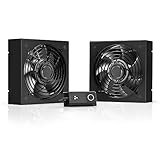
- A quiet fan kit designed for standard 19” racks, to be mounted on the roof or to replace existing fans.
- Features a speed controller utilizing PWM which can control the fan's speed without generating noise.
- Compatible with CLOUDPLATE series rack fans and can be linked to share the same programming.
- Heavy-Duty steel construction with spiral fan guards, mounting hardware, and power adapter.
- Size: Standard 120mm Rack Fans | Fans: 2 | Airflow 200 CFM | Noise: 26 dBA | Bearings: Dual Ball
Use rack density to assess the cooling approach
Density helps explain why an AI rack may need a different heat-removal design from a conventional server rack, but published ranges are context—not a substitute for the equipment inventory.
| Context | ASHRAE range | How to use it |
|---|---|---|
| AI/HPC high-power rack requirements | Often 30–100+ kW per rack, in ASHRAE’s 2026 integrated-design discussion | Context for integrated planning; not a sizing value for an individual rack. ASHRAE, Integrated Design Principles |
| GPU clusters | Often 40–100 kW per rack | A workload-class comparison on ASHRAE’s framework page, not a measurement of a particular installation. ASHRAE, Energy and Thermal Efficiency |
| Legacy CPU racks | Often 5–10 kW per rack | Comparison with GPU-cluster density; not a design assumption for a new rack. ASHRAE, Energy and Thermal Efficiency |
At high density, assess whether air cooling, direct-to-chip liquid cooling, or a hybrid approach fits the equipment and facility design. ASHRAE advises against relying solely on air for high-density AI clusters; include both heat captured by the liquid system and any residual room-air load in the estimate. ASHRAE, Retrofit & Modernization Strategies
Report a useful range, not false precision
Present an expected workload-based estimate alongside a conservative peak or nameplate bound. State the boundary, included equipment, workload and peak assumptions, measurement period, cooling method, and known uncertainty. If the workload or measurement basis is not defined, the result is only a screening estimate.
- Include electrical headroom and plans for rack expansion.
- Identify whether AI workloads can peak at the same time and how that affects the assumed rack maximum.
- Document the heat-removal path, including residual room heat from liquid-cooled equipment.
- For facility estimates, state the PUE boundary and operating assumptions rather than applying an unexplained multiplier.
- Account for site climate and available heat-rejection options when evaluating cooling.
Final service, UPS, power-distribution, and cooling capacities depend on the actual equipment, site, climate, reliability targets, and applicable engineering and code review. The ASHRAE, PNNL, and NEMA framework provides planning guidance; it does not replace applicable codes and standards. ASHRAE, PNNL, and NEMA, AI Data Center Energy Performance Framework ASHRAE, NEMA, and PNNL framework release, June 10, 2026
Free tools Windows power users keep installed
One-click scans. No signup required.
Quick Recap
Product prices and availability are accurate as of the date/time indicated and are subject to change. Any price and availability information displayed on Amazon at the time of purchase will apply.




