What’s actually slowing this PC down?
Pick the symptom - the matching free tool is one click away.
A sustainable NFT game economy starts with a game people want to play even if its tokens never appreciate. Designers then need to balance how resources enter and leave the game, decide how freely assets can be traded, and test whether progression and rewards remain workable as the player base changes. That matters to players because economic design can affect access, fairness, and the usefulness of the assets they buy or earn. It is a game-design framework, not a promise of investment returns.
What makes an NFT game economy sustainable?
Here, “sustainable” means that a game can support enjoyable play and a functioning resource economy over time without relying indefinitely on inflationary rewards or a constant stream of new entrants. It does not mean that a token will hold its price, that an NFT can always be resold, or that players will earn money.
The starting point is the player experience. Ask what players learn, create, compete over, collect, or share when token prices and resale prospects are set aside. Then identify where economic value comes from: other players’ purchases, the game publisher’s offerings, or buyers outside the game. If the main reason to play is to receive a reward that must be sold to someone else, the design is exposed to changes in demand and participation.
Genopets’ whitepaper frames its proposed economy around experiences and NFTs worth paying for, with rewards tied to skill and dedication rather than financial investment alone. That is the publisher’s design thesis, not independent evidence that the game has achieved long-term economic sustainability.
#1 Best Overall

- ZERO CRYPTO KNOWLEDGE NEEDED – Never touched Bitcoin? Doesn't matter. Everyone starts on a level playing field, so your crypto-obsessed mate and the total newbie have the exact same shot at winning. Fair, fast and instantly playable
- INNOVATIVE BITCOIN BOARD GAME - For 2-6 players with approx. 60-90 minutes of playing time per game round
- OUTSMART, OUT-TRADE, OUT-HODL YOUR FRIENDS – This is real strategy: build mining and staking farms, gamble on ICOs, flip NFTs, drop hacks and fire back with action cards. Whoever stacks the most Bitcoin wins – if they can hold their lead
- PLOT TWISTS UNTIL THE LAST ROLL – The unique Time Cards can flip the whole board on its head at any second. That "guaranteed" winner? Wrecked by one card. No two games ever play out the same – comebacks stay possible right to the end
- THE CRYPTO GIFT THAT ACTUALLY GETS PLAYED – Stuck for a present for a Bitcoin or strategy game fan? Cryptoly is the gift they'll actually pull off the shelf – and sneakily teaches real crypto history through its action cards while everyone's having fun
How do you balance resource sources and sinks?
For every currency and important resource, make a ledger of all the ways it enters the economy and all the ways it is spent, removed, or consumed. In game-economy design, these are often called sources (or faucets) and sinks (or drains). A healthy-looking ledger on paper is only a starting point: player behavior determines whether a drain is attractive enough to use and whether new supply accumulates faster than the game can absorb it.
| Mechanic | Possible source or sink | Design question |
|---|---|---|
| Quests, competitions, or participation | Source: awards resources to players | Does the reward reflect play, or does it mainly encourage repeated farming? |
| Crafting or repairing items | Sink: spends or consumes resources | Does the resulting item or repair provide value players actually want? |
| Unlocking content | Sink: uses resources to access an activity or progression step | Does the cost create a meaningful choice, or block ordinary participation? |
| Cosmetics or collectibles | Sink: spends resources on optional items | Is the appeal tied to player choice and expression rather than competitive advantage? |
A sink is not automatically useful because it burns a token. Players need a reason to pay it. A sink that improves future earning can also have the opposite of its apparent effect: it may delay selling pressure while increasing the amount a player can earn later. Immutable’s version 1 documentation warns that when net outflow of value exceeds net inflow, an economy’s value will trend toward zero. Treat that statement as a design warning, not as a precise forecast for any particular game.
Model the expected flow under different player behaviors, including low participation, growth, and players reaching later stages of progression. For each proposed change, estimate who earns, who pays, what resource is removed or created, and what happens if players do not use the new sink as often as expected.
Rank #2
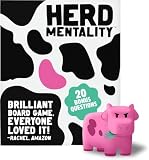
- Udderly hilarious board game for family and friends game nights. Fun for big groups of 4-20+ players
- Easy to learn, quick to play and endlessly repayable board game. This version comes with 20 extra questions
- Think the same to win the game. Flip over a question and guess what your family and friends are thinking
- If your answer is in the majority, you win cows. If you’re the odd one out, you’re stuck with the pink cow of doom
- One of the best board games for families, adults, teens and kids aged 10+. Perfect icebreaker game. Easy and fun for everyone! Perfect as a Thanksgiving or Christmas game
Should the economy be closed, open, or hybrid?
How much of the economy is tradable changes both the team’s control over it and how easily people outside the game can influence it. There is no universally best model; the right trade-off depends on the game’s goals and on how much complexity the team can manage.
| Model | Control and participation | Key trade-off to assess |
|---|---|---|
| Closed | Participation is restricted to players; the team has more control over the economy. | Management may be easier, but player and provider incentives may be less aligned and outside trading is limited. |
| Open | External participants and trading outside the game are allowed. | Trade can align some incentives, but outsiders and market forces make the economy harder to control. Non-players may be able to buy assets that affect progression. |
| Hybrid | Some resources remain closed and play-earned while selected assets are tokenized and tradable. | It can preserve gameplay-linked resources while allowing asset trading, but players need clear rules about which items require play and which can be bought. |
Immutable cites Gods Unchained’s Flux as an example of a non-tradable, play-earned resource used to upgrade or mint NFT cards. The example illustrates a hybrid design choice; it does not establish that every game should copy it. If you mix tradable and non-tradable resources, document how each affects access, upgrades, and competitive progression.
How can a game limit pay-to-win pressure?
Tradable assets can turn spending into a shortcut around play. If bought assets decide too much of a competitive outcome, players who cannot or do not want to spend may feel that skill and progression matter less. That can undermine the experience the economy is meant to support.
Rank #3

- A TWIST ON CLASSIC BATTLESHIP GAME: This Amazon Exclusive Battleship with Planes board game features airplanes in addition to ships for awesome strategic gameplay and epic battles
- SINK SHIPS AND CRASH PLANES: With this strategy naval combat game, fans of the Battleship game can crash enemy planes in addition to sinking ships to win
- PORTABLE GAME WITH STORAGE: This Battleship game includes 2 portable battle cases and convenient ship, plane, and peg storage. It's an ideal travel game for kids—dive into an instant game on the go
- A CHILDHOOD FAVORITE: Remember playing the Battleship strategy game as a kid? Enjoy playing this 2 player board game with a new generation
- GREAT FOR FAMILY GAME NIGHT: Looking for fun indoor games for game night? This strategy board game for kids is a great choice
- Consider making some tokenized items cosmetic or expressive rather than decisive in competition.
- Keep meaningful inputs to progression tied to play where that supports the game’s fairness goals.
- Check whether economic rewards determine competitive outcomes, and whether players can participate meaningfully without purchasing tradable assets.
- Explain which assets can be bought, earned, or traded, and what each route changes in the game.
These are choices to test against the game’s intended experience, not a guarantee that any one restriction will produce fair play. More openness gives players and outsiders more ways to transact, but also makes it harder to prevent market access from substituting for in-game effort.
How do you design for the game’s lifecycle?
A launch economy can behave differently once more players arrive, existing players advance, or initial demand fades. A fixed reward pool, for example, may mean less per player as participation grows. Resource sources may also change when players reach later levels and stop using early-game activities.
Outdated Drivers Are Slowing You Down
One free scan finds every outdated or missing driver and matches the right update for your exact hardware.Free scan · exact hardware matchWindows Errors? Fix Them Before They Spread
Repair common Windows errors and clear accumulated junk for a smoother, more stable PC - no reinstall needed.Free scan · no reinstallPlan around those transitions rather than assuming that launch rewards will work forever. Axie Infinity’s whitepaper discusses utility, vertical progression, accessibility improvements, and supply sinks as possible parts of its approach, while warning that adding sinks too early may raise asset prices and make access harder. Those are the publisher’s stated goals and proposed design choices, not proof of achieved outcomes or a universal recipe.
Rank #4

- Add a blue disc to block opponents and lift discs higher
- Features blue Blocker Disc: This game includes blue Blocker Disc that open doors to new strategies
- Features blue Blocker Dics: this game includes blue Blocker Dics that open doors to new strategies
- Map how earning and spending change as players move through progression.
- Consider whether seasons, new assets, resets, or decay mechanics can refresh demand—and what existing assets may lose relevance as a result.
- Test how a new sink affects both resource supply and the cost of entering or continuing to play.
- Check whether the economy still has meaningful uses for resources when growth slows or players become more advanced.
What should you measure besides token price?
Decide what success means for the game before choosing metrics. Token price alone cannot tell you whether the game is enjoyable, whether players return, or whether its resources are distributed in a way that supports progression.
Immutable lists floor price, player stickiness, trade volume, and token velocity as possible economic measures. Use these alongside gameplay outcomes such as participation and retention, then interpret them in context: a rising floor price is not, by itself, evidence of a healthy player experience.
- Player behavior: Track participation and retention to see whether people continue engaging with the game.
- Trading activity: Monitor trade volume and floor prices, while recognizing that trading can change without gameplay improving.
- Token movement: Examine holding or velocity as indicators of how resources circulate, not as stand-alone verdicts.
- Resource distribution: Model who receives tokens and resources over time, including how a mechanic changes the long-term distribution.
For each change, examine both the individual mechanic and its effect on the wider economy. A source or sink can appear balanced in isolation but shift access, incentives, or resource ownership across the whole game.
Recommended Free Tools
Best Value

- DYNAMIC DUNGEON BUILDER: Modular tiles and evolving layouts create a new adventure every session. Double-sided cards become rooms or gear, so the map shifts as you explore. No two playthroughs are ever the same.
- TEAMWORK AND TACTICS: Choose from 8 unique heroes and work together in this fully co-op experience. Share loot, combine abilities, and coordinate strategies to survive enemies and defeat the boss.
- SMART CARD SYSTEM: Every card has two uses—expand the dungeon or boost your hero. This dual-purpose deck system drives deep decisions and exciting trade-offs with just three cards in hand.
- PLAY SOLO OR TOGETHER: Designed for 1–4 players, with solo rules built in. Whether you're flying solo or gathering your group, the scalable difficulty and quick sessions make it perfect for all setups.
- BIG FUN, SMALL BOX: Fast setup, quick turns, and replayable modes packed into a compact box. Perfect for weeknights, travel, or casual groups who want a dungeon crawler without the bulk or burnout.
Why include environmental impact in the design?
Blockchain interactions—including minting, purchases, transfers, and other financial actions—have environmental implications. The World Economic Forum has discussed how mechanics that require frequent on-chain state changes may add energy impact. The source does not provide a verified emissions figure for a particular game, so a game-specific carbon number or broad comparison between chains should not be asserted without separate evidence.
Where a game’s design makes on-chain actions part of ordinary play, consider which actions genuinely need to be recorded on-chain and how often they occur. This is a design consideration alongside gameplay and economic effects, not a substitute for measuring a particular game’s actual footprint.
Quick Recap
Product prices and availability are accurate as of the date/time indicated and are subject to change. Any price and availability information displayed on Amazon at the time of purchase will apply.




