Recommended Free Tools
To calculate a selling price that meets a target gross margin, divide the unit cost by one minus the margin expressed as a decimal. For example, a $100 cost and a 40% target gross margin give a price of $100 ÷ (1 − 0.40) = $166.67. The $66.67 difference between price and cost is 40% of the selling price.
The selling-price formula for a target margin
Selling price = unit cost ÷ (1 − target gross margin)
Convert the percentage to a decimal before using it: 40% becomes 0.40. Subtract that from 1, then divide the cost by the result. This is the standard gross-margin calculation described by Massachusetts guidance on pricing products and Shopify’s product-pricing guide.
- Write the target margin as a decimal.
- Subtract it from 1 to find the share of the price that covers cost.
- Divide unit cost by that share.
- Check the result by subtracting cost from price, then dividing the difference by price.
For a 40% target, the cost share is 1 − 0.40 = 0.60. A $100 unit cost divided by 0.60 gives $166.67. The gross profit before other expenses is $66.67, and $66.67 ÷ $166.67 is approximately 40%.
#1 Best Overall

- Profitability calculations; cash flow function Calculates NPV and IRR for uneven cash flows
- Time-value-of-money and Amortization keys solve problems including: pension calculations, loans, mortgages, etc.
- Ideal calculator for students, managers and statisticians
- Built-in functionality : List-based one- and two-variable statistics with four regression options: linear, logarithmic, exponential and power
- The BA II Plus calculator is approved for use on the following professional exams: Chartered Financial Analyst exam. GARP Financial Risk Manager (FRM) exam. Certified Management Accountants exam
Margin and markup use different denominators
Gross margin measures the difference between selling price and cost as a share of the selling price. Markup measures that same difference as a share of cost. Because the denominators differ, the percentages are not interchangeable.
| Measure | Formula | Example with $1 cost and $1.50 price |
|---|---|---|
| Gross margin | (Selling price − cost) ÷ selling price | $0.50 ÷ $1.50 = 33.3% |
| Markup | (Selling price − cost) ÷ cost | $0.50 ÷ $1.00 = 50% |
The University of Maine Cooperative Extension uses this $1.00-cost, $1.50-price example to illustrate the distinction in its pricing guidance. Massachusetts’ guidance also explains why margin is lower than markup when both describe the same dollar difference.
Rank #2
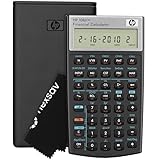
- HP 10BII+ FOR STUDENTS & PROFESSIONALS – This HP calculator is built for business, finance, accounting, and statistics courses. Perfect for learners and professionals who need to solve common financial problems quickly without memorizing formulas or relying on spreadsheets.
- 100+ FUNCTIONS FOR REAL WORLD MATH – Quickly solve time value of money, interest rates, loan payments, NPV, IRR, cash flows, and more. The 10bII+ also includes probability distributions for statistics courses—a feature not often found in financial calculators.
- ALGORITHMIC INPUT WITH DEDICATED KEYS – This high-school/college calculator uses algebraic and chain logic with minimal keystrokes. Layout appears the same as standard calculators for easy learning. Dedicated keys give quick access to commonly used financial and statistical functions
- APPROVED FOR MAJOR EXAMS – The HP 10bII+ algebra calculator is permitted for use on SAT, PSAT/NMSQT, and AP tests. An ideal statistics calculator and business calculator for school finance and accounting students preparing for class, coursework, or standardized exams.
- INCLUDES TRAVEL CASE, CLEANING CLOTH & BATTERIES– Slim, durable, and easy to keep on hand or store in a backpack or locker. Includes a protective case, cleaning cloth, and batteries so it’s ready out of the box. Large screen with clear contrast (non-backlit) is easy to read during exams or lectures.
If you intend to apply a markup percentage instead of targeting a margin, use selling price = cost × (1 + markup). For example, a 50% markup on $1.00 gives a $1.50 price. Do not put a margin percentage into the markup formula.
Worked calculations
| Unit cost | Target gross margin | Calculation | Calculated price |
|---|---|---|---|
| $100 | 40% | $100 ÷ (1 − 0.40) | $166.67 |
| $14.28 | 20% | $14.28 ÷ (1 − 0.20) | $17.85 |
The second calculation matches an example in Shopify’s pricing guide. These examples show how the arithmetic works; they are not recommendations for what a business should charge or claims about typical margins.
Rank #3

- Solves time-value-of-money calculations such as annuities, mortgages, leases, savings, and more
- Performs cash-flow analysis for up to 32 uneven cash flows with up to 4-digit frequencies
- Calculates various financial functions: Net Future Value Net present Value Modified Internal Rate of Return Internal Rate of Return Modified Duration Payback Discounted Payback
- The Texas Instruments BAII Plus Professional features an Automatic Power Down (APD) function for extended battery life
- Prompted display guides you through financial calculations showing current variable and label. Ten-digit display
Decide what belongs in unit cost
The formula only works as intended if “cost” is defined. Gross margin commonly compares a selling price with direct product cost or cost of goods sold. The amount left after those costs must still help cover overhead and contribute to profit. Massachusetts guidance lists expenses such as facilities, insurance, interest, utilities, office and sales staff, and marketing as costs that can affect net margin.
Depending on the business and sales channel, taxes, payment or marketplace fees, freight, discounts, and returns may also matter. There is no single treatment in the cited guidance that applies to every jurisdiction and sales model. Decide which expenses are included in your unit-cost figure and account for other relevant costs separately; do not treat the basic gross-margin formula as a complete tax or fee calculator.
Rank #4

- Profit margin calculation
- Quick and easy tax calculation
- Square root, sign change, and memory keys
- Attractive metallic design
- 12 digits
Gross margin does not establish profitability
Meeting a target gross margin does not by itself show that a business is profitable after overhead. To connect unit economics with operating costs, break-even analysis considers overhead as well as the contribution from sales.
- Break-even sales: overhead expenses ÷ contribution margin ratio.
- Break-even units: overhead expenses ÷ (unit selling price − unit cost).
Business Victoria’s break-even guidance describes these calculations. They rely on the business’s own cost and sales figures, so use them as planning calculations rather than a guarantee of results.
Free tools Windows power users keep installed
One-click scans. No signup required.
Best Value

- PROFESSIONAL FINANCIAL CALCULATOR : Built-in TVM, IRR, NPV. Engineered for business analysts, real estate investors, accountants, and finance students.
- ADVANCED CASH FLOW & AMORTIZATION : Execute time value of money, break-even analysis, depreciation schedules, and bond pricing. Trusted for professional exam prep", MBA coursework, and banking certifications.
- CATIGA CF-300 : Flip-open hard case with a snap-close design for a secure fit. Compact and portable: designed for daily professional use in office, classroom, or on-site.
- ALL-IN-ONE FOR PROFESSIONALS : From NPV/IRR for real estate analysis to statistical calculations for business analysts. Handles probability, linear regression, and complex financial formulas.
- MORTGAGE, LOAN & INVESTMENT CALCULATOR : Covers bond pricing, loan amortization, investment analysis, and exam-level computations. Your go-to accounting calculator, business calculator, and real estate calculator in one device.
Use the calculated price as a starting point
A cost-based calculation answers what price would meet a chosen margin given a stated cost. It does not determine what customers will pay or which price will maximize profit. Before setting a final price, compare the result with market conditions and competitor prices, as Shopify advises. A price substantially above comparable offers may be difficult to sell, while a lower price may fail to support the costs and margin the business needs.
Quick Recap
Product prices and availability are accurate as of the date/time indicated and are subject to change. Any price and availability information displayed on Amazon at the time of purchase will apply.




