You can build an emergency fund without investing in stocks: set a reachable savings goal, contribute on a schedule that fits your cash flow, and keep the reserve in an accessible deposit account whose insurance and withdrawal terms you have checked. The right target depends on your circumstances; the CFPB recommends using your own past unexpected expenses as a starting point, not relying on a universal dollar amount.
This guidance is U.S.-focused. An emergency fund is cash set aside for unplanned expenses or financial emergencies—not money for ordinary monthly bills. Car or home repairs, medical costs, and a loss of income are examples. The Consumer Financial Protection Bureau (CFPB) recommends considering what unexpected costs you have faced and how much they required when choosing a savings goal.
Choose a goal you can reach
Start with expenses you have actually faced
List the unexpected costs you have had, estimate what each cost, and consider which could happen again. Use that history and your current circumstances to set an initial milestone. There is no single emergency-fund amount that fits everyone, and a modest reserve can still provide some security.
Make the goal specific
Choose a dollar amount for the first milestone and a contribution pace that fits your budget. Check your progress periodically and adjust the goal or pace when your expenses, income, or responsibilities change. The CFPB’s emergency-fund guide suggests setting a goal, tracking progress, and looking for ways to save.
Free tools Windows power users keep installed
One-click scans. No signup required.
#1 Best Overall
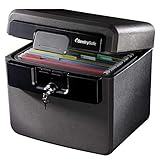
- FIRE AND FLOOD PROTECTION FOR ESSENTIAL PAPERS: UL Classified to withstand high temperatures for up to thirty minutes and ETL Verified to protect contents during water exposure, helping safeguard critical paperwork during common home emergencies
- DESIGNED FOR IMPORTANT DOCUMENT STORAGE: Spacious interior fits hanging file folders and is ideal for organizing passports, birth certificates, insurance records, and legal paperwork
- KEY LOCK SECURITY YOU CONTROL: Durable key lock helps prevent unauthorized access and keeps the lid securely closed during fire events. Two keys are included for backup access
- HOME FRIENDLY SIZE WITH PORTABLE DESIGN: Compact footprint fits easily in closets, offices, or under desks while remaining portable enough to relocate when needed
- BUILT FOR EVERYDAY PEACE OF MIND: Black exterior offers a clean, neutral look that blends into home or office spaces while providing dependable document protection year round
Build contributions around your cash flow
If your income is steady
Choose a fixed amount to save on payday or set up a recurring transfer from checking to savings. If your employer allows it, splitting direct deposit so some pay goes straight into savings can reduce the need to move it manually. The CFPB says, “Saving automatically is one of the easiest ways to make your savings consistent so you start to see it build over time.”
If your income varies
Track when money arrives and when bills are due. Set aside an amount during stronger cash-flow periods rather than committing to a transfer that may not be affordable every pay period. You can also save part of a tax refund, gift, or other one-time income. Before an automatic transfer, check that the checking balance can cover upcoming bills and the transfer; otherwise, you risk an overdraft fee.
Choose an account for access and protection
A bank or credit-union deposit account is a practical place to hold a cash reserve. Compare transfer timing, fees, minimum-balance requirements, and any limits on withdrawals or transactions. Confirm that the institution and the specific account qualify for the applicable deposit insurance and that your combined balances remain within coverage limits.
Rank #2

- Ultimate Fireproof & Water-Resistant Protection: Keep your valuables safe with our DocSafe Hard-Shell fireproof file organizer. It is made of thickened silicone coated fireproof heat insulated cotton material and hard-shell material which can stands up against fire and passed the UL94 -V0/5VA flame retardant test. Fireproof box is both fireproof and water-resistant, ensuring your documents stay protected during fires, floods, or wet weather. It may fit both letter and legal-size files
- Upgraded Hard-Shell Design Fireproof Box: Our fireproof document box combines hard-shell construction with fireproof materials, offering unmatched protection and durability. Unlike traditional soft case, our design withstands extreme conditions while maintaining a sleek, professional look. The Non-dusty material actively repels dust,hair and stains, keeping your box clean and tidy for years. It’s the ultimate solution for safeguarding your important documents, laptop, and valuables
- Large-capacity: Outside size: 15.5" x 11.5" x 3"(Thickness can be expanded up to 4"). Our Accordion fireproof document box adopts a multi-layer design that can meet all your storage needs. These include 13 accordion Pockets with labels,1 zipper pocket,4 pen slot,14 card slots,4 passport holder,4 small mesh bags,2 mesh bags,and 1 main pocket. It can store your important documents,money,passport,U Disk,cards,laptop,certificates in a safe and orderly way. Perfect for daily file filing and storage
- Fireproof File Organizer with Lock: Protect your valuables with the built-in high-quality combination lock (No keys required). Featuring a double metal zipper for convenient opening and closing. Design with a strong handle for carrying everything you needed easily. The fireproof file folder is suitable for business, travel, office, school, home storage, you can be 100% sure that your important documents are in a safe place. Of course, giving it as a gift to your family is also a good choice
- Trusted after sales service: Nothing is completely foolproof, but added protection is always a good idea. In an emergency, our fireproof document organizer ensures your files stay intact, giving you time to save your important documents. It is lighter, easier to carry than fireproof safes and quick to grab and go. If there any quality problem, please feel free to let us know. We are committed to solving your problem immediately, your suggestion has a great impact on the upgrade of our products
For U.S. banks, the FDIC’s standard insurance limit is $250,000 per depositor, per insured bank, per ownership category. The FDIC combines covered deposits held at the same bank in the same ownership category when applying that limit. This is an insurance ceiling, not a recommended emergency-fund target. See the FDIC’s insured-deposit guidance for covered products and how coverage works. Credit-union coverage is administered separately through the NCUA; check the institution and account’s eligibility and applicable limits.
Do these 3 things before closing this tab:
1Repair Windows errors before they cause bigger problems2Scan for outdated or missing drivers - takes under a minute3Clear out junk files and repair common Windows errorsUnderstand what “money market” means
A money market deposit account at a bank or credit union is a deposit account and may qualify for FDIC or NCUA insurance. Its minimums and transaction rules vary; some accounts limit certain check, debit-card, or electronic transactions. A money market mutual fund, by contrast, is an investment—not a bank savings or checking account—and is not FDIC-insured. Similar names or check-writing features do not make the two products equivalent. The CFPB explains the distinction in its money market account overview.
Independent reader supportYour contribution helps us test, update, and keep practical guides available for everyone.Compare common places to keep the reserve
| Option | Protection and risk | Access considerations |
|---|---|---|
| Insured savings account at a bank or credit union | Qualifying deposits may have FDIC or NCUA coverage within applicable limits. | Check transfer times, fees, and account terms. |
| Bank or credit-union money market deposit account | A deposit account that may qualify for FDIC or NCUA coverage. | Minimums or transaction limits may apply; verify the account terms. |
| Money market mutual fund | An investment, not an FDIC-insured deposit account. | Brokerage access and settlement conditions can differ from a bank account. |
| Treasury bills, bonds, or notes | Not FDIC-insured; the FDIC identifies these U.S. government securities as backed by the full faith and credit of the U.S. government. | Sale or maturity timing can affect access. They are not interchangeable with an immediately accessible bank deposit. |
| Cash kept at home or with someone you trust | No deposit insurance; cash can be stolen, lost, or destroyed. | May be immediately available if physically accessible, but storage and loss risks apply. |
For any account or instrument, weigh insurance or principal risk alongside access speed, transfer or withdrawal rules, minimums, and fees. Account yields and terms vary and can change; check current details with the institution. The sources cited here do not establish a full comparison of Treasury liquidity or market-value risk, so do not assume those securities offer the same access or stability as an insured deposit account.
Rank #3

- FIREPROOF: The safe is UL Classified to endure 1/2 hour at 1550°F to protect irreplaceable documents, small valuables, DVDs, and USBs from fire
- WATERPROOF: The safe is ETL Verified for 72 hours of water submersion offering peace of mind in the event of a flood
- COLOR: Dark Gray Color offers a sleek and professional appearance
- MEASUREMENTS: Exterior: 16. 6 in. W x 13. 8 in. D x 14. 1 in. H; Interior: 12 in. W x 8. 1 in. H x 11. 6 in. H; large capacity 0. 66 cubic feet; weighs 41 pounds
- DURABLE: Fireproof lock box features a flat key lock to prevent the lid from opening in the event of a fire; includes two keys
Set rules for using and rebuilding the fund
Decide what counts as an emergency before one occurs. A useful test is whether the expense is unplanned and outside routine spending—for example, an urgent repair or medical bill. Apply your rule consistently so the reserve remains available for genuine unexpected costs rather than predictable bills or discretionary purchases.
After using the fund, return to your contribution plan and rebuild it. If your budget has changed, choose a new sustainable pace rather than abandoning saving altogether. The CFPB’s guide to building an emergency fund recommends replenishing savings after an emergency withdrawal.
What’s actually slowing this PC down?
Pick the symptom - the matching free tool is one click away.
Quick Recap
Product prices and availability are accurate as of the date/time indicated and are subject to change. Any price and availability information displayed on Amazon at the time of purchase will apply.




