Free tools Windows power users keep installed
One-click scans. No signup required.
A company can run stand-ups, plan two-week sprints and track work on a board while releases remain slow, approvals pile up and customers see little improvement. Agile culture is not a meeting schedule. It is the ability of teams to make informed decisions, deliver useful increments, learn from evidence and improve without hiding problems.
For a business, the point is not speed at any cost. A well-designed agile culture makes uncertainty visible earlier, helps teams respond to changing needs and gives leaders a clearer view of value, risk and constraints.
What an agile development culture means
An agile development culture is an environment where teams align around outcomes, work in short feedback loops, collaborate across disciplines, make decisions close to the work and adapt based on evidence. Scrum, Kanban, story points, stand-ups and work-management software can support that environment; none creates it on its own. Microsoft cautions that there is no universal Agile prescription and that ceremonies alone do not change culture: Microsoft’s guidance on adopting Agile.
The four values of the Agile Manifesto remain a useful starting point: value individuals and interactions, working software, customer collaboration and responding to change more highly than their counterparts—not as a reason to discard tools, documentation, contracts or plans. See Atlassian’s overview of Agile.
#1 Best Overall

- DRY ERASE PROJECT MANAGEMENT PLANNER: Be made of 250 gsm construction paper, laminated by special formula film that is erasable, make the surface resistant to ghosting or staining. We can erase easily even months later and use this work schedule board over and over again
- PRODUCTIVE PROJECT MANAGEMENT TOOLS: This project management board is a game changer and something physical for managing personal or team projects efficiently. It allows you or members to quickly view and share the status of up to 12 projects at the same time, a very good practical kit of team building
- SCRUM WHITEBOARD FOR OFFICE ESSENTIALS: This project organizer worth the investment for business use. It's easy to use for products development, marketing strategic projects or as a sales goal tracking whiteboard. You can easily measure budget, milestones, resources, inventory and timeline at a glance. It helps you plan, execute, assign tasks efficiently
- MOUNTING IS A BREEZE: This vision board is lightweight and comes with removable mounting stickers. You can mount this program Management Board easily without tools. On the other hand, you can take it down easily too if you need to remount your project board to other place later
- COMPLETE ACCESSORIES INCLUDED: Our huge project manager planner for wall is cost-efficient for daily use in office, home office or family. It comes rolled in a study tube with, premium dry erase eraser, reusable fluorescent colored tabs for entrepreneurs, managers or person working at home
Five layers make the culture real
- Values: Favor customer value over internal activity, collaboration over siloed handoffs, responsiveness over obsolete plans and learning over blame. Keep documentation when it improves safety, compliance or operations.
- Leadership: Set direction and boundaries without prescribing every implementation detail. Managers remove obstacles and develop people; executives protect quality and learning when short-term pressure rises.
- Team design: Give stable teams a clear product or service boundary, cross-functional capability, decision rights and manageable dependencies. Pair autonomy with accountability for outcomes.
- Delivery system: Work in small batches, integrate and test frequently, define what “ready” and “done” mean, seek stakeholder or customer feedback and improve based on what the team observes.
- Measurement and incentives: Track outcomes, quality, flow, reliability and learning. Use measures to improve the system, not to rank individuals or punish teams.
Why a business benefits
Markets, customer expectations, security threats and regulations can change while software is being built. Agile does not eliminate uncertainty or guarantee a faster result. Its advantage is that it helps make uncertainty visible sooner and gives the organization ways to respond.
It makes it cheaper to discover a bad assumption
Long batches can conceal usability, technical, performance or business problems until a large investment is already committed. Smaller increments expose questions earlier, when a change may be easier than after assumptions and dependencies multiply. The value lies in faster learning, not simply in releasing more often.
It reduces handoff friction and supports resilience
When product, design, engineering, testing, security and operations work as separate queues, information is delayed and ownership can become ambiguous. Shared responsibility across the product lifecycle reduces the “throw it over the wall” pattern. Atlassian describes this emphasis on shared ownership and collaboration in its DevOps culture overview.
Teams that can surface problems and act on evidence are better positioned to respond to incidents, customer complaints, failed experiments, security vulnerabilities, platform changes and new compliance requirements. DORA’s current research highlights learning culture, user-centricity, platform capabilities and sociotechnical systems as contributors to performance; it also frames AI as an amplifier of the underlying system, not a substitute for healthy ways of working: DORA research.
Recommended Free Tools
It gives leaders better visibility—and can improve work only if it stays sustainable
Making work visible can reveal blocked items, dependencies, untested assumptions, technical debt, quality problems and capacity constraints. That visibility is useful only when leaders address systemic barriers rather than pressure teams to hide them. Learning culture is associated with software delivery performance in DORA’s learning-culture guidance; Atlassian also highlights clear expectations and psychological safety in its DevOps culture playbook.
Autonomy and learning may support a better employee experience, but Agile can increase stress if it becomes a demand for permanent urgency, constant availability or more work per person. Sustainable flow is different from treating every iteration as a crisis.
Foundations to establish before choosing ceremonies
- A shared product purpose: State who the product serves, what problem matters and what outcome the team is pursuing.
- Customer proximity: Give teams access to user research, support patterns, analytics or direct feedback, rather than relying only on assumptions passed through layers.
- Small, valuable increments: Break work into pieces that can be inspected or tested and that produce useful learning or value.
- Decision authority: Make clear which decisions a team can make and how it can escalate decisions outside its remit.
- Psychological safety and standards: Make it possible to raise risks and admit mistakes while retaining clear expectations and accountability.
- Technical excellence: Invest in testing, integration, observability, security and recovery so frequent feedback does not mean frequent avoidable failure.
- Sustainable pace and transparent trade-offs: Make capacity limits and quality obligations visible; be willing to stop or defer low-value work.
What leaders need to change
Culture follows what leaders reward, tolerate and decide. A team cannot be accountable for an outcome if it has no authority to influence the work, priorities or constraints that shape it.
Rank #2

- Complete Project Kit – Board, 6 markers, eraser, wall hardware, tray, and 4 rolls of color-coded tape to plan timelines and track task status.
- Instant Project Visibility – Use tape for timelines and status, so teams see progress, deadlines, and delays at a glance.
- Built for Business Use – Magnetic backing, aluminum frame, and smooth dry erase surface designed for daily office use.
- Large Format for Teams – 40"x24" size gives clear visibility in meetings, offices, and project rooms.
- Professional Management Tool – Ideal for business planning, team collaboration, and project management professionals.
Set direction, then delegate the solution
Define a customer or business outcome, the constraints that matter and the quality or reliability expectations. Give the team a bounded problem to solve instead of a fully prescribed feature list. Fund stable product teams where possible rather than repeatedly assembling temporary groups around projects. Microsoft’s guidance on Agile culture emphasizes clear ownership, trust and allowing teams to choose Scrum, Kanban or a mix.
Change the incentives and remove friction
- Reduce approval layers for routine decisions and clarify who owns exceptions.
- Reward customer value, learning, quality and early risk visibility—not apparent busyness or utilization.
- Make cross-functional collaboration part of how work is expected to happen.
- Protect time and capacity for maintenance, testing, security and technical debt.
- Model openness about uncertainty and failure; do not punish teams for reporting evidence that a plan is at risk.
- Do not use velocity as a management target.
- Review whether urgent work repeatedly bypasses normal quality controls and address the cause.
How to build the culture: a staged plan
1. Diagnose how work actually moves
Map how an idea becomes deployed software. Identify where work and decisions wait, where handoffs occur, how defects are found, how incidents are handled and what work remains invisible. Talk with developers, product staff, operations, customers and business stakeholders. Compare stated values with the incentives and consequences people experience, and check whether team authority matches team accountability.
2. Define the product context
For each product or service, identify the target user, problem, intended outcome, current evidence, constraints, decision owner and quality expectations. Ask what the smallest useful increment would be. Start with “What must this team learn and deliver?” rather than “Which Agile framework should we adopt?”
3. Pilot with a real product team
Choose a product area with a real customer or internal user, manageable scope, enough cross-functional capability, a measurable outcome and a leader willing to change behavior. Avoid a pilot chosen only because its members already favor Agile: the point is to expose organizational constraints, not stage a success story.
4. Put in a thin delivery system
- Use one prioritized backlog and a clear product goal.
- Set a small work-in-progress limit so too much unfinished work does not accumulate.
- Agree on a definition of done.
- Review usable outcomes with real stakeholders on a regular cadence.
- Give each retrospective an owner and a follow-up date.
- Make the release or deployment path visible; add automated build and test checks where feasible.
5. Improve technical flow and recovery
Build the capabilities that let teams integrate, test, release and learn safely. Depending on the product, this may include version-controlled source code, automated builds, suitable automated tests, continuous integration, small pull requests, reproducible environments, deployment automation, monitoring, alerting, rollback procedures and controlled-release mechanisms such as feature flags. These are enabling practices, not proof that a culture is agile.
6. Change management behavior and learn before scaling
Review whether priorities change without explanation, approvals create queues, teams are measured on outputs rather than outcomes, and teams can surface unrealistic commitments. Make leadership behavior part of the improvement work. Add a scaling framework only after product boundaries are clear, dependencies are manageable, shared architecture is coordinated and teams can integrate and release together. Otherwise, more roles and events may add bureaucracy without removing the underlying bottlenecks.
Choose Scrum, Kanban or a hybrid to fit the work
A framework is a container for behaviors, not the culture itself. Pick practices based on how work arrives, how often priorities change and what coordination the team needs.
Rank #3

- Project Management Whiteboard: our 24" x18" aluminum-framed whiteboard with a double-sided design features a smooth, easy-to-write surface with clear lines; Nice as a weekly planner whiteboard, it helps track tasks, schedules, and project milestones without smudging or ghosting
- Versatile Schedule Board for Any Space: whether for office projects, home planning, or team coordination, this team task tracker keeps everything visible
- Ideal Dry Erase Board Project Planner: streamline tasks with a dedicated space for notes, deadlines, and reminders; The magnetic-free surface ( compatible with sticky notes) allows quick updates, while the white board layout ensures nothing gets overlooked
- Easy to Wipe Reuse Daily: the dry erase surface wipes clean effortlessly, leaving no residue; Reuse it endlessly for daily agendas, project tracking, or brainstorming—nice for offices, classrooms, or home centers
- Sturdy and Space-saving Design: the lightweight yet durable aluminum frame includes a built-in wall hook for easy hanging; Its compact 24"x18" size fits tight spaces while offering ample room for weekly planner whiteboard layouts, charts, or inspirational quotes
| Approach | Often fits when | Watch for |
|---|---|---|
| Scrum | A team develops in increments, benefits from a recurring planning and review cadence, has a clear product goal and can protect a short planning horizon. | Fixed sprint commitments can become artificial if urgent work routinely interrupts the team or priorities are not stable enough to plan. |
| Kanban | Work arrives continuously, support or maintenance dominates, priorities change frequently, or controlling work in progress is more useful than fixed iteration commitments. | Without explicit prioritization and work-in-progress limits, a board can make a queue visible without improving its flow. |
| Hybrid | Discovery is continuous, engineering uses iterations for coordination, support follows a flow, or compliance requires scheduled reviews or release gates. | Keep the arrangement understandable; adding layers of process without a clear need increases coordination cost. |
Use a cadence only while it creates useful decisions
- Product or outcome planning: Clarify goals, customer problems, constraints and measures.
- Backlog refinement: Make upcoming work sufficiently understood to begin.
- Daily coordination: Focus on progress toward the goal and blockers, not reporting status to management.
- Review or demo: Inspect usable outcomes with customers or stakeholders.
- Retrospective: Choose one or two changes to test and assign follow-up.
- Release or operational review: Examine reliability, incidents, support load and customer impact.
- Strategy review: Decide periodically whether the team is still solving the right problem.
A team should redesign or cancel an event that no longer produces useful information or decisions.
Build psychological safety without lowering accountability
Psychological safety means people can speak honestly so the organization can respond to reality. It does not mean avoiding standards or consequences. Leaders can make candor more likely by asking what worries the team, thanking people for raising risks, letting junior staff challenge senior assumptions and ensuring retrospectives lead to action.
The Tool Desk
Outbyte Driver Updater FREEScan for outdated or missing drivers - takes under a minuteDriver Scan →Outbyte PC Repair FREERepair Windows errors before they cause bigger problemsFix Now →Use blameless incident reviews to understand how conditions and decisions combined to produce an outcome, while retaining accountability for decisions and conduct. Do not punish reasonable uncertainty in estimates or demand a green status when the evidence is red. If the same impediment recurs, leaders should address it rather than treating every retrospective as a team-level problem.
Prioritize work and manage technical debt as business risk
Make the trade-offs explicit
- Start with the business or customer outcome.
- State the user problem or opportunity.
- Review evidence and expected impact.
- Consider risk reduction, including security and reliability.
- Assess cost, complexity, dependencies and sequencing.
- Include compliance and operational obligations.
A full backlog is not evidence of a good strategy. A healthy product team is willing to stop, defer or delete work that no longer has sufficient value.
Make debt visible and link it to consequences
Technical debt is a product and business risk when it increases failure likelihood, operating cost or the time and risk of future changes. Show how it affects customers, delivery or operations; reserve capacity for maintenance and refactoring; and include testing, observability, security and necessary documentation in the definition of done. Microsoft warns that postponing bugs, setup, upgrades, localization, accessibility and similar work creates debt that must eventually be paid in its Agile adoption guidance.
Independent reader supportYour contribution helps us test, update, and keep practical guides available for everyone.Measure outcomes, flow, quality and team health
Use a balanced set of indicators suited to the product. No single measure is a universal target, and a number should prompt investigation rather than replace judgment.
What’s actually slowing this PC down?
Pick the symptom - the matching free tool is one click away.
| Area | Examples | What to learn |
|---|---|---|
| Customer and product outcomes | Adoption, conversion, retention, task completion, customer satisfaction, support contacts, revenue or cost impact where relevant, experiment results. | Whether the work changes a customer or business outcome, not just whether it shipped. |
| Flow | Lead time from idea or commitment to usable outcome, cycle time, work in progress, blocked time, queue time, aging work and throughput. | Where work waits and whether the system can deliver in a more predictable, useful way. |
| Quality and reliability | Defect escape rate, change failure rate, time to restore service, availability, performance, security findings and remediation time, incident recurrence, test reliability. | Whether delivery is sustainable and safe for users and operations. |
| Team health | Psychological safety, purpose clarity, decision autonomy, cognitive load, workload sustainability, retrospective follow-through and unplanned work. | Whether the conditions for learning and reliable delivery are improving. |
DORA measures are delivery-system indicators, not individual developer productivity scores. DORA’s research overview provides context for delivery performance; apply measures at an appropriate service or team/system level and interpret them in context.
Rank #4
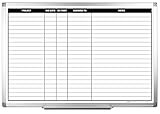
- MAGNETIC DRY-ERASE SURFACE — The whiteboard design is permanently printed onto durable, industrial‑quality dry‑erase vinyl that won’t smudge and is resistant to stains and ghosting. Its smooth, long‑lasting writing surface is also magnetic, giving you added functionality for notes, magnets, and accessories
- EASY INSTALLATION — Comes complete with durable mounting brackets and hardware, ensuring a secure and effortless wall‑mounting
- DURABLE ALUMINUM FRAME — Built with a sleek 1" aluminum border and a spacious 2.5" deep aluminum tray to keep markers and accessories neatly within reach
- SPACIOUS WRITING SURFACE — Ample writing space with a usable area that extends nearly edge‑to‑edge, measuring just 2" shy of the board’s total dimensions
- Please inspect your whiteboard upon arrival — If you notice any issues, please contact us through Amazon's Buyer-Seller Messaging system
Do not turn activity measures into targets
Story points, lines of code, commits, pull requests, hours worked, utilization, tickets closed and sprint velocity can sometimes help with local planning or diagnosis. Used as performance targets, they can encourage gaming, artificial ticket splitting, avoidance of uncertain work or concealment of problems. Velocity is a planning aid for a team, not a measure of business output or a valid basis for comparing teams.
Adapt the approach to the operating environment
Remote and distributed teams
- Write down decisions and the context behind them.
- Keep product goals and backlog information accessible asynchronously.
- Use overlapping meeting time for decisions, not routine status updates.
- Set response-time expectations and rotate inconvenient meeting times across regions.
- Give remote participants equal access to planning and design discussions; do not treat office presence as commitment.
- Create structured opportunities for informal connection and document incidents and retrospective outcomes.
- Make work visible without monitoring individual activity.
The goal is reliable collaboration across geography, not a digital replica of office routines.
Regulated, safety-critical and security-sensitive work
Agile does not require abandoning governance. Make compliance work visible and incremental: include requirements in the backlog, automate evidence collection where possible, involve security and quality early, and maintain traceability among requirements, implementation, tests and releases. Keep independent approvals and risk-based release gates where required; distinguish mandatory controls from avoidable bureaucracy. The principle is compliance continuously, not compliance later.
Do these 3 things before closing this tab:
1Repair Windows errors before they cause bigger problems2Scan for outdated or missing drivers - takes under a minute3Clear out junk files and repair common Windows errorsSupport, maintenance, legacy systems, hardware and contracts
- Support and maintenance: Continuous-flow work may suit Kanban, explicit service expectations, work-in-progress limits and classes of service better than fixed sprint commitments.
- Legacy platforms: Reduce bottlenecks and dependencies before adding ceremonies; otherwise the team may only become more efficient at waiting.
- Hardware-software products: Physical testing and manufacturing cycles can constrain iteration, so shorten feedback where feasible without pretending physical constraints disappear.
- Fixed-price contracts: Use incremental discovery, explicit change control and contract arrangements that do not punish legitimate learning.
- Small teams: Use lightweight planning and review practices; avoid process overhead that costs more than the coordination it provides.
Product development with uncertain requirements is often a strong fit for iterative learning, but Agile principles do not imply one method for every business. Adapt practices to risk, work arrival, regulatory obligations and dependency structure.
Recognize and correct common failure modes
| Failure | What it looks like | Better response |
|---|---|---|
| Agile theater | Stand-ups without authority, retrospectives without follow-through, sprints that are renamed project phases, dashboards instead of conversations, demos with nothing usable, or functional handoffs unchanged. | Change decision rights, ownership, incentives and feedback loops—not just the meeting calendar. |
| Executive support without behavior change | Leaders add urgent work mid-iteration, demand fixed scope, date and cost simultaneously, reward utilization, override priorities or penalize reported risk. | Make leadership behavior part of the improvement work; establish product goals and explicit rules for changing priorities. |
| Velocity as productivity | Teams inflate estimates, avoid uncertain work or optimize points rather than customer outcomes. | Use outcome, flow, quality and learning indicators; keep velocity local to planning if useful. |
| Scaling too early | New roles, events and reports multiply while product ownership, technical flow and dependencies remain broken. | Fix team boundaries, release capability and dependency management before adding scale practices. |
| Operations excluded | One group builds features while another absorbs incidents and support demands. | Bring operational health, user support and incident learning into product decisions. |
| Autonomy without support | A team is held accountable without context, skills, resources or access to decisions. | Pair authority with clear goals, coaching, enabling platforms and a fast escalation path. |
| Discovery neglected | The team becomes efficient at building features whose value is untested. | Connect customer research, experiments, analytics and delivery in one learning loop. |
| Rhetoric without safety | The organization talks about learning but punishes dissent, mistakes or bad news. | Reward early risk identification and use blameless reviews while keeping standards and accountability clear. |
Choose tools only after the operating model is clear
A work board can expose ownership and queues; a development platform can connect code, builds, tests and deployment; neither creates trust, product clarity or decision authority. Choose the lightest tool that makes work, ownership, dependencies, feedback and delivery health visible. Upgrade only when a demonstrated coordination or governance problem warrants it.
Evaluate tools by whether they support the team’s actual flow; connect product, engineering, QA, security and operations without duplicate records; integrate with source control, CI/CD, incidents and customer feedback; and allow useful workflow customization without bureaucracy. Also check reporting, permissions, auditability, identity and data-residency requirements, total cost, data export and whether reports will support learning rather than surveillance. Jira, for example, supports Scrum and Kanban boards, workflows, reports and integrations, but whether it fits depends on the organization’s needs; its capabilities are described at Atlassian’s Jira Agile page.
How to tell whether the culture is becoming more agile
Ask whether a team can identify a valuable problem, build a small increment, release or test it, learn from real evidence and adjust direction without waiting months for permission. Look for shorter delays in feedback and decisions, visible quality and operational risks, clear ownership across disciplines, and improvement actions that leaders actually resolve. If only the meeting names and software have changed, the organization has adopted Agile vocabulary, not yet the capability.
Quick Recap
Product prices and availability are accurate as of the date/time indicated and are subject to change. Any price and availability information displayed on Amazon at the time of purchase will apply.




