What’s actually slowing this PC down?
Pick the symptom - the matching free tool is one click away.
Build around your spending needs, time horizon, and ability to absorb losses—not around the highest displayed yield. Treat mortgage REITs (mREITs) as one leveraged, rate- and credit-sensitive exposure, then compare them with bonds, dividend-paying stocks, cash equivalents, and property-focused REITs. Set target weights for your own circumstances, check what your holdings actually own, and rebalance by a planned rule rather than chasing recent payouts.
Why mortgage REITs are a distinct income exposure
A real estate investment trust (REIT) may own income-producing property or real-estate-related assets. A property-focused, or equity, REIT generally owns properties and earns income related to them. A mortgage REIT instead provides financing to real estate owners and operators through mortgages or other loans, or invests in mortgage-backed securities. That difference matters: rent-related property exposure and mortgage-credit exposure do not have the same underlying cash-flow drivers.

As an Amazon Associate I earn from qualifying purchases.
The SEC says mortgage REITs tend to use more leverage than REITs focused on properties. It also identifies interest-rate sensitivity, credit quality, borrowing and hedging strategies, derivatives, and borrower defaults as risks to consider. Leverage can magnify the effect of changes in asset values and financing conditions; it does not make a distribution more dependable. A high stated yield by itself does not show whether a payout can continue or whether the investment will preserve principal.
For a named mREIT, review its current prospectus and most recent Form 10-K risk disclosures. Look for how it obtains financing, what mortgage assets it holds, how it manages rate exposure, and what could affect its ability to pay distributions. The SEC’s August 30, 2016 Investor Bulletin on publicly traded REITs says REITs are required to distribute at least 90 percent of taxable income for the year. That rule is not a forecast of an investor’s yield, a promise that distributions will continue, or a guarantee of positive total return. The bulletin also notes that REIT dividends typically do not receive the favorable tax treatment accorded to qualified dividends; an investor’s actual tax treatment depends on their circumstances.
#1 Best Overall
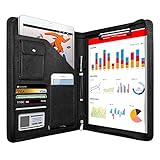
- 1. Multiple Compartments: This padfolio has 1 A4 clipboard, 1 A4 document sleeve, 1 mobile phone pockets, 5 card slots with a ID window, 1 gadget pocket with fastener and 1 pen holder
- 2. Practical Size: 34 × 25.5 × 3 cm / 13.3 × 10 × 1.1 inch, easy to carry in your suitcase or briefcase, a great companion for a business trip
- 3. Quality Material: made from PU Leather material, offering long-term durability, and super easy to clean up
- 4. Versatile Usage: Look confident and professional when using this stylish business portfolio at meetings, job interviews, or classrooms; give positive impression at all important occupations
- 5. Perfect Choice: Handy portfolio binder, suits both men and women; also a great gift choice for work colleagues, friends, or a recent college graduate
Compare income sources, not just payout rates
Each category below can play a different role, but none is automatically appropriate for every investor. The SEC’s broad descriptions are general comparisons, not current yield quotations or promises: bonds are generally less volatile than stocks and offer more modest returns; stocks are more volatile; and cash equivalents are generally lower risk but exposed to inflation risk. Specific holdings can behave differently, and every investment can carry risks not captured by its label.
| Category | What may produce income | Risks and checks |
|---|---|---|
| Mortgage REITs | Interest and other income associated with loans or mortgage-backed securities. | Review leverage, interest-rate exposure, credit quality, borrowing, hedging and derivatives, and defaults. Distribution levels and principal value can change. |
| Property-focused REITs | Income related to owning and operating real estate, including rent-related activity. | Property type and sector concentration, interest rates, management, occupancy, and property-market conditions matter. REITs often specialize in a property type, and types can respond differently to economic activity. |
| Bonds and bond funds | Bond interest, subject to the issuer’s terms and ability to pay. | Consider interest-rate and duration risk, credit quality, and the fund’s holdings. High-yield bonds are a higher-risk exception to broad descriptions of bonds. |
| Dividend-paying stocks and stock funds | Company dividends, which can change, plus any change in share value. | Equity prices can be volatile and companies can reduce or suspend dividends. Check company, sector, and fund concentration; a narrow dividend-sector fund can preserve concentration rather than reduce it. |
| Cash equivalents | Interest from choices such as savings deposits, certificates of deposit, Treasury bills, and money market instruments or funds. | They may help with liquidity and near-term spending, but inflation can erode purchasing power. Check the specific product’s terms and protections. |
| Mutual funds and ETFs | Income generated by the underlying securities, according to the fund’s holdings and distribution policies. | A pooled structure can hold many securities, but a narrowly focused fund may still be concentrated. Inspect holdings, overlap with other funds, fees, structure, and risks rather than relying on the fund name or payout rate. |
This comparison is about different sources and risks, not a ranking. A bond fund, stock fund, or property REIT can lose value; cash can lose purchasing power; and a diversified portfolio can still lose money. Diversification does not guarantee income or protect against every loss.
Think of the categories as potential components with different jobs, not as interchangeable ways to reach one payout number. A bond’s interest depends on its terms and the issuer’s ability to pay; a stock dividend is a company decision that can change; rent-related REIT income comes from property activity; and cash interest comes from the specific deposit or instrument. An mREIT’s financing and mortgage assets introduce a different mix of rate, credit, and leverage exposure. Spreading income across these sources may reduce dependence on a single one, but it does not remove the risks attached to the holdings.
The Tool Desk
Outbyte PC Repair FREEClear out junk files and repair common Windows errorsFree Scan →Outbyte Driver Updater FREEFix the driver behind crashes, sound loss and screen glitchesFind Drivers →Also distinguish an investment category from the wrapper used to hold it. A mutual fund or ETF can make it easier to own a basket of securities, but it may focus on one sector or asset type. Several funds can overlap substantially. The underlying holdings, concentration, expenses, structure, and risks matter more than the number of funds or the breadth suggested by a fund name.
Build the portfolio in a deliberate sequence
- Define what the portfolio must do. Write down the spending the portfolio is meant to support, when the money will be needed, and what liquidity you may require along the way. Separate near-term cash needs from longer-term income and growth goals. Consider both how much loss you could financially withstand and how much volatility you could tolerate without abandoning the plan.
- Choose broad target weights before choosing products. Decide how much belongs in broad categories—such as stocks, bonds, and cash—and whether real estate exposure fits the goal. The SEC’s asset-allocation guidance emphasizes that there is no single model that suits every financial goal. Do not start with a desired yield and reverse-engineer a portfolio around the riskiest products that appear to meet it.
- Inventory actual exposures. List each account’s investments and inspect fund holdings, not just ticker symbols or names. Estimate what is tied to mortgage credit, property ownership, a single issuer, sector, or asset category. Check overlap: owning several funds does not necessarily diversify a portfolio if they hold many of the same securities or concentrate in the same market segment.
- Compare how each holding produces cash flow. Ask whether income depends on interest, dividends, rent-related activity, or cash-deposit interest. Then examine the relevant risks: credit losses, rate changes, leverage, inflation, property markets, equity-price volatility, and possible distribution changes. For specific investments, use current issuer documents and fund disclosures.
- Set a review and rebalancing rule. Decide in advance how often you will check whether the portfolio has drifted from its targets and what deviation, if any, would prompt action. Calendar reviews and pre-set thresholds are both approaches described in SEC guidance; neither is mandatory. The SEC says rebalancing generally works best relatively infrequently.
- Make changes with costs and taxes in view. Directing new contributions toward underweighted categories can help restore target weights without selling. Selling overweight positions is another option, but consider transaction costs and tax consequences before trading. Do not assume a rebalance is costless or tax-neutral.
- Revisit the plan when your circumstances change. A changed goal, time horizon, financial situation, or tolerance for risk may justify a different target allocation. A recent rise or fall in one category, on its own, is not a reason to rewrite the plan around the latest performance.
It can help to write down the decisions behind the target before choosing investments: what the money is for, when you expect to use it, what portion needs ready access, and what level of loss would be financially or emotionally difficult. That record gives the later review a reference point. Otherwise, a product’s current payout or recent performance can quietly become the portfolio’s organizing principle even though it may not match the original need.
Asset allocation is a decision about the whole portfolio, not a prediction about which category will perform best next. The SEC’s guide puts it plainly: “There is no single asset allocation model that is right for every financial goal.” A target therefore needs to reflect your own financial situation and tolerance for risk; a model or example from another investor cannot determine the right mix for you.
Rank #2

- 【Quality Material】FYY leather a5 journal binder is wear-resistant and comfortable to handle. The card slots and pockets inside can organize your cards, tickets, cash, etc. The pen holder can keep the pen in place. We care about climate change impacts. Our products are CLIMECO-certified, joining the "Climate Friendly Commitment" program to measure, reduce and offset carbon footprints.
- 【Convenient Structure】The 6 rings binder a5 is structured with a convenient metal snap closure, include A5 refill paper, binder pockets and dividers paper sheet inside, perfect for a school notebook, office notebook, travel journal, budget noteboook, sketchbook, notebook, personal organizer, a planner, etc.
- 【Sturdy 6-rings】Made of sturdy stainless steel, can hold the paper firmly and prevent papers from falling off. With 2cm inner diameter, the binder can keep 80-100 sheets paper, meeting your daily needs.
- 【Perfect Size】The size of the a5 journal binder cover is 23.5 x 17.8 x 2 cm (9.2 x 7 x 0.8 inches), perfect for your shoulder bags and backpacks. An ideal gift for Christmas, New Year, Valentine's Day, Birthday.
- 【Package Contain】The 6 rings binder a5 includes 1pcs 6 ring binder cover, 80 sheets of lined paper, 3pcs binder pockets with 3 styles, and 5pcs dividers paper sheet. Your 100% satisfaction is our mission. If there is any problem about our items, please feel free to contact us in e-mail, we will provide money-back or replacement service.
Measure concentration through the holdings beneath the labels
There is no universal mREIT cap in the SEC guidance cited here, and the evidence does not establish a portfolio yield target. A suitable amount, including zero, depends on the investor’s goals and circumstances. Instead of treating a percentage as a rule for everyone, identify the portfolio’s sources of exposure and decide how much dependence on each source is acceptable for your plan.
- Issuer concentration: Check whether a large share of the portfolio depends on one company, borrower pool, or fund sponsor.
- Sector and property concentration: Identify whether multiple holdings rely on the same property type, real estate segment, or economic driver.
- Mortgage-credit and leverage exposure: Distinguish mREIT holdings from property-owning REITs and look through pooled funds for mortgage-related assets.
- Fund overlap: Compare underlying holdings across funds. Different fund names do not prove different exposures.
- Liquidity and timing: Consider when you may need to withdraw money and whether the holding can be sold or accessed on that schedule.
A practical way to map a holding is to record its cash-flow source, the risks that could interrupt or reduce that cash flow, and its role in the portfolio. If two holdings depend on the same rate environment, credit conditions, sector, or payout source, count that overlap even when the holdings have different labels.
For a simple inventory, make one row per holding and note the category, underlying assets, cash-flow source, major risks, and any fund overlap. Then group the rows by exposure rather than by account or ticker. A fund may add many securities but still leave the portfolio leaning on a single sector or income source. This exercise will not produce a universally correct percentage; it makes the portfolio’s dependencies visible so you can compare them with the target you chose.
Look at liquidity alongside concentration. If money may be needed on a particular schedule, ask whether the investment can be sold or accessed when required and whether its value could fluctuate before then. Cash equivalents may support near-term liquidity, but their lower-risk profile does not eliminate inflation risk. The right balance depends on spending timing and the investor’s circumstances, not on a general rule that one type of holding is always suitable.
Evaluate yield alongside total-return and distribution risk
A displayed yield is only one part of an income investment’s profile. It does not tell you whether the distribution is stable, whether the share or bond price may fall, or what the investor’s return will be after price changes, fees, and taxes. Compare a holding’s distribution with its underlying cash-flow risks and its effect on the whole portfolio rather than selecting whichever product displays the largest payout.
For bonds and bond funds, review credit quality, interest-rate sensitivity, duration, and what the fund owns. For dividend stocks, account for the possibility that dividends change as well as the volatility of share prices. For REITs, distinguish property-related activity from mortgage financing and examine concentration and leverage. For cash products, check their terms and protections and weigh the effect of inflation on purchasing power. These checks are more informative than treating unlike income sources as interchangeable because they all make payments.
Rank #3

- PERFECT BUSINESS PORTFOLIO - Designed to fit either side bound letter size notebooks or top bound letter (8.5x11 inch) and legal (8.5x11.75 inch) notepads, our padfolio is ideal for taking notes in meetings, delivering presentations or acing the big job interview. It serves as a legal pad holder, providing a convenient option for those who need to take notes on legal pads.
- STYLISH, CLASSY, PROFESSIONAL PORTFOLIO - make a strong impression in every business meeting, show your confidence with our hand-crafted folio made from high quality faux leather. Be the envy of your office or conference with this leather legal pad holder.
- SLIM & LIGHTWEIGHT PORTFOLIO - holds everything you need for a conference meeting - pen, resume, writing pad & business cards; this portfolio has a hard sturdy base providing a stable platform for making notes. It also functions as a resume portfolio folder, allowing you to keep all your important documents in one place. Additionally, the clear inside pocket provides a handy spot for your business card and the 3 pocket business card holder helps you stay organized.
- SPECIAL GIFT FOR SOMEONE YOU LOVE - celebrate their success in getting that new job or landing the big client that only they could do. Our leather portfolio document holder comes in a beautiful, strong matt black box that needs no additional wrapping. They will love you for this stylish and functional leather notepad.
- 1 Year Replacement Warranty - We want you to be 100% happy with your new legal pad portfolio for women and men; please contact us if you have any issue at all with your padfolio and we will replace it immediately.
Taxes also affect usable income. The SEC’s REIT bulletin says REIT dividends typically do not qualify for the favorable tax treatment given to qualified dividends, but that statement is not an individual tax calculation. Tax results depend on your circumstances and the account holding the investment. Consider tax consequences before selling during a rebalance, and seek qualified tax advice when the treatment of a specific holding is unclear.
Use a consistent comparison for each candidate instead of comparing products by a single number. Ask what produces the cash flow and how that source might be interrupted; what interest-rate, credit, leverage, inflation, property-market, or equity-price risks apply; and how concentrated the issuer, sector, asset class, geography, and fund holdings are. Add liquidity, expenses, trading costs, possible taxes, distribution variability, and the fit with your time horizon and spending schedule. These questions do not predict performance, but they help reveal why two investments with apparently similar payouts may have very different roles and risks.
A distribution requirement should not be mistaken for an investor return requirement. The SEC’s 2016 bulletin describes a REIT requirement to distribute at least 90 percent of taxable income for the year. That statement concerns taxable income and does not establish the amount an investor will receive, whether a particular distribution is sustainable, or how the share price will change. A payout rule is not a substitute for reviewing current issuer information or considering total-return risk.
Use a review routine that protects the plan from yield chasing
At a scheduled review, compare current weights with the targets you selected and check whether the portfolio’s underlying exposures have changed. For funds, inspect updated holdings and fees; for a named mREIT, revisit its current prospectus and latest Form 10-K. Reassess whether the portfolio still fits your spending schedule, liquidity needs, and tolerance for loss. If weights have drifted, apply the rebalancing rule you chose rather than changing the target simply because a category has recently performed well or offers an attractive-looking payout.
The SEC describes calendar-based checks, such as every six or twelve months, as one possible approach, and pre-set percentage thresholds as another. Those intervals are examples, not instructions to trade on a fixed date. Rebalancing relatively infrequently and accounting for costs and taxes can help keep the process tied to the allocation decision rather than short-term market moves.
There are two basic ways to move closer to target weights. You can direct new contributions to categories that have become underweighted, which may avoid selling some holdings, or sell part of holdings that have become overweight. Neither approach is automatically best in every account: check transaction costs and possible tax consequences before acting. Rebalancing is meant to restore the chosen allocation, not to guarantee a gain or forecast which category will do better.
For recordkeeping, a short portfolio-planner notebook or similar worksheet can hold your targets, the date of your last review, and the next review date. It is an organizational aid, not an investment solution. The SEC notes that many fund-company websites offer portfolio-analysis tools and that investors may consider professional help with allocation decisions. Any tool or adviser should be evaluated for its actual capabilities, costs, and fit; the existence of a calculator does not make its output an individualized recommendation.
Do these 3 things before closing this tab:
1Repair Windows errors before they cause bigger problems2Scan for outdated or missing drivers - takes under a minute3Clear out junk files and repair common Windows errorsA decision checklist before adding or keeping an mREIT
- Can you explain whether the holding finances real estate through loans or mortgage-backed securities, or owns properties?
- Have you reviewed the current issuer disclosures for leverage, interest-rate exposure, credit quality, financing, hedging, derivatives, and default risks?
- Have you looked through funds and accounts to see the portfolio’s total mortgage-credit and real-estate exposure?
- Do you understand what produces the distribution and what could cause it to change?
- Does the holding fit your chosen targets, liquidity needs, time horizon, and capacity to bear loss?
- Have you considered fund expenses, trading costs, and tax consequences before making a change?
The SEC’s asset-allocation and diversification guidance and its investor guide on allocation, diversification, and rebalancing are useful starting points for understanding these decisions. They are general U.S. investor education, not individualized portfolio recommendations. If you need help setting targets for a particular financial situation, consider consulting a qualified investment professional.
Frequently Asked Questions
How much of an income portfolio should be in mortgage REITs?
There is no universal mREIT cap or portfolio yield target established by the SEC guidance discussed here. The suitable amount, including none, depends on your goal, time horizon, financial situation, liquidity needs, and ability and willingness to bear loss. Start with target weights for the portfolio as a whole, then check how much mortgage-credit and leverage exposure you already have through individual holdings and funds.
What can I own for income besides mortgage REITs?
Possible categories to compare include bonds and bond funds, dividend-paying stocks and diversified stock funds, cash equivalents such as savings deposits, CDs and Treasury bills, and property-focused REITs. Each has different sources of cash flow and risks. None is automatically safer, better yielding, or appropriate for every investor, so compare underlying holdings, concentration, liquidity, expenses, taxes, and fit with your time horizon.
Does a REIT’s requirement to distribute 90 percent of taxable income guarantee my yield?
No. The SEC’s August 30, 2016 Investor Bulletin describes a requirement for REITs to distribute at least 90 percent of taxable income for the year. It is not a forecast of an investor’s yield, a promise that distributions will continue, or a guarantee of positive total return. The value of an investment can change, and tax treatment depends on your circumstances.
How often should I rebalance an income portfolio?
SEC guidance describes calendar reviews, such as every six or twelve months, and reviews triggered by pre-set allocation deviations as possible approaches. Neither interval is mandatory; the SEC says rebalancing generally works best relatively infrequently. You can direct new contributions to underweighted categories or sell overweight holdings, while considering transaction costs and tax consequences.
Is owning several income funds enough to diversify?
Not necessarily. A pooled fund can hold many securities, but a narrow fund may still be concentrated, and multiple funds may have overlapping holdings. Look through each fund to check issuer, sector, asset-category, and mortgage-credit exposure rather than assuming that different fund names create diversification.
The Bottom Line
Build an income portfolio around your own goal, time horizon, liquidity needs, and tolerance for loss—not the highest displayed payout. Compare cash-flow sources and underlying risks, look through funds to measure concentration, and use a personal target and rebalancing rule. Mortgage REITs can be one exposure, but neither a high yield nor a diversified label guarantees reliable income or protects against losses.
Quick Recap
Product prices and availability are accurate as of the date/time indicated and are subject to change. Any price and availability information displayed on Amazon at the time of purchase will apply.
Quick wins for a faster PC:
Fix the driver behind crashes, sound loss and screen glitchesFind Drivers →Clear out junk files and repair common Windows errorsFree Scan →Scan for outdated or missing drivers - takes under a minuteDriver Scan →



