Outdated Drivers Are Slowing You Down
One free scan finds every outdated or missing driver and matches the right update for your exact hardware.Free scan · exact hardware matchPC Slower Than It Used to Be?
A free scan shows the junk files, broken settings and background clutter dragging Windows down - then fixes them in one click.Free scan · Windows 10 & 11Short answer: GST is ultimately paid by the final consumer, but the amount you see on a clothing tag, website or negotiation is not necessarily the same as the taxable value on your invoice. A registered seller’s tax invoice should identify the garment, taxable value, applicable tax rate, tax charged and total payable. Whether GST appears as a separate addition or is already built into the quoted price depends on how the seller displays and bills the price.
Do not use the often-copied ₹1,000 apparel threshold as a current rule. The Ministry of Finance says Notification No. 9/2025-Central Tax (Rate), dated 17 September 2025, superseded the earlier goods-rate notification. The Department of Consumer Affairs says the revision took effect on 22 September 2025. The operative CGST and IGST schedules must therefore be checked before applying any current clothing rate.
As an Amazon Associate I earn from qualifying purchases.
What GST changes when you buy clothes
GST is a destination-based consumption tax. CBIC explains that only value addition is taxed through the supply chain, while the burden is ultimately borne by the final consumer. A clothing seller may collect GST from you and remit it through the GST system; the tax does not become a separate optional charge simply because it is printed on a bill.
Your out-of-pocket price can contain several different concepts:
#1 Best Overall

- CONVENIENT 6-PACK VALUE - Stock up on everyday essentials with six comfortable crewneck undershirts designed for dependable fit, everyday performance, and trusted Hanes quality.
- EVERYDAY COTTON COMFORT - Made from soft, breathable cotton (heather styles are a cotton/polyester blend), these men's undershirts provide lightweight comfort for layering or wearing on their own.
- MOISTURE-WICKING PERFORMANCE - Men's t-shirt made with Cool Comfort fabric helps wick away moisture while advanced odor protection helps keep you cool, dry, and feeling fresh throughout the day.
- DESIGNED TO STAY TUCKED - An extra-long t-shirt hem is designed to stay tucked in, providing dependable coverage and a neat appearance whether you're working, traveling, or going about your day.
- CLASSIC COMFORT - A lay-flat crewneck collar and tag-free design help deliver lasting comfort while creating a clean look under button-downs, polos, sweaters, and t-shirts.
- Displayed or negotiated price: the amount shown on a tag, website, quotation or sales conversation.
- Taxable value: the value on which GST is calculated after any applicable price adjustment reflected by the seller.
- GST amount: the tax calculated at the rate applicable to that supply.
- Final amount payable: the amount you actually pay, including the taxable value and tax, plus any separately stated permitted charges.
Two shops can show the same final price in different ways. One may advertise a tax-inclusive amount and show GST as a breakdown on the invoice. Another may display a pre-tax selling price and add GST at checkout. The bill, rather than the clothing tag alone, tells you how the seller calculated the transaction.
Does GST get added on top of the MRP?
There is no single answer for every clothing purchase because MRP, selling price and tax presentation are different questions. MRP is the maximum retail price printed or displayed for a packaged consumer product. A seller may discount an item below that figure, and a seller’s invoice can show the taxable value and tax separately even when the customer-facing price was presented as one tax-inclusive number.
Before paying, ask which of these prices the seller quoted:
Recommended Free Tools
- Tax-inclusive price: GST is already included in the amount advertised or negotiated. The invoice may mathematically split that amount into taxable value and tax.
- Tax-exclusive price: GST is added to the quoted selling price. The seller should show the tax rate and amount before collecting the final total.
- Discounted price: the seller reduces the selling price from the tag or MRP, then calculates tax using the value shown on the invoice.
Do not infer tax treatment from a large printed MRP, a marketplace headline price or a verbal statement such as “GST extra.” Request the final payable amount and a bill that identifies the taxable value and tax calculation. For a qualifying packaged item affected by the 2025 transition, the original printed MRP also cannot simply be hidden by a revised sticker.
Is the GST rate based on MRP or the selling price?
CBIC’s former apparel-rate explanation distinguished a garment’s transaction or sale value from its MRP. That explanation is useful for understanding why a tax calculation can refer to the transaction value rather than the printed maximum price. It is not a current rate table.
Rank #2
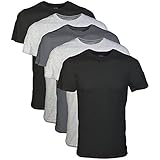
- Soft, breathable cotton
- Moisture wicking technology keeps you cool and dry
- Tag-free to prevent irritation
- Classic length for easy tucking
- Durable stitching
The legacy FAQ commonly states that readymade garments at or below ₹1,000 per piece attracted 5% GST and garments above ₹1,000 attracted 12%. Those figures belong to the earlier rate framework. Notification No. 9/2025-Central Tax (Rate), dated 17 September 2025, superseded the previous general goods-rate notification, and the Ministry of Consumer Affairs says the revised regime became effective on 22 September 2025. The detailed current apparel entries and thresholds must be verified in the operative CGST and IGST schedules; the old ₹1,000 rule should not be quoted as current.
For a shopper, the practical rule is simple: compare the invoice’s taxable value with the amount you agreed to pay, then check the rate printed on that invoice. If the tax rate looks wrong, ask the seller which current schedule entry they applied. Do not try to establish the rate from MRP alone.
How to read a clothing bill
Invoice layouts differ according to the supply and the buyer, so every receipt will not look identical. A normal shopper-facing bill should nevertheless make the following information understandable.
| Bill field | What it tells you | What to check |
|---|---|---|
| Garment description | Which item was supplied | Match the description, size, colour, quantity and any style or stock code to your purchase. |
| Taxable value | The value used to calculate GST | Check that discounts or agreed price changes are reflected and that the figure is not confused with MRP. |
| Applicable tax rate | The percentage applied to the taxable value | Confirm that the seller has used the current schedule, not an old threshold copied from a legacy FAQ. |
| Tax charged | The rupee amount of GST | Recalculate approximately as taxable value multiplied by the stated rate. |
| Final amount payable | What you must pay | Ensure the total equals the taxable value plus tax and any clearly identified additional charges. |
| MRP or revised sticker, where relevant | The package’s displayed maximum retail price | For qualifying packaged stock, check that an original printed MRP has not been obscured. |
CBIC’s invoice particulars include the description of goods, taxable value, applicable tax rate and tax charged. A receipt that shows only a card-machine total or a handwritten amount may not give you enough information to verify the GST calculation; request the seller’s proper invoice where appropriate.
How to check the arithmetic on a tax-inclusive price
When a seller says a price already includes GST, the tax is not found by multiplying the final total by the rate. If R is the applicable rate expressed as a decimal and T is the tax-inclusive total, use:
Rank #3

- Fabric: Crafted from a blend of 60% Polyester, 35% Rayon, and 5% Spandex, this casual and trendy tops offers a loose fit, soft, skin-friendly, and comfortable, making it the perfect addition to your fashionable wardrobe
- Design: This oversized summer tops features a Collarless, Off-Shoulder Neck style. This trendy fashion loose shirts for womens adds a good wearing experience, while the short sleeves ensure versatility
- Occasion: These loose summer shirts work for a range of occasions, from casual outings to more dressed-up events. The off-shoulder design adds a simple touch, and they are suitable for daily use – at work, at home, or on the go
- This women's short sleeve oversized shirt is made from a soft, breathable fabric that's both stretchy and lightweight. Perfect for spring, summer, and fall, it offers comfort and ease, making it a great choice for casual wear
- Washing suggestion: Machine washable or dry cleaned
Taxable value = T ÷ (1 + R)GST = T − taxable value
For illustration only, suppose a bill totals ₹1,100 and the invoice states a hypothetical 10% rate. The taxable value would be ₹1,000 and GST would be ₹100. The 10% figure is an arithmetic example, not a current apparel rate. Use the rate printed on the seller’s invoice and verify it against the operative schedule.
If GST is added on top of a tax-exclusive price, the calculation is different:
GST = taxable value × RFinal total = taxable value + GST
For example, with a hypothetical taxable value of ₹1,000 and a hypothetical 10% rate, GST would be ₹100 and the total would be ₹1,100. These formulas help detect a mismatch; they do not determine which rate legally applies to a particular garment.
Quick wins for a faster PC:
Repair Windows errors before they cause bigger problemsFix Now →Scan for outdated or missing drivers - takes under a minuteDriver Scan →Rank #4

- Comfort Fabric: These athletic shorts for women are made of 92% polyester and 8% spandex, offering comfort and durability, while keeping you cool and dry during workouts
- High Waist & Tummy Control: Leafigure women yoga shorts feature a high-waisted design, offering gentle compression and tummy control
- Pockets Design: Designed with practical side pockets could holding your phone, keys, or other essentials while you’re running, biking, yoga or at the gym
- Super Stretch: The material is stretchy and soft, ensuring that legging shorts move with your body during any activity, whether you're bending, squatting, or stretching, without irritation or restriction
- Stylish for Everyday Wear: These bike shorts are easily paired with tunics, T-shirts, jackets, dress or sports bras, idea for workouts to daily errands
Discounts, bundles and alterations: what to ask
Discounted garments
A sale tag can show a reduced amount while the package still carries a higher MRP. Ask the seller to show the discounted taxable value on the invoice. Compare that value with the price you accepted, rather than assuming the tax is calculated on the original tag.
“Buy two” and bundled offers
Bundles can make it difficult to tell which value belongs to each garment. Check whether the invoice lists separate quantities and values or gives a clearly explained combined line. If different products are supplied together, ask how the seller has identified the taxable value for each item.
Alterations and other services
Tailoring, embroidery, delivery or other services may appear as separate lines. Do not assume that a service charge has the same tax treatment as the garment. Ask the seller to identify each line and its applicable rate instead of accepting one unexplained lump sum.
Returns and exchanges
Keep the original invoice. When a seller processes a return, exchange or credit adjustment, the tax correction should be traceable to the original garment line and amount. If the replacement item has a different value, request a revised bill showing how the adjustment was made.
The Tool Desk
Outbyte PC Repair FREEClear out junk files and repair common Windows errorsFree Scan →Outbyte Driver Updater FREEScan for outdated or missing drivers - takes under a minuteDriver Scan →What changed in September 2025
The Ministry of Consumer Affairs announced that the 2025 GST revision was effective from 22 September 2025. It also issued transition guidance for qualifying unsold pre-revision packaged stock:
Best Value

- Fit: Loose. XS=US(0-2), S=US(4-6), M=US(8-10), L=US(12-14), XL=US(16-18), XXL=US(20-22),3XL=US(24-26), 4XL=US(28-30).
- Fabric: 68% Polyester, 27% Rayon, 5% Elastane. Stretch - Slight, Thickness - Slight, Softness - Medium.
- Designs: The summer shirts designed with short sleeve, henley v neckline with buttons, casual loose fit, tunic length, basic tees.
- Style: This v neck top is super cute and flattering to pair with shorts, jeans or skirts for work office outfits, casual wear, running errands, laidback weekends.
- Care: Machine or hand wash cold, do not bleach. Hang or lay flat to dry, do not tumble dry.
- Revised price stickers were optional.
- The original printed MRP could not be obscured.
- Old packaging could be used through 31 March 2026 or until the stock was exhausted, whichever came first.
This transition does not automatically cover every clothing purchase. It concerns qualifying pre-packaged commodities and stock held under the announced conditions. A made-to-order garment, an unpackaged item or an ordinary store receipt should not be treated as covered merely because it is clothing. If a seller points to an old package, ask whether the item actually falls within the transition and request an invoice showing the amount charged.
The transition date also matters when you compare old and new receipts. A package printed before the revision may remain in circulation under the stated conditions, while a current invoice must still reflect the tax treatment applicable to the actual supply date and schedule entry.
Comparing two clothing bills
When two sellers offer what appears to be the same shirt, trousers or dress, compare the complete calculation rather than only the headline price.
| Comparison point | Bill A | Bill B |
|---|---|---|
| Garment description and quantity | Record exactly what is listed | Record exactly what is listed |
| Quoted or discounted price | Was the amount tax-inclusive or tax-exclusive? | Was the amount tax-inclusive or tax-exclusive? |
| Taxable value | Copy the invoice figure | Copy the invoice figure |
| Rate shown | Check against the current schedule | Check against the current schedule |
| Tax amount | Check the arithmetic | Check the arithmetic |
| Final payable total | Include any separately stated charges | Include any separately stated charges |
| MRP or packaging note | Relevant only where the item is a qualifying packaged product | Relevant only where the item is a qualifying packaged product |
A lower MRP does not automatically mean a lower final price, and a separate GST line does not automatically mean the seller charged more. The meaningful comparison is the final amount for the same goods, supported by the taxable value and tax amount on each invoice.
Common mistakes shoppers make
- Treating the ₹1,000 rule as current: it comes from a legacy FAQ and must not be used after the superseding 2025 notification without checking the operative schedule.
- Assuming GST is always extra: a seller may quote a tax-inclusive amount and show the tax only as a breakdown.
- Assuming MRP is the taxable value: the invoice identifies the value used for tax; MRP answers a different pricing question.
- Comparing tags instead of totals: discounts, bundles and separate services can change the final amount.
- Accepting an unexplained total: ask for the garment description, taxable value, rate and tax amount.
- Assuming every old package is covered by transition rules: the 2025 guidance applies to qualifying pre-packaged stock, not automatically to every item of clothing.
What to do if the bill looks wrong
- Ask the cashier or seller whether the quoted price included GST.
- Request an invoice identifying the garment, taxable value, rate, tax amount and final total.
- Check that the arithmetic links the taxable value and stated rate to the tax amount.
- Ask which current CGST or IGST schedule entry supports the rate, especially if the seller cites the old ₹1,000 threshold.
- Keep the invoice, payment record, product tag and photographs of any relevant packaging.
- If the seller refuses to explain a material discrepancy, use the seller’s formal complaint channel and the applicable consumer-protection or tax-authority route for your jurisdiction.
Do not withhold payment or alter a package yourself while disputing a bill. Preserve the original documents and ask for a written correction or credit record if the seller agrees that the invoice was wrong.
Questions to ask before you pay
- Is the amount on the tag or website inclusive of GST?
- What is the taxable value after the discount?
- Which GST rate is being applied, and where is it shown on the invoice?
- Does the final total include any tailoring, delivery or other service line?
- If the garment is packaged stock printed before September 2025, does the announced transition apply to this item?
What is established—and what still needs verification
The billing principles are clear: GST is borne by the final consumer, invoice particulars distinguish taxable value from tax charged, and MRP and tax line items answer different questions. The September 2025 revision and its packaging transition dates are also stated in government announcements.
What should not be stated without checking the operative schedule is a universal current apparel threshold or percentage. The old CBIC FAQ remains easy to find, but its ₹1,000 and 5%/12% figures describe the former framework. Before relying on a rate for a purchase, verify the current CGST and IGST entries applicable to the garment, the type of supply and the date of sale.
What’s actually slowing this PC down?
Pick the symptom - the matching free tool is one click away.
Quick Recap
Product prices and availability are accurate as of the date/time indicated and are subject to change. Any price and availability information displayed on Amazon at the time of purchase will apply.




