PC Slower Than It Used to Be?
A free scan shows the junk files, broken settings and background clutter dragging Windows down - then fixes them in one click.Free scan · Windows 10 & 11Outdated Drivers Are Slowing You Down
One free scan finds every outdated or missing driver and matches the right update for your exact hardware.Free scan · exact hardware matchGenerative AI is not replacing Bitcoin’s proof-of-work or making ASICs calculate SHA-256 hashes more efficiently. Its practical role is around the mining process: helping operators interpret data, draft maintenance guidance, and explore operating scenarios. Predictive models and optimization software can also help manage power, cooling, and fleets. The larger shift is commercial: some mining companies are adapting their power and data-center infrastructure for AI and high-performance computing (HPC), a different business from AI-powered Bitcoin mining.
What “generative AI in cryptocurrency mining” means
The phrase can refer to three different things. Distinguishing them matters because the capabilities, risks, and economics are not the same.

- Generative AI produces text, code, reports, or structured recommendations. In a mining operation, it might summarize equipment logs, draft a shift report, or let an operator ask questions in natural language.
- Predictive AI and machine learning analyze data to forecast or classify outcomes—for example, predicting power prices, detecting anomalous temperatures, or estimating equipment failure risk. These tools need not generate text and are often more directly useful for operational decisions.
- AI/HPC infrastructure means using facilities or capital associated with mining to host GPU computing, AI training or inference, or other data-center workloads. That is diversification into a different computing business, not a new way to mine Bitcoin.
In practice, a mining company may use all three, but a dashboard or automatic switch is not necessarily generative AI. Vendors should explain what the model actually does and what measurable result it improves.
Why generative AI cannot mine Bitcoin in place of ASICs
Bitcoin mining is a proof-of-work process. Specialized application-specific integrated circuits (ASICs) repeatedly calculate hashes and test whether a result meets the network’s difficulty target. Each attempt is effectively independent; a language model cannot reason out the winning nonce in advance or replace the hashing work.
Quick wins for a faster PC:
Scan for outdated or missing drivers - takes under a minuteDriver Scan →Clear out junk files and repair common Windows errorsFree Scan →#1 Best Overall

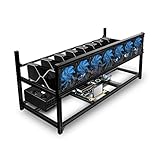
- 6/8 SLOTS - Support to 6/8 GPU . (GPU is not included).
- MATERIAL - The open air mining frame case is made up of the highest quality stainless steel material, strong, durable and available. Fully protecting your GPU and eectronic device.
- PERFECT DESIGN - Professional design for mining rig frame, accelerating the air convection, super cooling design for heat dissipation. Enough space reserved between the graphics cards.
- EASY TO INSTALL - This mining case is easy to install and is with strong structure. Keep all cables clean and organized, along with everything in your mining machine.For installation steps, please refer to the user manual
- NOTICE - This mining rig frame is the Frame Only, not includes Fans or other CPU, GPU, PSU, Motherboards, Cables. If you are not 100% satistifed with this Miner, please feel free to contact us, we will offer you a satisfactory soluiton within 24 hours.
Mining still depends on ASIC capacity, electricity, cooling, connectivity, and—if a miner participates through one—a mining pool. AI can help decide which machines to run and when, but it does not create hashing capacity or free electricity. Claims that a chatbot can predict a winning Bitcoin hash or make home mining profitable by itself confuse operational assistance with proof-of-work.
Where AI can help a mining operation
The most credible uses combine conventional measurements and controls with AI for forecasting, anomaly detection, or operator support. A language model can make information easier to query; it should not become the source of truth for electrical, thermal, or financial calculations.
Forecasting electricity costs and flexible loads
A forecasting and optimization system can combine power prices, contracts, weather, renewable generation, grid conditions, curtailment terms, Bitcoin price, network difficulty, and fleet efficiency. It may recommend running all machines, dispatching only the most efficient ASICs, throttling a site, or taking part in a demand-response program. Research has modeled mining loads in ancillary-service and demand-response markets and examined optimization under renewable-energy uncertainty: research on cryptocurrency mining and ancillary services, research on mining machines for demand response, and research on mining loads under renewable-energy uncertainty.
A forecast is not a profit guarantee. A mistaken power-price or hashprice forecast can lead an operator to shut down too early, mine through an uneconomic period, or miss an opportunity. The value depends on the site’s contracts, market rules, and ability to respond.
Predictive maintenance and fault investigation
Models can flag unusual changes in hashrate, power draw, chip temperature, fan speed, rejected shares, error rates, voltage, or pool latency. A generative layer can summarize the evidence for an operator—for example, noting that a rack’s declining hashrate coincides with rising power variance and recommending an airflow inspection based on approved maintenance records.
That explanation is a lead to investigate, not a confirmed diagnosis. Sensor readings, equipment manuals, engineering checks, and technician judgment remain essential. A model can hallucinate a fault or recommend an incorrect repair, so it should cite the telemetry and documentation behind its answer.
Rank #2
- ✅Premium Aluminum Construction: Constructed from high-quality aluminum for enhanced durability and heat dissipation, ensuring longevity and optimal performance.
- ✅ Accommodates 8 GPUs: Designed to house up to 8 graphics cards, providing ample space for expanding your mining setup and maximizing efficiency.
- ✅ Superior Airflow and Cooling: Engineered with optimized airflow design to prevent overheating and maintain optimal operating temperatures for prolonged mining sessions.
- ✅ Easy Assembly: Simple and straightforward assembly process allows for quick setup, getting you up and running in no time.
- ✅ Sleek and Space-Saving Design: Compact and minimalist design saves space while adding a professional touch to your mining rig setup.
Cooling and thermal management
Forecasting and control systems can help manage fan curves, airflow, liquid-cooling temperatures, immersion-cooling circulation, and rack-level thermal loads. Better control may reduce cooling power, thermal throttling, failures, or uneven equipment wear. It does not automatically reduce a facility’s total electricity use: lower operating costs could encourage more mining or support additional workloads.
MARA’s annual filing describes cooling-efficiency research and patents alongside a broader strategy that includes AI and HPC capacity: MARA’s 2025 annual filing.
Dispatching a mixed-efficiency fleet
ASIC fleets differ in efficiency, age, reliability, cooling needs, warranty status, and resale value. An operator can rank machines by expected contribution margin rather than switching every unit on or off as a group. A conceptual hourly calculation is:
Expected hourly margin = expected mining revenue + power-market or curtailment value − electricity, cooling, pool, hosting, and expected maintenance costs.
This is a framework, not a universal calculator. Mining revenue and costs vary with network difficulty, pool payout terms, transaction fees, downtime, local power prices, and equipment performance. A dispatch policy should also account for long-term hardware wear; maximizing short-term hashrate can increase repair costs or shorten equipment life.
Scale helps explain why fleet management attracts attention. MARA reported approximately 495,000 mining rigs and 72.2 EH/s of energized hashrate as of March 31, 2026. Those figures describe one company’s reported fleet at that date, not an industry average: MARA’s March 31, 2026 filing.
Natural-language operations assistants
A private assistant connected to approved logs, manuals, and dashboards could answer questions such as which site lost the most hashrate during a heat event, summarize a firmware rollout, draft a shift handover, or create a maintenance-ticket draft from telemetry. This is a useful interface when staff need to find information across many systems; it does not make the underlying data more accurate.
For consequential operations, safer designs use read-only access by default, role-based permissions, audit logs, and human approval before changing power settings or shutting down equipment. Wallet keys and treasury systems should be isolated. Logs, tickets, and external text can contain malicious instructions, so a connected model must treat them as untrusted input rather than commands.
Scenario analysis and digital twins
Operators can model questions such as what happens if power prices spike for six hours, outside temperatures exceed a cooling limit, a portion of the fleet fails, or AI workloads receive priority over mining. A language model can help specify scenarios or explain results, but a validated operational model should calculate electrical, thermal, and financial outcomes. A 2026 study describes digital-twin-guided LSTM forecasting for energy management in blockchain mining, illustrating the role of predictive modeling rather than proving that a generative model controls a real facility: the 2026 digital-twin and LSTM study.
Why mining companies are moving toward AI and HPC
For some public miners, the more significant change is not AI improving Bitcoin mining but mining operators trying to sell computing infrastructure to AI and HPC customers. Existing sites may offer valuable power interconnections, land, substations, cooling, connectivity, security, and experience operating dense computing equipment. Those assets can provide a starting point, but they do not make an ASIC mine ready to host GPUs.
Recommended Free Tools
| Bitcoin-mining facility priorities | AI/HPC facility priorities |
|---|---|
| Low-cost power and tolerance for interruption | Reliable service and customer uptime commitments |
| Bitcoin ASICs and relatively straightforward workload scheduling | GPU accelerators, software stacks, storage, and orchestration |
| Cooling suited to the installed ASIC design | Potentially high-density liquid cooling and different rack layouts |
| Mining-pool connectivity and fleet management | High-bandwidth networking, enterprise security, and customer support |
The table describes broad differences, not universal specifications: requirements depend on the customer workload and facility design. Power access is valuable but insufficient. A conversion can require major investment in cooling, electrical distribution, networking, permitting, and equipment.
MARA says its strategy is expanding from Bitcoin mining into AI, HPC, and other critical IT workloads. It reported approximately 1.9 GW of energy capacity across 19 data centers as of March 31, 2026; that company-reported capacity is not the same as installed GPU capacity or revenue-producing AI capacity. Its filing also reported approximately 495,000 rigs and 72.2 EH/s energized at that date, and described acquiring 2.4 EH of next-generation used ASIC miners during Q1 2026 at below-market prices and under warranty. These company-specific figures and descriptions are in MARA’s Q1 2026 filing.
Rank #4

- Hashrate: The MINI DOGE III HAS 700MH/S 400W , making it a high-performing miner for Dogecoin Litcoin
- Goldshell MINI DOGE Ⅲ is an upgraded version of MINI DOGE II with significantly improved hashrate
- Application Scenario: MINI DOGE III is an ideal choice for home mining with its whisper-quiet operation at just 35dB, resembling the sound of rustling leaves
- Specifications: Dimensions: 198×150×96(mm), Weight: 2.3KG, Algorithm: Scrypt, Cryptocurrency: LTC|DOGE Coin, Connection Port: Ethernet only, Operating Temperature: 0~35℃, Relative Humidity: ≤65%, Input Voltage: 100-240V, Power Cable: 10A, Fan Specifications: 4500rpm
- Competitive Advantages: Goldshell MINI DOGEⅢ offers high hashrate, low power consumption, and quiet operation, making it the best choice for home mining
CoinShares reported more than $70 billion in announced AI/HPC contracts across publicly listed miners. That is an aggregate of announcements, not proof of equivalent realized revenue. The report also projected that some miners might derive about 70% of revenue from AI by the end of 2026, compared with about 30% at the time of its report; this is a projection, not an established outcome: CoinShares’ Q1 2026 mining report. S&P Global likewise described miners’ pivot toward AI and HPC amid weaker cryptocurrency-market conditions: S&P Global’s report on the pivot. Another company filing describes mining sites being developed for AI/HPC use: the SEC-filed disclosure.
Why the business case is attractive—and uncertain
Mining revenue is exposed to Bitcoin’s price, network difficulty and hashrate, subsidy halvings, electricity costs, ASIC depreciation, financing, repairs, and downtime. AI/HPC contracts may offer longer-term or more predictable revenue for some sites, and can provide another use for power and data-center assets. But the economics depend on execution and contract terms, not on the “AI” label.
What’s actually slowing this PC down?
Pick the symptom - the matching free tool is one click away.
When assessing an announcement, distinguish the following stages:
- Announced agreement: a public statement may describe intent or planned capacity without a completed contract.
- Signed contract: obligations and conditions depend on the actual agreement, customer credit, milestones, and termination rights.
- Construction and power delivery: the site still needs completed infrastructure and available grid capacity.
- Installed, energized equipment: GPUs or other systems must be installed, connected, and operating.
- Recognized revenue: the company must deliver service under the applicable accounting and contract terms.
GPU purchases or customer financing, delivery schedules, expensive cooling retrofits, uptime obligations, debt, and hardware depreciation all add risk. A site designed for interruptible Bitcoin mining may not meet enterprise requirements without substantial changes.
Strategies that combine mining, AI, and energy management
- Dynamic power allocation: use an optimization engine to compare mining, AI inference, GPU cloud workloads, grid services, and power sales where each is technically and contractually available.
- Hybrid ASIC/GPU sites: operate interruptible ASICs when power is favorable while reserving separate, appropriately designed capacity for GPU customers. The two workloads may need different electrical layouts, cooling, networking, and service policies.
- Waste-heat recovery: route heat to a suitable water-heating, greenhouse, district-heating, or industrial use. AI may help match heat supply to demand, but a viable project still depends on installation and plumbing costs, seasonal demand, maintenance, and local energy prices.
- Maintenance and compliance drafting: use a constrained language model to prepare incident summaries, checklists, shift reports, and environmental or energy-report drafts for human review.
- Firmware and undervolting assistance: search for operating points that balance hashrate, watts per terahash, temperature, error rates, and component life. Compatibility, manufacturer limits, electrical safety, and warranty terms constrain any automated tuning.
Proof-of-useful-work is experimental, not Bitcoin mining
Some proposals aim to replace conventional proof-of-work with computation that performs useful machine-learning work, such as training or serving models. Academic proposals include proof-of-useful-work and blockchain-based distributed deep-learning mining. They are distinct from Bitcoin’s current SHA-256 consensus mechanism and do not show that Bitcoin has adopted AI mining.
A protocol would need to verify useful work cheaply and reliably, prevent participants from submitting fake or low-quality results, and preserve consensus security and network liveness. If useful work favors specialized hardware or concentrated datasets, it may also reproduce centralization pressures. A proposal alone does not establish a functioning network, liquid market, or durable developer ecosystem.
The Tool Desk
Outbyte PC Repair FREEClear out junk files and repair common Windows errorsFree Scan →Outbyte Driver Updater FREEFix the driver behind crashes, sound loss and screen glitchesFind Drivers →Best Value
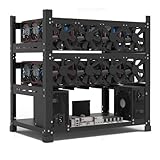
- SLOT - 6/8/12 GPU slots, support 2 ATX power supplies.
- MATERIAL - The open air mining frame case made up of the highest quality stainless steel material, strong, durable and available. Fully protecting your GPU and eectronic device.
- PERFECT DESIGN - Professional design for mining rig frame, accelerating the air convection, super cooling design for heat dissipation. Enough space reserved between the graphics cards.
- EASY TO INSTALL - Easy to install and strong structure. Keep all cables clean and organized, along with everything in your mining machine.
- NEED TO ASSEMBLE BY YOURSELF - For installation steps, please refer to the user manual. The Frame Only, Not includes Fans or other CPU, GPU, PSU, Motherboards, Cables. If you are not 100% satistifed with this Miner, please feel free to contact us, we will offer you a satisfactory soluiton within 24 hours.
What can go wrong with AI in mining
- Hallucinated answers: a model may invent a hardware fault, repair instruction, vendor feature, or saving. Ground responses in approved manuals and records, show the source, and keep calculations in deterministic systems.
- Unsafe control: corrupted inputs or prompt injection can lead a model to misunderstand instructions. Keep control systems isolated, set hard operating limits, and require human approval for consequential actions.
- Forecast failures: heat waves, grid emergencies, abrupt price changes, pool outages, and transmission failures can break ordinary patterns. Define conservative fallback behavior before automating decisions.
- Over-optimization: maximizing immediate output can accelerate fan wear, stress cooling systems, or violate warranty limits. Optimize risk-adjusted lifetime contribution, not just current hashrate.
- Site mismatch and capital risk: power alone does not provide GPU-compatible cooling, high-bandwidth fiber, redundant power paths, suitable permits, or customer-ready security. Construction delays and debt can make a planned conversion financially risky.
- Grid and environmental impacts: flexible loads are not automatically beneficial. The outcome depends on local market rules, whether power would otherwise be curtailed, emissions, water use, transmission capacity, noise, and land-use effects.
- Greater concentration: large operators may have better telemetry, power contracts, engineering staff, and capital for automation, advantages that can reinforce mining-industry concentration.
When generative AI is the wrong first tool
Many mining tasks are better handled by simpler or more deterministic software. A sensible system uses each tool for the job it can do reliably.
| Need | Often better first choice |
|---|---|
| Hashrate and uptime dashboards | Conventional monitoring software |
| Temperature alarms | Rule-based thresholds |
| Power dispatch | Mathematical optimization or model-predictive control |
| Failure detection | Supervised anomaly detection |
| Energy forecasting | Time-series models |
| Maintenance records | Structured maintenance-management software |
| Questions across approved documents and logs | A retrieval-augmented assistant |
| Automated shutdowns | Deterministic safety rules |
| Scenario analysis | A digital twin combined with optimization |
A robust design typically puts sensors and deterministic controls first, predictive models and optimization next, and a generative interface on top for explanation and reporting. Human review should remain in the loop for actions that can damage equipment, affect grid obligations, or move money.
How operators can evaluate an AI tool
Before buying or integrating a system, ask whether it solves a measurable problem and what happens when it fails.
- Data: Are power, pool, temperature, telemetry, and maintenance records complete and reliable?
- Function: Is the product generating text, forecasting, detecting anomalies, optimizing dispatch, or merely automating a fixed rule?
- Integration and latency: Can it safely connect to the relevant ASIC managers, SCADA systems, market feeds, ticketing systems, and pool APIs? Does it need real-time control or only daily recommendations?
- Safety and security: Is access read-only or approval-based? Are credentials, firmware, wallets, and treasury systems isolated? Are actions and recommendations logged?
- Evidence of value: Does the vendor show measured changes in uptime, W/TH, cooling cost, failure rates, or realized power-market revenue, with a clear baseline?
- Resilience and ownership: What happens during an outage or corrupted input? Can the operator export telemetry and model outputs?
- Payback: Do expected savings justify software, sensors, integration, engineering, and ongoing support costs?
How investors can assess a miner’s AI pivot
Company announcements can describe very different stages of development. Read filings and contracts where available, and compare operational progress with claims about future capacity.
Free tools Windows power users keep installed
One-click scans. No signup required.
- Separate energized power from planned power and installed GPUs from announced capacity.
- Compare contracted and recognized revenue; examine customer identity, credit quality, contract conditions, and termination rights.
- Track construction, grid-interconnection, cooling, and customer-acceptance milestones.
- Review financing, debt maturities, possible dilution, and the capital still required to complete a project.
- Ask how much Bitcoin-mining capacity remains and whether AI revenue is recurring, usage-based, or only a target.
What individual miners should know
For an individual, the label “AI-powered” does not change the basic mining economics: ASIC efficiency, electricity price, hardware cost, cooling and noise, pool fees, network difficulty, Bitcoin price, downtime, taxes, and local rules. A chatbot or optimization subscription cannot make structurally uneconomic electricity or obsolete hardware profitable.
Be especially cautious with services that promise fixed mining returns, demand wallet access, obscure machine ownership or fees, or cannot document a measured improvement. Hosting changes where equipment runs; it does not remove Bitcoin-price, difficulty, hardware, contract, or counterparty risks. Check ownership, electricity and maintenance charges, curtailment rules, downtime policies, payout terms, insurance, jurisdiction, and withdrawal conditions before committing money.
Quick Recap
Product prices and availability are accurate as of the date/time indicated and are subject to change. Any price and availability information displayed on Amazon at the time of purchase will apply.




