Quick wins for a faster PC:
Fix the driver behind crashes, sound loss and screen glitchesFind Drivers →Clear out junk files and repair common Windows errorsFree Scan →Scan for outdated or missing drivers - takes under a minuteDriver Scan →Fish farming is not automatically more or less environmentally sustainable than growing crops or raising livestock. The result depends on what is farmed, where and how it is produced, and which impacts are measured. A useful comparison separates greenhouse-gas emissions, water and land use, and nutrient pollution—and compares equivalent outputs rather than treating “fish farming” and “agriculture” as single methods.
What counts as fish farming and traditional agriculture?
Fish farming, or aquaculture, raises aquatic organisms such as finfish, shellfish, and seaweed. Its systems range from fed fish in cages or ponds to species that do not require feed. “Traditional agriculture” is not one comparator: it can mean rain-fed or irrigated crops, livestock, or mixed farms that combine activities.
That diversity makes a universal ranking misleading. A fed fish operation, a seaweed farm, a rain-fed crop, and a livestock system have different inputs and impacts. Any claim that one is “more sustainable” needs to identify the products, production systems, location, and environmental measures being compared.
How to make a fair comparison
First define the assessment boundary. A farm-gate comparison may count impacts at the farm but omit some upstream inputs; a broader life-cycle assessment can include feed production and other inputs. Then choose a functional unit—the amount of product used to compare systems.
#1 Best Overall

- YEAR ROUND WATER GARDEN: The Back to the Roots Water Garden Duo allows you to grow a succulent or houseplant garden all year round and comes with everything you need to get started - no green thum or big backyard needed.
- CONVENIENT AND EASY: Harvest organic microgreens from your aquarium in just 10 days; Your Water Garden becomes a self-cleaning fish tank that also grows fresh food up top; The fish waste fertilizes the plants on top and the plants clean the water
- THE PERFECT LIVING HOME DECOR OR GIFT: Each Back to the Roots Water Garden Duo comes with a free STEM curriculum on aquaponic and hydroponic systems to encourage your kids to learn more about it; This award-winning ecoystem is also the perfect gift.
- COMPLETE AQUATIC ECOSYSTEM KIT: This DIY aquaponic fish tank kit is fully equipped with everything you need to get started - radish and wheatgrass seeds, water conditioner, a growing medium for your seeds to take root, water dechlorinator, fish food, and even a fish coupon
- MADE IN THE USA: Back to the Roots indoor gardening kits are crafted with care in the USA. For any concerns with your kit's performance, please contact us for assistance. Refill kits are also available
- Per kilogram: useful for comparing product weight, but it does not show how much energy or protein the food provides.
- Per calorie or per unit of protein: useful for comparing nutritional output, but rankings may differ from a per-kilogram comparison.
- Per unit of water or nutrient input: useful for examining resource efficiency, but it does not capture every environmental effect.
FAO’s 2007 comparative-assessment proceedings explain why the comparison is difficult: aquatic and terrestrial environments differ, and both sectors include diverse systems. They conclude that “No method is robust enough to capture the full suite of environmental impacts and costs associated with food production.” A sound assessment therefore reports several measures rather than compressing them into one sustainability score. FAO, Comparative assessment of the environmental costs of aquaculture and other food production sectors.
How the environmental measures compare
Greenhouse-gas emissions
Emissions vary among aquatic foods and farm systems, just as they do among crops and livestock. For fed aquaculture, feed can be a major source of impact. FAO’s 2022 aquaculture chapter says feed is among the leading inputs for many farmed fish and crustaceans and that aquafeeds often dominate undesirable impacts in commercial-aquaculture life-cycle assessments. This makes feed sourcing and feed conversion important parts of the comparison, rather than details to ignore. FAO, The State of World Fisheries and Aquaculture 2022.
Rank #2
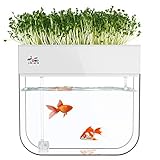
- Fish Tank & Seed Sprouter: The fish waste fertilizes the plants, and the plants clean the water for fish.
- Self Cleaning System: Plants consume fish dung as nutrients, so the tank requires 50% fewer cleanings than traditional fish tanks.
- Siphon Oxygen Supply: The water level of the tank is tidal-like fluctuation, and the roots of the plants can breathe regularly, no need watering or fertilizing. Meanwhile a natural oxygen supply is brought to the fish.
- Educational Product: Use the system at home or in a classroom. Let kids learn germination and teach concepts like food sustainability, aquatic environments, and animal care.
- Great Gift: A wonderful gift for kids, parents, teachers, foodies and gardening lovers. (Note: Search B08BR8H72X for the pump spare parts.)
Water and land use
Water use is not interchangeable with water scarcity: the location and source of water matter. Land use also varies by species and production method. In a 2021 Nature analysis, farmed salmon and trout used the least land and water among the farmed finfish and crustacean groups examined. That does not establish that every salmon or trout farm uses less water or land than every crop farm; it is a study-level comparison across groups, not a farm-by-farm verdict.
The same study standardized greenhouse-gas, nitrogen, phosphorus, freshwater, and land stressors for aquatic-food species groups covering nearly three quarters of global production. It found farmed bivalves and seaweeds had the lowest stressors across the blue foods analyzed. Among farmed finfish and crustaceans, silver and bighead carp had lower greenhouse-gas, nitrogen, and phosphorus emissions but higher water use. The trade-off illustrates why a single “best” ranking can conceal differences between impact categories. Nature, Environmental performance of blue foods.
Rank #3

- ★ 2 in 1 Hydroponic Growing System:2 in 1 Smart Indoor Hydroponic & Aquarium System, the ultimate dual-purpose solution for both planting and fish farming. This innovative system combines the benefits of hydroponic gardening and ecological fish cultivation, giving you a versatile and rewarding experience like no other.
- ★ Full Spectrum LED Lamp:featuring full spectrum illumination, you can provide your plants with optimal lighting conditions to ensure vigorous growth and abundant harvests. The lamp is designed to automatically switch on and off, eliminating the hassle of constantly adjusting the lighting schedule and providing energy-efficient plant growth.
- ★ Touch Screen Panel:This intuitive interface allows you to easily adjust the water pump time, growth mode time, and aquarium light mode, all at the touch of a button. With this level of control, you can create the perfect environment for your plants and fish, ensuring their well-being and maximizing their growth potential.
- ★ Water Level Buoys:These features make it easy to add water and keep track of water levels, ensuring that your plants and fish are always provided with the optimal conditions for growth. Say goodbye to the tedious task of constantly monitoring water levels, and enjoy a seamless gardening experience with our thoughtfully designed system.
- ★ Adjustable & Replaceable Bracket:designed to accommodate plants of various sizes. You can customize the height and position of the lamp to meet the specific needs of different plant species. Whether you're growing herbs, leafy greens, or flowering plants, our hydroponic system offers the flexibility to adapt to your gardening preferences.
Nitrogen and phosphorus pollution
Nitrogen and phosphorus can enter water from feed and farm waste, among other sources. The 2021 Nature analysis found lower emissions of these nutrients for some groups than others, but it does not establish that all aquaculture causes more or less nutrient pollution than crop or livestock production. In integrated systems, nutrients may be used by other farmed species or crops; whether that reduces impact depends on system design and management.
What the comparative studies show—and what they do not
Water and nutrient efficiency in arid areas
A 2007 comparison by R. E. Brummett assessed published data for 20 crop and 19 fish production systems. Rain-fed cassava ranked strongly for water and nutrient efficiency among the crops, while results differed by output: maize, wheat, and crop legumes were efficient sources of protein, and cassava was efficient for energy. Among aquaculture examples, sharp-tooth catfish in fed raceway-ponds, tilapia in fed cages, and tilapia in sewage-fed ponds were among the most efficient systems examined.
Rank #4
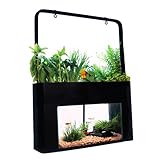
- The AquaSprouts Garden is a self-sustaining aquarium & aquaponics kit for the home, office or school
- Fish fertilize the plants. Plants clean the water for the fish. Once up & running, aquaponics requires minimal water changes & no filter replacements
- Grow your favorite veggies, herbs and greens anywhere, all-year-round. No need for added fertilizers—let your fish friends provide the nutrients your plants need
- Perfect tool to explore how our natural environment works and great option for those with limited space
- Fits any standard 10-Gallon aquarium (approximately 20" X 10" X 12") from any manufacturer (not included)
The analysis found aquaculture comparable to crop production on selected measures, including edible dry matter per cubic meter of water and crude protein per kilogram of nitrogen. In arid areas, however, comparable efficiency required high intensification and/or strong integration with other farm enterprises. These results use older, location-specific published data; they are not a global league table. WorldFish, Aquaculture in arid areas: a comparative evaluation of production systems.
Integrated farms in Vietnam’s Mekong Delta
A 2011 cradle-to-farm-gate life-cycle assessment followed inputs and outputs over two years at 11 Mekong Delta farms: three rice-based, high-input fish farms; four rice-based, medium-input fish farms; and four orchard-based, low-input fish farms. Land use per calorie did not differ among the three system types. Per calorie, global-warming potential, energy use, and eutrophication tended to be higher in the orchard/low-input system. Impacts per kilogram of fish were also higher there, which the authors attributed to pond management and lower fish yield.
Best Value
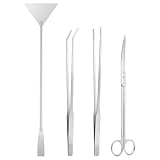
- 4 in 1 Long Aquarium Tools Kits: The aquascape tools kit contains 1 x 10" aquarium scissors, 1 x 10.6" straight long tweezer, 1 x 10.6" curved feeding tongs, and 1 x 12.56" Aquarium substrate spatula. One set of terrarium supplies to help you better manage your aquarium and terrariums. This aquascaping tools are long and slender enough to easily use in any gallon fish tank, good as fish tank accessories. It suits both beginner and experienced people.
- Rust-proof and Stainless Steel Material: The 4pcs of aquarium supplies are made of high-quality stainless steel material, rustproof and corrosion-proof, sturdy, and long-lasting. With the protection of the rustproof coating, every tool has excellent corrosion resistance.
- Multi Functions and Applications: Ohtomber aquascape tools is ideal for all types of grooming, maintaining, and sorting out aquatic plants in water as an aquarium accessories. Aquarium scissors could help you trim the plant, furnish the aquarium landscape with driftwood cornerstones, sand, and aquarium algae scraper could be applied to scrap the algae and smooth out plant stratum substrate. Do use it to maintain a comfortable environment for fish in an aquarium tank now!
- Minimizing interference: Long aquascaping tools can prevent accidental injuries to Aquarium plants and damage to the environment. Long aquarium tweezer can adjust driftwood, and feed little reptiles instead of putting your hands into water. It is very effective in precise operation and avoiding getting your hands wet. Similarly, Long aquarium scissors are suited for small or thin water plants and help trim excess parts. It won't hurt the plant's cross-section.
- Maintenance tips: In order to extend tool life and keep performing well, we recommend that you rinse off the saltwater attached to the tools surface and then wipe up to keep dry.
Rice and pigs were major contributors to total environmental impacts in the farms studied. The findings show why it matters whether the comparison counts only fish or the whole integrated farm—and whether results are expressed per calorie or per kilogram. They describe these farms in the Mekong Delta, not integrated aquaculture everywhere. Phong, de Boer, and Udo, Life cycle assessment of food production systems on the Mekong Delta, Vietnam.
Independent reader supportYour contribution helps us test, update, and keep practical guides available for everyone.Can better management reduce aquaculture’s impacts?
Feed efficiency and production yield can change the footprint of fed aquaculture. In the 2021 Nature study, modeled improvements in feed conversion reduced stressors among fed groups, while a modeled increase in fish yield reduced land and water use by up to half. The “up to half” figure is a modeled result, not a reduction observed or guaranteed at every farm.
Integration is another possible approach. Integrated multitrophic aquaculture pairs fed species with extractive species that can use nutrients associated with feed and waste. Integrated agriculture-aquaculture can combine activities such as rice-fish, livestock-fish, or bird-fish production. These arrangements require suitable infrastructure and management; combining outputs alone does not prove that every impact category will fall. The Mekong study’s differing results across systems and functional units are a reminder to assess the actual farm. FAO, The State of World Fisheries and Aquaculture 2022.
How to judge a claim that fish farming is more sustainable
Before accepting a comparison, check whether it tells you:
Do these 3 things before closing this tab:
1Scan for outdated or missing drivers - takes under a minute2Clear out junk files and repair common Windows errors3Fix the driver behind crashes, sound loss and screen glitches- Which aquatic species and farming system are being compared with which crop, livestock product, or mixed farm.
- Where the production takes place and whether local water conditions are relevant.
- Whether the assessment includes feed and other upstream inputs, or stops at the farm gate.
- Whether the result is reported per kilogram, calorie, protein, or resource input.
- Which impacts are counted—at minimum, greenhouse gases, nutrient pollution, freshwater, and land—and whether trade-offs are visible.
- Whether an apparent improvement is a measured farm outcome or a modeled scenario.
The practical answer is conditional: species, feed, location, yield, system design, and management determine how fish farming compares with a particular agricultural product. Neither “fish farming” nor “traditional agriculture” has one environmental footprint, and no single metric settles the comparison.
Quick Recap
Product prices and availability are accurate as of the date/time indicated and are subject to change. Any price and availability information displayed on Amazon at the time of purchase will apply.




