Ford and Mazda built one of the auto industry’s deepest cross-company alliances. It began with vehicle supply and a 1979 equity investment, expanded into Ford’s 33.4% controlling stake and management of Mazda, and connected product engineering, factories, purchasing and distribution across several regions. Ford’s control ended after the 2008 financial crisis, but cooperation did not vanish: AutoAlliance (Thailand), still owned 50:50 by Ford and Mazda, remains an active manufacturing venture. The companies are no longer under common global ownership, and Ford is not listed among Mazda’s major shareholders as of March 31, 2026.
How the Ford–Mazda relationship started
The alliance grew in stages rather than appearing as a single merger. Mazda’s corporate history records industrial cooperation with Ford before the formal equity deal, followed by a 1979 capital tie-up and a much broader strategic alliance in the 1990s.
Pre-alliance cooperation: 1969 and 1971
In 1969, Mazda, Ford and Nissan agreed to establish Japan Automatic Transmission Company. Two years later, Mazda began supplying Ford’s Courier/Proceed small pickup. These arrangements show that the companies were already sharing industrial capability before Ford bought a stake in Mazda.
The 1979 equity investment
In November 1979, Ford acquired a 25% shareholding in Mazda. Mazda’s historical materials describe the investment as helping expand commissioned manufacturing for Ford—from small commercial vehicles into transmission units and small passenger vehicles. The relationship was therefore operational as well as financial from its beginning.
The Tool Desk
Outbyte PC Repair FREEClear out junk files and repair common Windows errorsFree Scan →Outbyte Driver Updater FREEScan for outdated or missing drivers - takes under a minuteDriver Scan →#1 Best Overall

- Complete Repair Coverage: Step-by-step repair procedures specific to your vehicle — from routine maintenance like oil changes and air filter replacement to complex engine and transmission repairs
- 700+ Photos & Illustrations: Every procedure is visually supported with clear, close-up photography taken during an actual vehicle teardown and rebuild — no guesswork required
- Beginner to Advanced: Written in plain language so a DIY owner with basic tools can tackle most repairs confidently, while still serving as a valuable reference for experienced mechanics
- Full Troubleshooting Section: Quickly diagnose problems with dedicated troubleshooting guides for engine, electrical, brakes, and drivetrain systems
- Time-Saving Tips Throughout: Pro shortcuts and notes highlight common pitfalls, helping you avoid costly mistakes and get your vehicle back on the trail faster
Ford’s ownership and Mazda’s transformation
From strategic partner to controlling shareholder
Ford increased its Mazda holding to 33.4% in 1996. That was not 100% ownership, but it gave Ford effective control and substantial influence over management. Ford appointed Henry D. G. Wallace as Mazda’s first non-Japanese president and chief executive while Mazda pursued restructuring under its Millennium Plan.
In December 1993, the companies had agreed to build a global strategic alliance. The plan coordinated product development, manufacturing, distribution and related activities. During Ford’s management period, Mazda closed plants, reduced its workforce, rationalized its model range and clarified its brand position. Mazda simultaneously launched core “Zoom-Zoom” products including the Atenza/Mazda6, Demio/Mazda2 and Axela/Mazda3.
The most accurate description of this period is Ford-controlled Mazda with substantial operational integration. Mazda remained a distinct brand with its own engineering and product identity; it was not simply converted into a Ford marque.
What the alliance actually covered
The relationship operated at several levels, and the degree of sharing differed by program, market and model generation.
Free tools Windows power users keep installed
One-click scans. No signup required.
Rank #2

- Step-by-step procedures written from a complete teardown and rebuild, giving you the confidence to tackle repairs at any skill level.
- Over 700+ clear photos and diagrams that simplify complex systems, helping you complete jobs faster and with fewer mistakes.
- Comprehensive troubleshooting and fault-finding guides to quickly diagnose problems and reduce costly downtime.
- Capital and governance: Ford held a major Mazda stake and supplied senior management from 1996 until the post-2008 divestment.
- Product development: The companies coordinated vehicle programs and engineering work, sometimes using related architecture or components while tuning each product for its own brand.
- Manufacturing: Ford and Mazda operated joint plants in the United States and Thailand, with facilities producing vehicles for both companies and for export markets.
- Powertrains and technical information: Cooperation included engines, transmissions, technology information and global vehicle programs, but a shared component does not make every vehicle mechanically identical.
- Procurement and distribution: Mazda executives cited shared purchasing leverage and distribution advantages alongside joint development and production.
A shared platform, engine, transmission or assembly line could coexist with different body designs, suspension tuning, software, equipment and pricing. Any claim about a “Ford” or “Mazda” vehicle therefore needs to identify the exact model, generation, market and production period.
Major shared vehicle programs and factories
| Program or facility | What the evidence shows | Period or status |
|---|---|---|
| Ford Courier / Mazda Proceed | Mazda supplied Ford’s small commercial pickup, establishing cross-brand production before the equity alliance. | Supply began in 1971; market-specific arrangements varied. |
| Ford Ranger / Mazda Fighter and B-Series | AutoAlliance Thailand produced Ford and Mazda pickup programs for Thailand and export markets outside North America. | Production launched in 1998. |
| Mazda BT-50 | AutoAlliance Thailand added Mazda’s BT-50 pickup program. | Production began in February 2006. |
| Mazda2 / Ford Fiesta | The passenger-car plant at AutoAlliance Thailand was designed to build both brands’ small cars for Thailand and Asia-Pacific export markets. | Plant opened in 2009. |
| Mazda3 at AutoAlliance Thailand | The Thai venture expanded beyond pickups into Mazda passenger cars. | Production began in 2011. |
| Mazda CX-3 and CX-30 at AutoAlliance Thailand | Mazda added compact crossover production at the same joint venture. | CX-3 production began in 2015; CX-30 production began in 2019. |
| AutoAlliance International, Michigan | A Ford–Mazda manufacturing venture that produced Mazda6 alongside Ford-related products. | Formed as a 50:50 joint venture in June 1992; now a historical chapter rather than a current Mazda-listed facility. |
AutoAlliance Thailand: the enduring manufacturing link
AutoAlliance (Thailand), commonly abbreviated AAT, was established in 1995 as a Ford–Mazda joint venture. Its chronology records Ford and Mazda pickup production from the late 1990s, passenger-car production from 2009 and later Mazda3, CX-3 and CX-30 programs.
AAT’s own materials state that the facility reached four million cumulative units in 2024. Mazda’s Integrated Report 2024 identifies the Rayong facility as a current Mazda production site, lists Mazda’s investment ratio as 50% and Ford’s as 50%, and names Mazda2, Mazda3, CX-3 and CX-30 among its primary products.
Why the Michigan venture should not be confused with AAT
AutoAlliance International in Michigan became a 50:50 Ford–Mazda joint venture in June 1992 and was an important U.S. manufacturing chapter. Mazda later described the plant as producing the Mazda6 alongside Ford-related products, and the companies examined possible futures for the venture in 2011. Mazda’s current facilities information lists AutoAlliance Thailand but not AutoAlliance International as a current Mazda production facility.
Rank #3

- Detailed repair and maintenance coverage trusted by professional technicians and DIYers for decades.
- Clear step-by-step instructions supported by wiring diagrams, diagnostic charts, and technical illustrations.
- Covers routine maintenance through advanced repairs, making it the go-to resource for keeping your vehicle running reliably.
Why Ford reduced its Mazda stake
Ford began selling Mazda shares after the 2008 financial crisis and Lehman Brothers’ collapse. Mazda’s official history says Ford gradually reduced its ownership, ending Ford’s 12-year management of Mazda. The companies agreed in November 2008 to continue a strategic relationship even as common control weakened.
The 2010 sell-down
In November 2010, Ford announced that it would transfer most of its remaining Mazda shares to Mazda business partners. Ford was expected to retain 3.5%, while the remaining 7.5% would move through off-auction trading. Mazda said the companies intended to continue cooperation in mutually beneficial areas.
Ford’s later ownership position
Mazda’s fiscal-2015 financial materials reported that Ford’s stake had fallen to 2.1% because of further Ford sales and Mazda capital increases. Those materials described an ongoing strategic partnership involving key joint ventures, joint projects and technology-information exchange.
Mazda’s current shareholder disclosure, covering major shareholders as of March 31, 2026, lists Toyota Motor Corporation at 5.1% and does not list Ford. That supports the conclusion that Ford no longer holds a material disclosed ownership position in Mazda.
Recommended Free Tools
Rank #4

- Used Book in Good Condition
What remains of the alliance in 2026
AAT is still a live Ford–Mazda company
The clearest surviving institution is AutoAlliance Thailand. It remains a 50:50 manufacturing joint venture, rather than a relic of Ford’s former control of Mazda. Mazda continues to identify AAT as a production facility, while AAT presents itself as a manufacturing center for compact pickups and other vehicles.
Mazda’s 2025 investment plan
In February 2025, Mazda announced plans to invest 5 billion Thai baht to strengthen AAT and develop it as a manufacturing hub for new compact SUVs. The plan called for annual capacity of 100,000 units and an export focus on Japan and ASEAN markets. The announcement described Mazda’s production and sales strategy; it did not signal a return to Ford’s former corporate control.
The present-day relationship in one sentence
Ford and Mazda remain partners in a specific Thai manufacturing venture, but the former alliance based on common ownership, shared senior management and broad global integration has ended.
Independent reader supportYour contribution helps us test, update, and keep practical guides available for everyone.Why the alliance mattered to each company
What Mazda gained
- Capital and management support while Mazda faced serious financial and operating difficulties.
- Access to Ford’s global manufacturing, purchasing and distribution scale.
- Additional production capacity and opportunities to spread development costs across regions.
- A route to restructuring while preserving Mazda’s own brand and engineering identity.
What Ford gained
- Access to Mazda engineering and compact-vehicle expertise.
- Small commercial vehicles and pickup programs that Mazda could engineer or manufacture.
- Additional manufacturing capacity in the United States and Thailand.
- Regional products and production networks useful to Ford’s global operations.
The trade-off for customers
Shared programs could lower development and manufacturing costs and accelerate market entry. They could also make it difficult for buyers to tell which company engineered a vehicle, where it was built or how much technology was shared. The reliable approach is to evaluate the specific model and market rather than apply a blanket label to every Ford-era Mazda.
Best Value
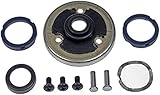
- Convenient solution - this transmission shifter repair kit allows for direct replacement of failed original shifter
- Cost-effective fix - inexpensive alternative to buying entire new shifter assembly from dealership
- Complete kit - includes cover, gasket, pins, bushing and spring for a complete repair
- Quality engineering - designed and tested in the United States
- Ensure fit - to make sure this part fits your exact vehicle, input your make, model and trim level into the garage tool
Five misconceptions, corrected
- “The partnership ended in 2008.” Ford’s controlling role ended, but strategic cooperation continued and AAT remains jointly owned.
- “Ford owned Mazda outright.” Ford’s peak holding was 33.4%, enough for control and management influence but not 100% ownership.
- “Every Ford-era Mazda was a rebadged Ford.” The alliance mixed shared platforms, parts, factories and technology with Mazda-specific engineering, styling and product decisions.
- “AutoAlliance Thailand is only historical.” Mazda’s 2024 report and 2025 investment announcement identify it as an active facility and planned future hub.
- “Ford is still a major Mazda shareholder.” Mazda’s major-shareholder disclosure dated March 31, 2026 does not list Ford.
How to interpret the alliance as an investor or buyer
For financial analysis, separate three questions that are often blurred together:
- Who owns whom? Ford no longer has a material disclosed major-shareholder position in Mazda; Toyota is listed at 5.1% as of March 31, 2026.
- Where do they still operate together? AAT is the documented continuing 50:50 venture.
- Was a particular vehicle shared? Check the model, generation, market and production plant. A corporate relationship alone does not prove identical engineering.
This framework avoids both extremes: treating the alliance as a complete merger or pretending that every connection disappeared when Ford sold down its Mazda stake.
The Bottom Line
Ford and Mazda’s alliance evolved from pre-1979 manufacturing cooperation into Ford’s 33.4% controlled ownership of Mazda and extensive global integration. Ford exited that controlling role after the financial crisis, but the relationship left a lasting industrial footprint. In 2026, the strongest documented link is AutoAlliance Thailand, a 50:50 joint venture that Mazda still uses and plans to expand, while Ford is no longer a major disclosed Mazda shareholder.
Quick Recap
Product prices and availability are accurate as of the date/time indicated and are subject to change. Any price and availability information displayed on Amazon at the time of purchase will apply.
Quick wins for a faster PC:
Scan for outdated or missing drivers - takes under a minuteDriver Scan →Clear out junk files and repair common Windows errorsFree Scan →Fix the driver behind crashes, sound loss and screen glitchesFind Drivers →



