“This company makes wood products without trees” refers to Foray Bioscience, a startup exploring how to grow materials and useful compounds from plant cells in controlled environments. It does not mean Foray is currently selling ordinary lumber made in a lab: the wood-like materials described in 2024 reporting were an early research effort, while the company’s public updates as of August 18, 2026, focus on plant biotechnology and fabricated seeds.
What Foray Bioscience is trying to do
Founded in 2022 by MIT-trained mechanical engineer Ashley Beckwith, Foray Bioscience is a plant-biotechnology company. Its approach is to culture living plant cells rather than grow a mature tree, harvest it, and mill it into lumber. The original work reported by MIT Technology Review used cells from black cottonwood, a type of poplar.
“Without trees” is shorthand for avoiding the need to harvest a whole mature tree for a product. The process still begins with plant material and depends on nutrients, growth media, hormones, energy, and controlled equipment. It is a biological manufacturing idea, not wood made from nothing.
How plant-cell culture could make wood-like material
- Take cells from a plant. The 2024 account described extracting cells from black cottonwood leaves.
- Grow them in culture. Cells are maintained and multiplied in a controlled medium with nutrients.
- Guide their development. In the reported method, cells were transferred to a gel containing the plant hormones auxin and cytokinin. Such signals can influence growth and differentiation.
- Harvest or process the desired output. The goal is to direct cells toward a useful tissue or compound, then collect and process it.
That sequence does not by itself produce a plank with the structure and properties of lumber. A tree builds organized wood over years; a cell culture must be shown to reproduce the particular material or chemical a manufacturer needs.
The Tool Desk
Outbyte PC Repair FREEClear out junk files and repair common Windows errorsFree Scan →Outbyte Driver Updater FREEFix the driver behind crashes, sound loss and screen glitchesFind Drivers →#1 Best Overall

- [Wood Carving Kit Deluxe Edition] Everything you need to start carving: 4 knives, 4 chisels, 7 basswood blocks, spoon blank, polishing compound, leather strop, sharpening stone, gloves, sandpaper, templates, and guide. All stored in a portable PU leather case—perfect for beginners and pros.
- [Premium Walnut Handles & Sharp Blades] Blades are precision-sharpened for effortless cuts. Metal cap prevents blade breakage. Ergonomically rounded walnut handles reduce hand fatigue, ensuring comfortable grip during long carving sessions.
- [Complete Maintenance & Storage Set] The wood whittling kit comes with a portable storage bag, easy to store and carry. Leather strop, polishing compound and sharpening stone prevent the blades from rusting and make them brighter and sharper.
- [Safe Carving for All Skill Levels] This wood carving knife set comes with cut-resistant gloves and cut-resistant bandage, and all knives come with protective sleeves. You can enjoy a safe and enjoyable carving experience with our high quality wood carving knife.
- [Perfect Gift for Creative Minds] Ideal for fathers, mothers, partners, or friends who love DIY crafts. Suitable for beginners and experts. Give the joy of wood carving—a relaxing and rewarding hobby that creates handmade treasures.
What Foray has demonstrated—and what remains a goal
The 2024 report described wood-like cells grown in laboratory dishes and fragrance samples made in the lab. It also said the samples had not yet been sent for external validation. The same report presented beams and planks as future ambitions, not finished commercial products.
Foray’s possible outputs span very different levels of difficulty and market use:
- Plant compounds and fragrances: Potentially valuable ingredients for fragrance, cosmetics, oils, or specialty chemicals. A fragrance may require several compounds in precise proportions, which adds complexity.
- Seeds and propagation materials: The company’s public-facing work now includes fabricated seeds and plant-production systems.
- Structural wood-like products: Beams and planks are a much more demanding ambition. The public evidence cited here does not establish commercial lumber or independently validated structural performance.
- Other long-term possibilities: Food, medicine, and bioplastics are broad potential applications of plant biotechnology, not evidence of products currently for sale from Foray.
Why grow plant materials instead of harvesting trees?
Trees produce useful materials and chemicals, but conventional forestry requires land and time, and demand for forest products can put pressure on natural forests. A controlled cell-culture process could, in principle, make selected plant outputs without waiting for a tree to mature or removing it from an ecosystem.
Rank #2

- Valued Carpenter Pencil Set: You will get 2 pcs solid carpenter pencils with 26 piece 2.8 mm refills, 1 replaceable sharpener, 1 plastic storage box.The complete carpenter pencils combination allows you to finish your work faster and more easily
- Deep Hole Marker Pencil: The deep-hole construction pencils adopts 45mm elongated tip design, which is more convenient to mark in the small hole or in other tight areas that other carpenter markers cannot reach
- Carpenter Pencils with Sharpener: The sharpener is screwed into the top of the work pencil, which won't get lost either. Built-in pencil sharpener that keep the lead with pointed and smooth to Improves line of sight in fine work
- Stronger Solid Lead: This work pencil is matched with a 2.8 mm thick lead , which is much thicker and stronger during the drawing process of construction work, it will not break or damage easily
- Marks on Various Surfaces: 3 colors solid construction pencil can marks on various surfaces,such as metal, plastic, wood, paper etc. Ideals for woodworkers, contractors, craftsmen, builders, merchants and masons
Beckwith told MIT Technology Review that the approach could produce some products up to 100 times faster and on less land than conventional growth. That is a company claim, not an independently established performance figure for commercial production. Whether the process actually reduces environmental impacts depends on the product and its full production chain, including energy, culture media, water, processing, durability, and end of life. “Tree-free” alone does not establish that a product is low-carbon or environmentally superior.
What’s actually slowing this PC down?
Pick the symptom - the matching free tool is one click away.
What must be solved before it can compete with lumber
Reliable cell lines and controlled growth
A useful manufacturing process needs cells that grow consistently and produce the intended output. Keeping cells alive is only the first step: the company must control whether they remain undifferentiated or develop into the target tissue or compound-producing cells.
Wood’s structure and performance
Construction lumber is judged by more than whether it looks wood-like. Buyers and builders need evidence about strength, stiffness, density, moisture response, dimensional stability, durability, fire behavior, machinability, and applicable building-code certifications. The 2024 coverage did not report validated structural-property data for Foray’s material, so equivalence to lumber should not be assumed.
Rank #3
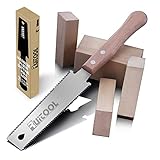
- An Idea Gift for Woodworker, Carpenter and Craft Man
- Optimal Blade Size: Through numerous manual tests, We found that the 6" Japanese saw blade is the ideal size for precise cutting, enabling easy flush and finish cuts.
- Durable and Flexible Saw Blade: The hand saw blade is made of SK5 high-carbon steel. The Japanese pull saw teeth are processed by a high-frequency hardening machine imported from Japan, and the hardness can reach HRC60-63 degrees.
- Double Edged: One side of Japanese hand saw is 17 TPI for cutting hardwood, and the other side is 14 TPI for cutting softwood. Also can seen as Rip cut and Cross cut.
- Hardened 3-Edge Teeth: The hand saw has three-sided grinding gear design, sharp edge, faster chip removal, and smoother cutting.
Scale-up, contamination, and cost
A culture that works in a small dish may behave differently in a larger vessel. Larger-scale production has to manage oxygen and nutrient distribution, contamination, heat, culture consistency, harvesting, and processing. The resulting cost per unit must compete with plantation timber, waste-fiber boards, plastics, and established chemical manufacturing. The original reporting described scaling as a substantial scientific and financial challenge.
Independent reader supportYour contribution helps us test, update, and keep practical guides available for everyone.Is Foray’s tree-free wood available to buy?
As of August 18, 2026, the public information cited here does not establish that Foray sells tree-free beams, planks, or consumer wood products, or offers a public price or checkout for them. Its company news page highlights plant-biotechnology work, fabricated seeds, and restoration-oriented partnerships involving plants such as chestnuts and hazelnuts, as well as mine-site revegetation. Research activity and partnerships are not the same as a retail product launch.
That makes Foray a poor fit for someone who needs lumber, flooring, or furniture board now. The company’s current public activity also means its 2024 wood-product ambition should not be mistaken for its only or necessarily primary focus today.
Rank #4

- Practical Gifts for Men: WETOLS corner clamps come in a gift-ready box, making them a practical gift for men, dads, husbands, and grandpas. This set of 4 wood clamps is ideal for aligning, nailing, welding, screwing, cabinet making, box assembly, picture frames, and woodworking DIY projects
- Quick and Accurate 90-Degree Alignment: Quickly align and hold boards and frames at a 90-degree angle. These corner clamps fit boards from 3/16" to 3/4" thick and are suitable for both 90-degree corners and T-joints
- Durable Polyamide Material: WETOLS corner clamps for woodworking are made of polyamide material for durability and reliable use in various woodworking projects
- Strong Flexible Spring: Strong spring tension helps keep boards securely in place while screwing or gluing them together, making assembly easier and more convenient
- Single-Handed Operation: The WETOLS right angle clamp features a lightweight design and can be easily operated with one hand. A practical addition to any woodworking tool collection for DIY and woodworking projects
How Foray differs from other tree-free materials
“Tree-free” materials use different feedstocks and processes. Some companies turn agricultural residues into boards; others use mycelium or rematerialize existing wood waste. Those products are not evidence that Foray has commercialized plant-cell-grown lumber.
| Company or approach | Input and process | Output or distinction |
|---|---|---|
| Foray Bioscience | Living plant cells cultured in controlled conditions | Explores plant-derived compounds and wood-like tissues; public commercial availability of structural wood is not established. |
| Craste | Crop residues processed into engineered materials | Boards, paper, and sound-absorbing panels; not plant-cell culture. |
| Feltwood | Vegetable fibers recovered from agricultural and food-production by-products | Molded fiber products; not cultured tree tissue. |
| PALLLM | Palm waste and agricultural by-products | Boards and pallet alternatives. |
| Ábhar Materials | Recovered wood fiber or agricultural residues, including mycelium-bound panels | Panels made through a different biological and material process. |
| Forust | Wood waste rematerialized through additive manufacturing | 3D-printed wood parts that use existing wood-derived material. |
These approaches may be closer to existing board, panel, packaging, or custom-part uses, but suitability depends on the specific product and its specifications. Bamboo and other fast-growing plants are another timber alternative, though they still require cultivating and harvesting plants.
Quick Recap
What to check when evaluating a “tree-free” material
- Identify the product: Is it a purified chemical, a panel, a molded-fiber item, a wood-like composite, or structural lumber?
- Check the feedstock: Living cells, crop residue, recovered wood, and mycelium-based composites have different resource and processing requirements.
- Ask for comparable performance data: For construction uses, look for relevant strength, moisture, fire, durability, emissions, and certification information for the exact product.
- Look for life-cycle evidence: Land use or avoided tree harvesting alone does not account for energy, media, water, processing, transport, and disposal.
- Confirm availability and price: A laboratory sample, partnership, or development goal is not proof that a product can be ordered at commercial volume.
Product prices and availability are accurate as of the date/time indicated and are subject to change. Any price and availability information displayed on Amazon at the time of purchase will apply.




