Starting a fish farm in Wisconsin begins with two separate checks: register the operation with the Wisconsin Department of Agriculture, Trade and Consumer Protection (DATCP), and determine which Wisconsin Department of Natural Resources (DNR) permits apply to the site and activity. The rules depend on what you raise, where the water comes from, and whether fish are kept for private use, sold live, stocked, used as food or bait, or processed. Wisconsin has many registered fish farms, but the available count does not establish commercial growth or profitability.
How to start a fish farm in Wisconsin
Plan around the intended use, species, water source and destination of the fish before building or stocking. Registration is not a substitute for environmental permits, and a pond registration alone does not authorize all construction, water use, stocking, importing or food-processing activities.
- Define the operation. Decide whether the project is a private recreational pond, live-fish or egg sales, food production, bait, stocking, education, or another use. Identify the species, whether they are hatchery- or wild-sourced, and whether they will move across state lines or into state waters.
- Contact DNR about the site early. Ask whether the waterbody is natural and which permits may apply to construction, withdrawals, discharge, wells, dams, stocking or other planned activities. DNR says permitting can take three months or longer, so resolve this before committing to a schedule or construction.
- Obtain a natural-waterbody status review if you are a new DATCP registrant. DNR determines whether the proposed site is a natural waterbody. If it is, and no applicable exception applies, a separate DNR permit may be required before DATCP registration.
- Apply for the appropriate DATCP registration. Registration is annual. Confirm the category and current application requirements with DATCP; the agency describes Types 1–3 in terms of the operation’s purpose and whether live fish or eggs are sold or distributed.
- Resolve fish movement, stocking and processing requirements. Verify rules for species, origin, destination and use before importing, moving or stocking fish. If you will process fish for food, confirm licensing and food-safety requirements with DATCP before beginning.
Use the agency pages for current application details: DATCP Fish Farm Registration and DNR Fish farming in Wisconsin.
Which fish-farm registration applies?
DATCP says Wisconsin fish farms must register and renew annually. Its broad registration framework covers hatchery or holding activity for purposes such as sale or distribution, introduction into state waters, fishing, bait or fertilizer, human food or animal feed, and holding another person’s fish or eggs. The agency’s plain-language descriptions distinguish the three types as follows:
#1 Best Overall

- High-Quality Materials: Made with reinforced 0.9 mm triple-layer PVC scraper cloth and 1.2 mm high-transparency PVC, this canvas fish pond is durable, sun-resistant, and tear-resistant. It offers clear visibility and is wear-resistant and scratch-resistant, with a seamless design to avoid leaks.
- Sturdy Structure: The above-ground fish pond features high-strength stainless steel pipes that are rust-resistant and corrosion-resistant. Its strong, stable frame ensures that it remains intact and holds its shape, even when full of water, ensuring long-term durability.
- Quick Drainage: With a large drainage valve, this fish pond allows quick water release with a simple turn, saving time and making maintenance more convenient.
- Large Capacity: This PVC fish pond measures 78.7 x 55 x 23.6 in (2000 x 1400 x 600 mm) and holds up to 470 gallons, providing ample space for aquatic life. It is ideal for indoor and outdoor aquaculture.
- Wide Application: Designed to accommodate a variety of aquatic species, this pond is ideal for koi, goldfish, shrimp, crabs, and more, meeting the needs of diverse aquaculture environments.
| DATCP type | General description | Practical distinction |
|---|---|---|
| Type 1 | Qualifying recreational ponds where no fish leave alive | Intended for qualifying private recreational pond activity, not live-fish sales or distribution. |
| Type 2 | Operations selling or distributing live fish or eggs | Relevant when live fish or eggs leave the operation for sale or distribution. |
| Type 3 | Specified wild-source fish or eggs susceptible to viral hemorrhagic septicemia (VHS) that will be sold or distributed | Applies to the specified wild-source and disease-susceptibility circumstances; confirm the exact classification with DATCP. |
These summaries are not a determination of a particular site’s classification. New DATCP registrants must also obtain DNR’s natural-waterbody status review. Consult DATCP’s registration guidance for current requirements.
What DNR permits might be needed?
DNR permit requirements depend on the location and the work or activity proposed. The agency lists possible permits or approvals related to aquatic plant control, dams, water diversion, stocking, high-capacity wells, natural-waterbody fish farming, non-native fish import, pond construction or dredging, private fishing preserves, waste discharge under the Wisconsin Pollutant Discharge Elimination System (WPDES), and water use. This is a list of possible requirements, not a checklist every farm must obtain.
Ask a DNR aquaculture coordinator which approvals apply to your specific parcel and plan. DNR cautions that permits may take three months or longer to receive. Its overview is at Fish farming in Wisconsin.
Rank #2

- High-Quality Materials: Made with reinforced 0.9 mm triple-layer PVC scraper cloth and 1.2 mm high-transparency PVC, this canvas fish pond is durable, sun-resistant, and tear-resistant. It offers clear visibility and is wear-resistant and scratch-resistant, with a seamless design to avoid leaks.
- Sturdy Structure: The above-ground fish pond features high-strength stainless steel pipes that are rust-resistant and corrosion-resistant. Its strong, stable frame ensures that it remains intact and holds its shape, even when full of water, ensuring long-term durability.
- Quick Drainage: With a large drainage valve, this fish pond allows quick water release with a simple turn, saving time and making maintenance more convenient.
- Large Capacity: This PVC fish pond measures 59 x 39.4 x 27.6 in (1500 x 1000 x 700 mm) and holds up to 270 gallons, providing ample space for aquatic life. It is ideal for indoor and outdoor aquaculture.
- Wide Application: Designed to accommodate a variety of aquatic species, this pond is ideal for koi, goldfish, shrimp, crabs, and more, meeting the needs of diverse aquaculture environments.
Natural waterbodies need particular care
A natural body of water can include a spring, stream, pond, lake or wetland that was historically present in natural condition, even if it was physically altered later. For a new registrant, DNR reviews the site. If it determines the site is a natural waterbody and no listed exception applies, a separate permit is required. DNR says natural-waterbody fish farming is limited to freeze-out ponds except for qualifying grandfathered permits. Because the determination and any exception are site-specific, request the review rather than assuming a constructed or modified pond is exempt. See DNR’s Natural Waterbodies guidance.
Free tools Windows power users keep installed
One-click scans. No signup required.
Rules for importing, moving and stocking fish
Fish movement rules turn on the species, source, destination and intended use. DATCP prohibits moving live fish or eggs when a person knows or has reason to know they are infected, exposed to, or showing signs of contagious or infectious disease. Import-permit triggers include certain out-of-state fish released into a nonregistered waterbody, fish used as bait, and wild-source fish delivered to a registered farm. DNR separately identifies non-native species subject to rules, including tilapia and several salmonids. Stocking fish into state waters requires a DNR stocking permit.
Check the applicable pathway before arranging transport or stocking; do not treat a supplier’s availability as proof that a fish may lawfully be imported or released. Consult DATCP Fish Movement and DNR Fish Importation.
Rank #3

- High-Quality Materials: Made from 0.9 mm thickened PVC scraper cloth, this canvas fish pond is corrosion-resistant, sun-resistant, wear-resistant, scratch-resistant, and secure. The seamless stitching ensures waterproof performance without leaks, ensuring secure use.
- Sturdy Structure: The above-ground fish pond features high-strength stainless steel pipes that are rust-resistant and corrosion-resistant. Its strong, stable frame ensures that it remains intact and holds its shape, even when full of water, ensuring long-term durability.
- Quick Drainage: With a large drainage valve, this fish pond allows quick water release with a simple turn, saving time and making maintenance more convenient.
- Large Capacity: This PVC fish pond measures 47 x 31.5 x 19.7 in (1200 x 800 x 500 mm) and holds up to 126.8 gallons, providing ample space for aquatic life. It is ideal for indoor and outdoor aquaculture.
- Wide Application: Designed to accommodate a variety of aquatic species, this pond is ideal for koi, goldfish, shrimp, crabs, and more, meeting the needs of diverse aquaculture environments.
Food fish and processing have separate requirements
Raising fish and processing fish for food are distinct activities. DATCP says fish raising requires farm registration at minimum, while processing requires a license. Its processing definition includes activities such as preparing, eviscerating, freezing, changing product form, packing, labeling and holding, subject to stated exceptions. Wholesale fish-product activity may also require compliance with seafood Hazard Analysis and Critical Control Point (HACCP) provisions.
Before adding slaughter, processing, packing or wholesale sales, ask DATCP which license and food-safety obligations apply to the exact products and steps. See DATCP Processing Fish for Food.
What sustainable aquaculture means in practice
“Sustainable” is not a single Wisconsin farm certification or an outcome established for every aquaculture system. It is more useful to assess the operation’s measurable impacts and management choices. DATCP’s general sustainability discussion for Wisconsin agriculture emphasizes science-based, measurable practices adapted to a farm; it is not fish-farming-specific evidence of environmental performance.
Rank #4
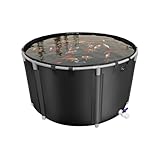
- 【Large capacity Aquaculture Pool/ koi pond】:Maximum capacity 450-1300 Gal,It can meet the needs of most fish farming. The spacious area allows the fish to move freely. Meanwhile, the large-capacity fish tank can better meet your fish farming requirements and is suitable for raising various types of fish.
- 【Wide-range in application】:The above ground outdoor fish pond is used for water storage, fish farming, shrimp farming,children's swimming pools, hydroponic plants, garden water storage, watering flowers, used for fish and shrimp breeding, pond water storage.
- 【Strong and Durable Material】:Tarpaulin is made of thick PVC coated waterproof fabric,which is safe,non-toxic,odorless,anti-aging,anti-static,sunscreen,anti-tear,easy to fold,durable.
- 【Pond Easy To Use】:Fish pond water container with faucet,can be connected to water pipe,very convenient to use,A drain is added to the bottom and a spill-proof port is added to the top.
- 【Easy to install and maintain】:7 support rods, 6 Circular tube,large and small mouth connection, easy to assemble, no need for complicated tools, easy to build your private fish pond,The excellent quality of the product enables the fishpond to be used for a long time.
- Water: Identify the source and volume of withdrawals, the effect on nearby waters, and how discharge is handled. Water-use and discharge requirements may apply depending on the project.
- Waste and energy: Track waste management and energy demand rather than assuming a pond, tank or other system is inherently low-impact.
- Fish health and mortality: Plan for disease prevention, monitoring and responsible movement. DATCP describes fish-health oversight as important to farm economics and food safety, and notes farms supplying stocked fish can serve as sentinels for disease concerns. This rationale does not prove the performance of any individual farm.
- Feed, stocking and escapes: Choose species and stocking practices with the site and intended market in mind; account for feed use, mortality and the risk of fish escaping or affecting natural waters.
- Species and habitat: Check non-native species and stocking restrictions before bringing fish onto a site or releasing them. Consider the effects on wetlands and connected waters when evaluating a location.
- Evidence: Compare systems only with defined measures—such as water use, energy, waste, mortality or production—and comparable operating conditions. The available state materials do not provide comparative environmental measurements for Wisconsin production systems.
For a site-specific sustainability assessment, combine operational records with applicable permits and fish-health guidance; avoid using a broad “sustainable” label without defining what is measured and compared.
Independent reader supportYour contribution helps us test, update, and keep practical guides available for everyone.Is fish farming growing in Wisconsin?
DATCP reports about 2,500 registered fish farms in Wisconsin, but says only about 350 meet its definition of facilities used for business or educational purposes. Most of the remainder are privately owned ponds stocked for the owner’s use. These are registration and facility counts, not commercial-farm counts, production volume, revenue, jobs or evidence of a trend over time. See DATCP Aquaculture Publications & Resources.
Wisconsin DATCP also reports $27.2 million awarded for 51 equipment grants and 30 infrastructure grants through its Resilient Food Systems Infrastructure program, which includes aquaculture among eligible food sectors. That figure describes program awards across eligible sectors; it does not show that all funds went to aquaculture or establish aquaculture growth. Details are available on the program page.
Do these 3 things before closing this tab:
1Clear out junk files and repair common Windows errors2Fix the driver behind crashes, sound loss and screen glitches3Repair Windows errors before they cause bigger problemsThe available figures do not establish Wisconsin aquaculture production volume, current industry revenue, farm-level margins or a time series showing sector expansion. The defensible conclusion is that Wisconsin has a broad registered pond and fish-farm base and state resources for the sector, but the cited counts cannot answer whether commercial aquaculture is growing or profitable.
How to compare possible fish-farming models
Wisconsin materials identify recreational ponds, live-fish sales and distribution, food fish, bait, game-fish stocking and aquaponics as possible activity types, but they do not supply comparable commercial returns or environmental results. Before choosing a model, compare the questions that determine its obligations and feasibility:
| Decision area | Questions to answer |
|---|---|
| Purpose and market | Is the operation for private recreation, live-fish sales, food, bait, stocking, education or another use? Who will buy or use the output? |
| Species and source | Which species will be raised? Are they native or non-native, hatchery- or wild-sourced, and local or out of state? |
| Water and site | Is the system a constructed or closed pond, or a natural waterbody? What water withdrawals, discharges, wetlands or public-water issues could apply? |
| Operating obligations | Which registration type, environmental permits, fish-health measures, movement/import rules, stocking permits and processing requirements are relevant? |
| Economics and environmental measures | What are the operation’s startup and recurring costs, energy and water needs, feed use, mortality, waste handling and verified buyer access? The state sources do not provide comparable farm-level values. |
Aquaculture guidance and organizations listed by DATCP include the Wisconsin Aquaculture Association, North Central Regional Aquaculture Center and Wisconsin Sea Grant. DATCP also lists Managing Wisconsin Fish Ponds, an 82-page UW Cooperative Extension manual covering pond design and construction, species selection, cold- and warm-water pond management, fish health, pond safety and aquatic plant control. It is particularly relevant to pond owners; it is not presented as a commercial business guide. Find these resources through DATCP’s Aquaculture Publications & Resources.
Quick Recap
Product prices and availability are accurate as of the date/time indicated and are subject to change. Any price and availability information displayed on Amazon at the time of purchase will apply.
Quick wins for a faster PC:
Repair Windows errors before they cause bigger problemsFix Now →Scan for outdated or missing drivers - takes under a minuteDriver Scan →Clear out junk files and repair common Windows errorsFree Scan →



