PC Slower Than It Used to Be?
A free scan shows the junk files, broken settings and background clutter dragging Windows down - then fixes them in one click.Free scan · Windows 10 & 11Outdated Drivers Are Slowing You Down
One free scan finds every outdated or missing driver and matches the right update for your exact hardware.Free scan · exact hardware matchField service management (FSM) software connects a service request to a work order, a dispatcher’s schedule, a technician’s work in the field, and the records needed to close the job. The right choice is the one that can handle your actual job types, skills, territories, shifts, parts, and exceptions—not simply the one with the longest feature list.
What is field service management software?
FSM software coordinates work performed away from a central office, such as repairs, inspections, installations, and preventive maintenance. It typically links work orders and customer or asset records with scheduling and dispatch, a technician mobile workflow, and job closeout. Depending on the system, it may also support inventory, customer updates, time capture, billing handoff, and reporting.


A work order is the operational record for a job. It can identify the service request, location, tasks, parts or products, and labor or services. Microsoft describes work orders in this way in its Dynamics 365 Field Service getting-started documentation. The practical test is whether the record gives the dispatcher enough information to assign the work and the technician enough context to complete it.
What features should dispatchers look for?
Structured work intake
Check whether requests can become work orders with the fields your operation needs: address, customer, asset, priority, required skills, job scope, parts, services, and status. If you handle repeat work, ask whether templates or service agreements can generate consistent jobs. Incomplete intake can undermine even a capable scheduling engine: dispatchers cannot reliably match work to a resource if the job’s requirements are missing.
Free tools Windows power users keep installed
One-click scans. No signup required.
#1 Best Overall
Scheduling that reflects real constraints
Dispatchers need a useful view of workload and availability, plus the ability to account for territory, location, skills, priority, travel assumptions, customer time windows, and other constraints. Ask how the system proposes or makes assignments: manually, with recommendations, or automatically. Also test whether a dispatcher can review, override, and explain an assignment when the day does not go to plan.
Microsoft documents a schedule board and resource matching based on factors including location, availability, skill, and priority, with manual, assisted, and automated approaches in its Dynamics 365 Field Service overview. ServiceNow documents scheduling optimization, routes, reassignment, and task dependencies in its Field Service Management documentation and Dynamic Scheduling product information. These descriptions establish documented features, not how well either system will schedule your particular operation.
Visibility and control when plans change
Ask what dispatch can see after assignment: job status, delays, exceptions, and changes to a technician’s schedule. Then demonstrate a realistic disruption, such as a job taking longer than expected or a technician becoming unavailable. The dispatcher should be able to understand the impact, communicate the change, and reassign work where appropriate without losing the job’s history.
Customer updates and service history
If customers need appointment visibility, reminders, or self-service scheduling, verify which communication steps are supported and how they are configured. Microsoft’s product page describes customer appointment visibility and automated reminders; it also identifies a scheduling agent as a preview in the material reviewed. Preview status and packaging can change, so confirm current availability and suitability with Microsoft before relying on it.
For recurring service, check whether asset history stays connected to the customer and service location, and whether preventive maintenance can generate repeat work. This helps dispatchers prepare for jobs using prior service information rather than treating each visit as an isolated request.
What should technicians be able to do in a field service app?
Evaluate the mobile workflow from the technician’s point of view, not just from a feature checklist. The app should make the assigned work understandable and let the technician record the outcome in the form the office needs.
- Understand the assignment: view the schedule, work order, scope, instructions, customer context, and relevant asset or service history.
- Record progress: update job status and complete required tasks or steps, including a follow-up flag when work cannot be finished.
- Capture evidence: record information such as photos, videos, or a customer signature if the process requires it.
- Handle parts: view or record inventory use and request parts when necessary.
- Stay connected: communicate with dispatch, customers, or partners while keeping the conversation tied to the job where the system supports it.
Microsoft documents a technician mobile app with work-order execution, customer assets, service history, evidence capture, and offline information download in its Field Service overview. Salesforce’s Field Service Mobile App help page lists capabilities including inventory access, communication, geolocation tracking, and knowledge associated with work orders. Salesforce Trailhead also describes dispatcher scheduling, optimization, dispatch, and technician work in its Field Service basics module. Confirm which features apply to the Salesforce edition and packaging under consideration.
Does field service software work offline?
Some FSM products document offline mobile capabilities, but that does not establish identical offline behavior across vendors or configurations. Microsoft documents downloading information for offline work. Before choosing a system, test the precise tasks technicians must perform without a connection and how changes sync after connectivity returns.
- Which work-order, customer, asset, instruction, and parts information is available offline?
- Can technicians update status, enter notes, capture required evidence, and record parts while disconnected?
- What syncs automatically, what requires an action, and how are conflicting changes handled?
- What devices, operating systems, security settings, or device-management policies are supported?
Run the test on a representative device and in conditions that resemble your service locations. The vendor materials cited here do not establish identical offline scope, sync timing, or device compatibility across products.
How should you compare field service management software?
Compare systems by walking one realistic job through the entire lifecycle. Include the dispatcher’s assignment and exception handling, the technician’s mobile work, and the records required to close the job. Use your own operational rules rather than relying on a generic demonstration.
- List the job types you perform. Include emergency repairs, scheduled maintenance, inspections, installations, and jobs requiring multiple technicians or dependent tasks if they apply.
- Write down assignment constraints. Specify skills or certifications, territories, shifts, travel assumptions, customer windows, priorities, parts, and equipment. Ask the vendor to demonstrate those constraints using sample jobs from your operation.
- Run the job from both roles. Have a dispatcher create or receive a work order, schedule it, handle a delay, and reassign it. Have a technician open the work, find the needed context, record work and parts, complete required steps, and close it or flag follow-up.
- Test mobile conditions. Verify supported devices and operating systems, offline availability, sync behavior, and your security or device-management requirements.
- Follow assets and parts end to end. Check truck stock, replenishment, purchasing, returns, asset history, preventive maintenance, and the inventory records left after a realistic job.
- Check integration and ownership requirements. Validate connections to your CRM, ERP, identity provider, maps, customer communications, and reporting. Ask about configuration, migration, implementation support, administration, and licensing for the specific edition and region.
- Use a pilot with agreed measures. Set a baseline and measurement method before evaluating results. Depending on your operation, measures could include time to assign, schedule adherence, first-time completion, travel time, work-order completeness, inventory accuracy, or timeliness of customer updates.
How do the documented vendor examples differ?
The following examples show capabilities described in official documentation; they are not a ranked shortlist or a neutral product test. The cited pages do not establish comparative usability, reliability, implementation time, productivity, or return on investment.
| Product | Documented capabilities relevant to dispatchers | Documented capabilities relevant to technicians | What to verify |
|---|---|---|---|
| Microsoft Dynamics 365 Field Service | Work orders, schedule board, resource matching and optimization, customer appointment visibility, and automated reminders are described in Microsoft materials. | Mobile work-order execution, offline information download, customer asset and service history, inventory activity, time tracking, and job closeout are described. | Confirm current licensing, regional availability, and packaging. Microsoft identifies a scheduling agent as a preview in the product-page material reviewed; verify its current status before depending on it. |
| Salesforce Field Service | Trailhead describes dispatcher scheduling, optimization, and dispatch. | Salesforce Help lists mobile inventory access, communication, geolocation tracking, and knowledge attached to work orders. | Confirm the applicable Salesforce edition and current packaging; the Help page specifies edition availability for the capabilities it covers. |
| ServiceNow Field Service Management | Documentation describes skills and territory matching, inventory-aware assignment, optimization, routes, reassignment, and task dependencies. | Documentation describes mobile work completion. | Confirm which capabilities are included in the specific ServiceNow products and licenses under consideration. |
These examples cover only documented feature areas, not the full FSM market. Feature names, availability, packaging, and preview status can change; confirm current details for your country, edition, license, and deployment directly with each vendor. Official feature documentation is useful for determining what a vendor says its software can do, but it does not show whether a workflow will be easy to use or effective in your business.
Best Value
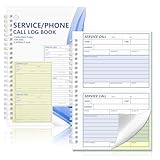
- 100 Two-Part Carbonless Sets in One Book – Each service call log book includes 100 preprinted 2-part carbonless forms Write once and produce a duplicate copy instantly without separate carbon sheets Ideal for service call logs work order records and daily business documentation
- Compact Size for Convenient Daily Use – The 5 5/8 x 8 1/2 inch layout offers a comfortable writing area while fitting neatly on desks service counters and clipboards The portable size makes this service call log book easy to carry for both office staff and field technicians ensuring quick and efficient documentation anywhere
- Includes Writing Shield for Clean Copies – Each book comes with a sturdy backing board that prevents ink bleed-through to other sets and provides a firm writing surface making it convenient for field service technicians and office front desk use
- Durable Spiral Binding for Smooth Use – Strong metal spiral binding keeps all sets secure and allows pages to flip easily and lay flat while writing Sheets tear off cleanly for customer or office copies supporting mobile and on-site communication needs
- Versatile for Service and Office Applications – Suitable for HVAC repairs plumbing electrical maintenance appliance service and more Also functions as a phone call log book or invoice receipt book for small businesses ensuring professional job tracking and customer messaging
What else affects the decision?
Fit with your existing systems and process
A scheduling feature is only useful if its inputs reflect your real work. A mobile app is only useful if technicians can complete the required process and sync the result. Inventory functions matter when jobs depend on parts; asset history and recurring work matter when you maintain equipment over time. Check how each candidate fits your current CRM, ERP, identity, mapping, communication, and service processes, including who will administer integrations and configuration.
Total cost and operational effort
The vendor materials cited here do not provide comparable current prices. Request an itemized estimate for the exact edition, licenses, add-ons, regions, implementation, integration, migration, support, and administration needs you expect. Do not treat a feature page or vendor outcome claim as proof of your likely savings or productivity gains; assess outcomes with a defined pilot and your own baseline.
Quick Recap
Product prices and availability are accurate as of the date/time indicated and are subject to change. Any price and availability information displayed on Amazon at the time of purchase will apply.




