The Tool Desk
Outbyte PC Repair FREERepair Windows errors before they cause bigger problemsFix Now →Outbyte Driver Updater FREEFix the driver behind crashes, sound loss and screen glitchesFind Drivers →India’s reported proposal would give some electric-vehicle passenger-transport and rental services a choice between 5% GST with restricted input tax credit (ITC) and 18% GST with full eligible ITC—the structure reported for comparable internal-combustion-engine services. It was still a proposal at the latest confirmed status: as of October 7, 2026, the GST Council had not been confirmed to have approved it or set an effective date.
What “GST parity” would mean for EV fleets
The proposal concerns GST on a fleet operator’s passenger-transport or vehicle-rental service, not a new tax rate on buying an electric vehicle. Financial Express reported on October 5, 2026, that operators providing vehicles with a driver could choose between 5% GST with restricted ITC or 18% GST with full eligible ITC, aligning their treatment with comparable services using internal-combustion-engine vehicles. The reported proposal also addresses credits for eligible vehicle-related inputs and capital goods, insurance, servicing, repairs and maintenance. These are reported terms, not confirmed rules. (Financial Express)

![Commercial EV Charging Station Maintenance Logbook: EVSE Inspection & Safety Tracker for Property Managers, Multi-Unit Housing, HOAs & Fleets [Second Edition]](https://m.media-amazon.com/images/I/51lW+TgV1QL._SL160_.jpg)
The GST Council was expected to consider the proposal on October 7. The available reporting does not establish that the Council approved it, nor does it establish a notification or start date. A Council recommendation alone does not put a GST change into effect: the relevant legal change must be made through notification.
How the reported 5% and 18% options differ
| Reported option | GST on the service | Input tax credit |
|---|---|---|
| Lower-rate route | 5% | Restricted ITC |
| Higher-rate route | 18% | Full eligible ITC |
“Full eligible ITC” does not mean that every cost automatically qualifies for credit. The exact eligible expenses and restrictions would depend on the final legal wording and the operator’s circumstances. The Financial Express report suggests the 18% route could matter to operators with substantial GST-bearing costs and credits they can use; it is not a personalized tax conclusion.
What an operator would need to compare
- GST charged on the service supplied to customers.
- Which GST-bearing vehicle, capital-goods and operating costs qualify for ITC, including any eligible insurance, servicing, repair and maintenance costs.
- The operator’s actual eligible costs and ability to use available credits.
- The final notification’s scope, conditions and effective date.
A lower outward rate is not necessarily the cheaper option overall if it prevents recovery of significant eligible input tax. Conversely, an 18% service rate may not be advantageous if the operator has little usable eligible ITC. The proposal’s reported outline is not enough to determine which route would suit a particular fleet.
GST on EV purchases is a separate issue
India’s GST treatment of electric vehicles as goods has a separate history. On July 27, 2019, the Ministry of Finance said the Council had recommended reducing GST on all electric vehicles from 12% to 5%, effective August 1, 2019. The same release reported a reduction from 18% to 5% for EV chargers or charging stations, and an exemption for hiring qualifying electric buses by local authorities. Those changes concern goods or a specified hiring exemption; they are not the reported 2026 proposal about the tax treatment of fleet services. (Ministry of Finance, PIB)
Rank #2

- Charge with Confidence: ChargePoint builds reliable, flexible EV charging stations for home, business, and fleets. Get 24/7 support and access to hundreds of thousands of North American charging locations
- Charge Smart: With the user-friendly ChargePoint Mobile App, you can control your electric car charger, manage reminders, connect to smart home devices, find stations, get data and charging info, and access the latest features
- Vast Network: Wherever you go, ChargePoint’s network includes 274k+ stations across North America and Europe and 565k+ roaming partner stations
- Safe & Durable: Rely on this UL-certified EV charger for safe home charging. It can be installed indoors or outdoors by an electrician and includes a cold-resistant cable
- Fast & Powerful: This EV charger charges 9× faster than a 120V outlet, delivering up to 45 mi/hr., dependent upon your vehicle. It features a NACS connector for Tesla EVs and requires a 20A or 80A circuit
Why the exact service and rules matter
GST treatment depends on how the supply is classified, not simply on whether the vehicle is electric. The CBIC rate table lists 5% for specified passenger-transport services and rentals subject to ITC conditions, and 18% for other listed categories. For example, it lists passenger transport by motor vehicle with fuel included at 5% subject to a stated ITC condition, and renting passenger vehicles with fuel included at 5% under a similar condition; other rental-service categories with operators are listed at 18%. Operators should check the applicable category and notification for their actual service rather than assume one rate applies to every fleet or rental arrangement. (CBIC GST rates)
Independent reader supportYour contribution helps us test, update, and keep practical guides available for everyone.What is known—and what is not
The confirmed context is that EV goods received a 5% GST rate under the 2019 change and that a 2026 proposal for parity in certain EV fleet services was reported. The proposal’s final scope, Council approval, operative notification and effective date are not established in the available reporting as of October 7, 2026. Until an applicable notification is issued, operators should not treat the reported 5%/18% choice as enacted policy.
Quick Recap
Rank #4
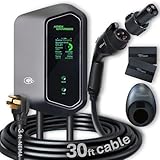
- An American brand 4 all EVs in the US: ApexCharger features high end displays on all of its level 2 charging station. Includes a J1772 connector & PRO 1, our exclusive NACS adapter to charge your Tesla; a turnkey solution design to fit every electric vehicle in America's fleet.
- Universal charging station, great design: Safety & style on this type 1, level 2 supercharger: Home or parking lot, we got you covered: an outdoor equipment enclosure for harsh weather. With PRO 1 ev charger adapter included, Apex Charger MACH 1 serves as a tesla charger.
- EV charger level 2: a fusion of utility upgrades & 240v of power. Bluetooth & Wi-fi enabled electric car charger, 2 RFID cards, the True Plug N' Play function, mobile smart app, connectors holder, 2.4 in led display panel for energy saving and 24h post sales customer support.
- Public or home charging station: On car safety accessories, MACH 1 stations stands tall. With its lights assist indicator and an ev charger cable holder on the frame for its heavy duty power cord, your chargepoint is safe w/ the anti-theft bolt & fittings (included).
- Flex installation option for those who want a level 2 charger at home: 40 amp ev charger level 2 uses a 240 volt outlet with 50A breaker. It has a Nema 14-50 plug to handle power to your vehicle. Hardwiring kit & instructions are inside your model's packing box fir the full 48A (60A breaker). Consumer reports available on the app.
Rank #3

- Charge with Confidence: ChargePoint builds reliable, flexible EV charging stations for home, business, and fleets. Get 24/7 support and access to hundreds of thousands of North American charging locations
- Charge Smart: With the user-friendly ChargePoint Mobile App, you can control your electric car charger, manage reminders, connect to smart home devices, find stations, get data and charging info, and access the latest features
- Vast Network: Wherever you go, ChargePoint’s network includes 274k+ stations across North America and Europe and 565k+ roaming partner stations
- Safe & Durable: Rely on this UL-certified EV charger for safe home charging. It can be installed indoors or outdoors by an electrician and includes a cold-resistant cable
- Fast & Powerful: This EV charger charges 9× faster than a 120V outlet, delivering up to 45 mi/hr., dependent upon your vehicle. It features a J1772 connector for all non-Tesla EVs and plugs into a 240V outlet with a 14-50 receptacle, requiring a 40A or 50A circuit. For Tesla EVs, this will require an adapter
Product prices and availability are accurate as of the date/time indicated and are subject to change. Any price and availability information displayed on Amazon at the time of purchase will apply.




